Growth creates problems you didn’t expect. Payroll starts to crowd your calendar. Compliance questions stack up. Tax registrations for remote hires slow down onboarding.
Many founders hit this wall and search for HR-managed services to get time back. Studies show companies using HR managed services cut hours spent on admin and improve hiring results through fractional HR expertise and compliance mitigation.
You get reliable payroll administration, scalable workforce solutions, and employee lifecycle management without building a full department. This guide breaks down what you gain from HR-managed services in 2025 and how the best providers work.
Top 10 Advantages of HR Managed Services (And Who Delivers Them)
Growth gets messy fast. You deal with payroll changes, policy updates, tax questions, and hiring delays. Many teams bring in HR managed services to control this workload and keep documents accurate. Each provider below offers a different support angle to strengthen daily operations.
1. DianaHR: Operational Execution and Fractional Expertise
A) The Advantage: DianaHR delivers HR managed services with real execution. They handle payroll administration, policy updates, remote team tax nexus issues, and employee lifecycle management. This managed HR support services style reduces mistakes and keeps documents clean across multiple states through fractional HR expertise.
B) Services Offered: State registrations, compliance mitigation, payroll administration, employee files, onboarding, and scalable workforce solutions.
C) Best For: Founders who want HR tasks completed without training internal staff.
D) Impact: Saves hours each week and prevents delayed filings or missed requirements.
2. Justworks: Buying Power
A) The Advantage: Justworks supports teams with HR managed services built for stronger benefits access. Smaller companies use HR-managed services to secure medical plans, retirement options, and wellness coverage normally priced for large groups. Their managed HR support services structure supports compliance mitigation and scalable workforce solutions with pooled rates.
B) Services Offered: PEO benefits access, payroll administration, compliance mitigation, onboarding, and scalable workforce solutions.
C) Best For: Teams that need affordable health coverage to stay competitive.
D) Impact: Improves retention and supports cleaner hiring.
3. Rippling: Automation Speed
A) The Advantage: Rippling delivers HR managed services through unified automation. One hire can trigger payroll administration, device setup, and access to software in minutes. Their mix of managed HR support services and outsourced human resources management reduces slow onboarding steps and keeps data accurate across systems.
B) Services Offered: Automation, payroll administration, employee lifecycle management, compliance mitigation, policy updates.
C) Best For: Teams adding workers quickly and needing clean workflows.
D) Impact: Speeds up onboarding and cuts manual corrections.
4. Bambee: Legal Protection
A) The Advantage: Bambee gives you a dedicated HR pro who handles sensitive work: writing policies, documenting performance issues, and tracking compliance deadlines. Companies use HR-managed services here to avoid quiet paperwork gaps. Outsourced human resources management keeps files consistent so you have proof when hard conversations happen.
B) Services Offered: Employee files, investigation notes, written policies, corrective notices, and compliance mitigation checks.
C) Best For: Managers who dislike handling terminations and documentation alone.
D) Impact: Lower chances of disputes, cleaner record keeping, and less stress during exits.
5. ADP TotalSource: Infinite Scalability
A) The Advantage: ADP TotalSource delivers HR managed services designed for growth across multiple sites. Their mix of managed HR support services and outsourced human resources management supports payroll administration, compliance mitigation, and structured reporting for large headcounts. Teams keep one system as they add offices and remote workers.
B) Services Offered: Multi-state payroll, benefits support, policy tracking, employee lifecycle management, and scalable workforce solutions.
C) Best For: Growing companies preparing to add dozens or hundreds of employees.
D) Impact: Keeps HR data consistent during expansion and reduces time spent fixing back office issues.
6. Deel: Global Reach
A) The Advantage: Deel helps you hire outside your home country without stopping to form legal entities. Companies use HR-managed services here to stay compliant on local taxes and required documents. With outsourced human resources management, you avoid confusing international rules and onboarding delays in remote hiring.
B) Services Offered: Local payroll setup, contractor agreements, compliance mitigation, employee files, global onboarding support, remote team tax nexus checks.
C) Best For: Teams building distributed talent pools in new countries.
D) Impact: Keeps hiring fast, reduces risk tied to unfamiliar labor rules, and supports cleaner cross-border record keeping.
7. Gusto: User Experience
A) The Advantage: Gusto keeps HR simple. You get HR-managed services that employees actually use without training. They can update personal info, switch benefits, and view pay history in a clean portal. This outsourced human resources management approach cuts daily questions and removes confusion during onboarding or open enrollment.
B) Services Offered: Payroll administration, benefits setup, compliance mitigation, employee lifecycle management, self-service tools.
C) Best For: Teams that want fewer HR emails and clearer employee documents.
D) Impact: Improves staff satisfaction and saves time for managers handling basic requests.
8. Paychex: Regulatory Safety
A) The Advantage: Paychex focuses on risk control for industries with strict wage and hour rules. Their HR managed services system tracks deadlines, tax filings, and rule changes. By using outsourced human resources management, companies avoid mistakes tied to overtime, tipped wages, and shift records.
B) Services Offered: Payroll administration, time tracking, compliance mitigation, employee documentation, policy updates.
C) Best For: Businesses with hourly workers, especially food service, field operations, and retail.
D) Impact: Cuts fines and keeps payroll consistent from one pay period to the next.
9. Insperity: Risk Transfer
A) The Advantage: Insperity supports growing companies with co-employment protection. Their HR managed services structure shares employer liability related to benefits, claims, and documentation. With outsourced human resources management, you get clean files and backup support on decisions that carry risk.
B) Services Offered: Benefits administration, compliance mitigation, employee lifecycle planning, payroll administration, policy controls.
C) Best For: Businesses moving from informal HR processes to formal systems.
D) Impact: Reduces exposure to disputes and helps leaders stay confident during sensitive actions.
10. Remote: IP Protection
A) The Advantage: Remote stands out for protecting source code during international hiring. Companies use HR-managed services with clear IP language that covers local labor laws, contractor terms, and invention rights. This approach to outsourced human resources management stops loose contracts from exposing confidential work.
B) Services Offered: Contract drafting, payroll administration, compliance mitigation, invention assignment, secure employee lifecycle management.
C) Best For: Product teams bringing on developers outside the country.
D) Impact: Keeps IP ownership clean and prevents disputes when projects shift or workers leave.
Quick Glance: Top 10 Advantages of HR Managed Services

The ROI of Managed HR Support Services
Founders want fewer loose ends in payroll, policies, and hiring records. This is where HR managed services make an immediate difference. Instead of building a department, you get a full support structure through outsourced human resources management.
The money saved is clear, and the time you recover is more valuable than any software upgrade.
Cost vs. Value (Straight to the Point)
Full-time HR hire costs around 80k per year plus taxes and benefits.
HR managed services packages for small teams often sit between 18k and 30k per year.
Outsourced human resources management includes payroll administration tools, compliance mitigation, and employee lifecycle management without extra software.
Founders often recover eight to twelve hours per week.
Real Cost Comparison (20 Employees)
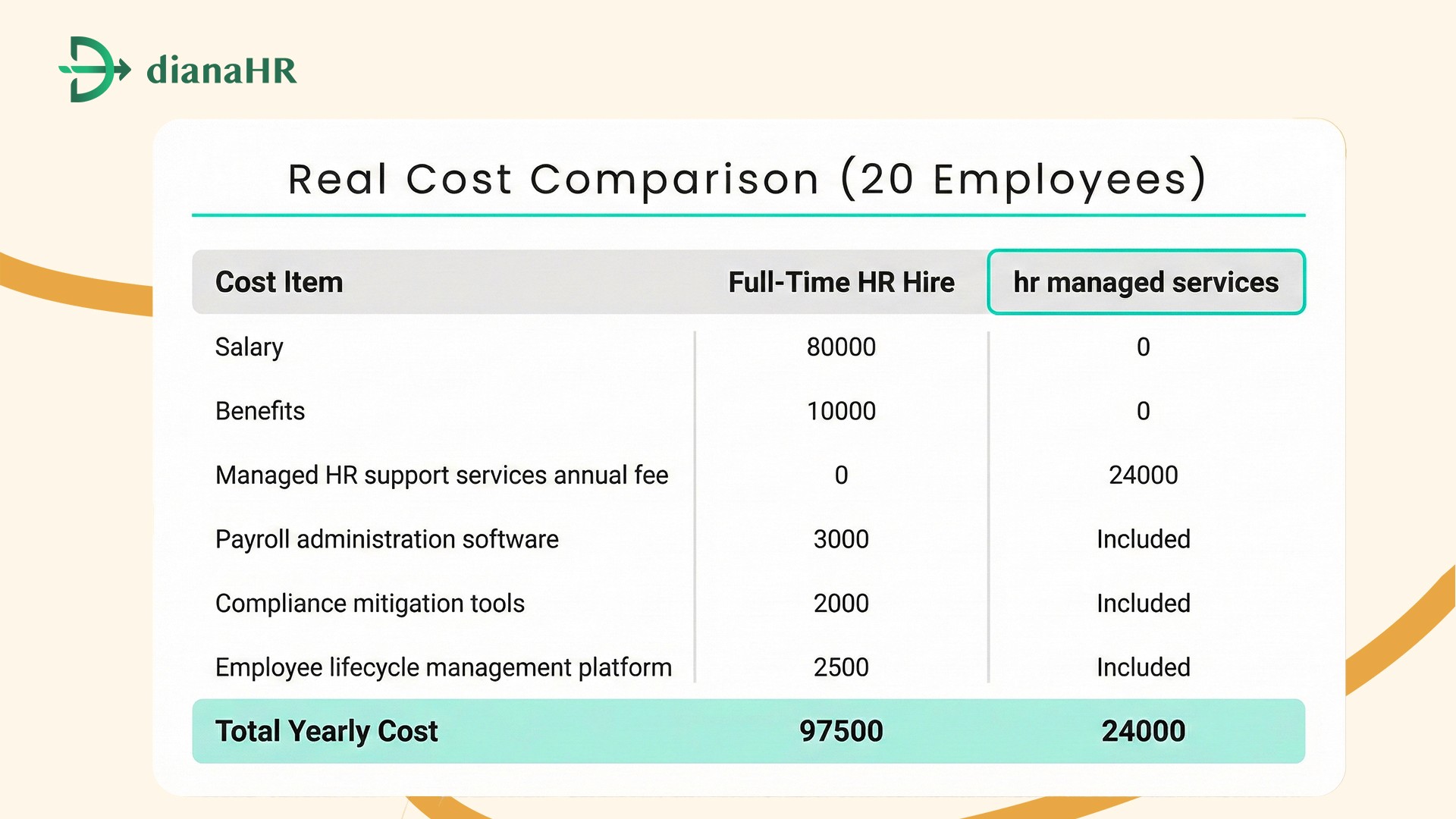
Annual Savings: 73500 dollars saved with better record control and cleaner onboarding.
This sets up a key question for growing teams: who handles this work best without slowing daily operations? Let’s look at how DianaHR solves this problem.
How DianaHR Can Help You Scale Operations
DianaHR is an AI-powered HR-as-a-Service platform built to simplify HR managed services for small and mid-sized businesses across technology, healthcare, nonprofits, retail, and professional services.
By combining intelligent automation with expert HR guidance, DianaHR helps clients reduce HR costs by up to 60 percent and save 15–20 hours per week. It enables founders and managers to eliminate repetitive admin work, maintain compliance across 40-plus U.S. states, and focus on growth through outsourced human resources management support.
Our Special Features:
AI-driven compliance management: Automates payroll taxes, benefits, and registrations for multi-state HR-managed services operations.
Human-in-the-loop support: A dedicated HR specialist handles onboarding, policies, and daily outsourced human resources management questions.
Seamless integrations: Connects with Gusto, ADP, Rippling, and other systems.
Smart task automation: Cuts manual steps by sixty percent.
Scalable people operations: Keeps workflows consistent as teams expand.
DianaHR turns back-office stress into predictable work. Connect with DianaHR today and simplify HR managed services with reliable outsourced human resources management support.
Conclusion
HR managed services give growing teams a clean way to handle payroll administration, onboarding, policies, and compliance mitigation. Many companies still try to manage this work alone and run into problems: late filings, missing documents, remote team tax nexus issues, and messy employee lifecycle management.
Errors stack up fast and create risk, fines, and hiring delays. Leaders lose time fixing paperwork instead of building the business. A structured plan avoids all of this.
DianaHR delivers outsourced human resources management with automation, documented processes, and dedicated support. You get consistency across HR-managed services tasks, clear guidance, and fewer surprises.
Connect with DianaHR today and make HR simple every week.
FAQs
1. What is the difference between managed HR and a PEO?
Managed HR uses HR managed services to run payroll administration, onboarding, and compliance mitigation without shared employment. A PEO uses outsourced human resources management plus co-employment for benefits access and tax filings.
2. How much do HR managed services cost?
Many providers price HR managed services between 18k and 30k per year. Companies using outsourced human resources management pay per employee for payroll administration, policies, and record control.
3. Will managed services replace my internal HR person?
No. HR managed services support daily work so internal staff can handle training and retention. Outsourced human resources management cuts admin tasks but leaves decision-making in-house.
4. Is my data safe with managed HR providers?
Yes. Most HR managed services systems use secure platforms to store contracts, payroll administration files, and compliance mitigation records. Outsourced human resources management reduces risk tied to document loss.
5. Can I use managed HR services for contractors?
Yes. Companies use HR-managed services to onboard contractors with tax forms, records, and payment schedules. Outsourced human resources management supports employee and contractor data in one system.
Share the Blog on: