Founders often freeze when trying to select an outsourced HR company. You face too many service models and confusing price structures. Picking the wrong partner creates messy payroll processing accuracy issues and exposes you to compliance management risks. This choice impacts your entire operation.
The Human Resource (HR) Outsourcing and Consultancy Services market is expected to grow to $81.71 billion by 2029, at a compound annual growth rate (CAGR) of 8.6%. These partnerships produce nearly 2x ROI when executed correctly. But you need the right approach. Selecting an outsourced HR company is a system decision, not a software purchase.
Phase 1: Define What You Want to Outsource
You must identify your specific internal gaps before interviewing vendors. Clarity here prevents you from buying services you don't need or missing critical support.
List Required Functions
Start with the repetitive tasks that distract your leadership. Most founders hire an outsource hr company to guarantee payroll processing accuracy and tax filings.
If you struggle with employee benefits administration, you need a partner to manage enrollments and carrier disputes. Compliance management is also standard, covering I-9 verification and labor laws. Finally, ask if you need help building onboarding workflows to welcome new talent.
Select a Service Model
You will generally choose between three models when hiring an outsourcing human resources partner.
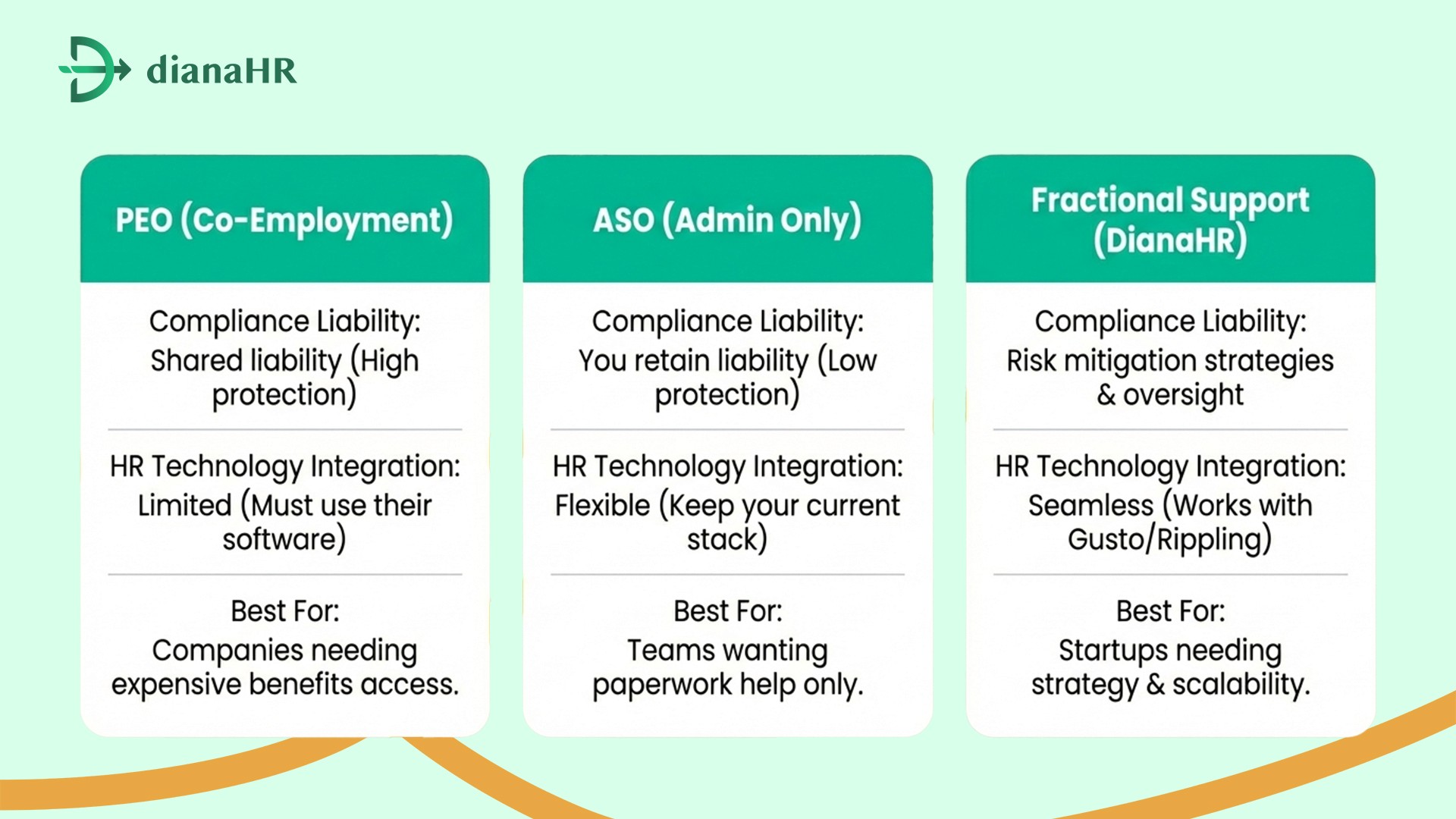
PEO (Co-employment): The provider becomes the legal employer for tax purposes. This limits your HR technology integration choices but offers better insurance rates.
ASO (Admin Service Only): You stay the legal employer. The outsourced HR firm handles the paperwork, but you keep your tax ID and software.
Fractional Support: A hybrid model. You get strategic leadership and dedicated account manager support without losing control of your systems. Understanding PEO vs ASO determines your flexibility.
Comparison of HR Service Models:
Now that you know your model, let's look at the specific criteria to vet these partners.
Phase 2: The Practical Vetting Checklist
Stop listening to sales pitches and start testing operational reality. You need to evaluate if an outsourced HR company can actually deliver results without disrupting your daily flow.
1. Compliance Liability
Most founders overlook who pays the bill when the IRS sends a fine. You need a partner that provides actual risk mitigation strategies. Ask the outsourced HR company explicitly if they assume financial responsibility for their errors.
If the contract only says they "assist" or "support" compliance management, walk away. You want specific language that confirms they indemnify you for mistakes they make.
2. Technology Fit
Modern operations die in "walled gardens." You shouldn't have to migrate your data to a clunky legacy system just to get help. A competent outsourced HR firm prioritizes HR technology integration that works with your current stack.
Look for API-first providers that connect seamlessly with tools like Gusto, Rippling, or BambooHR rather than forcing a full software migration.
3. Support Structure
Your team hates talking to robots. The difference between a solution and a headache is often the support model. Ensure you get a dedicated account manager who knows your history, rather than a random call center agent.
Ask for their service level agreements (SLA) in writing. You need to know exactly how fast they respond to urgent payroll issues before you sign.
4. Scalability
Your needs change when you hire employee number 50. The right outsourcing human resources partner offers scalability and flexibility for that growth phase. Verify they handle global workforce management and remote onboarding. They must be able to register your business in new tax jurisdictions instantly as you expand.
5. Culture Alignment
This partner becomes the face of HR to your staff. They will handle sensitive questions about pay and benefits. Assess cultural alignment early. Their communication style must match your internal tone to ensure a positive employee experience.
Once you verify their capabilities, you must inspect the costs to ensure the numbers make sense for your budget.
Phase 3: Understand Pricing Before Signing
Pricing structures in this industry are notoriously opaque. You need clarity here to prevent budget shock. Before signing with any outsourced HR company, break down the costs into one-time and ongoing buckets to see the true financial impact.
1. One-Time Costs
Be wary of large upfront fees that lock you in before you see value. Most contracts include implementation fees for syncing data and setting up your account. If your previous records are messy, expect the outsourced HR company to charge extra for document organization and historical tax corrections.
2. Ongoing Fees
The industry standard is Per-Employee Per-Month (PEPM). Your costs scale linearly with headcount. However, some agile firms now prefer flat monthly retainers.
Fast-growth startups often benefit from flat rates to reduce variable cost spikes every time they hire a new batch of interns. Always check your outsourced HR firm agreement for "hidden" items like per-payroll-run charges or year-end W-2 processing fees.
How DianaHR Meets All Selection Criteria
DianaHR is an AI-powered HR-as-a-Service platform built to simplify the outsourced HR company experience for small and mid-sized businesses across industries such as technology, healthcare, nonprofits, retail, and professional services.
By combining intelligent automation with expert HR guidance, DianaHR helps clients reduce HR costs by up to 60% and save 15–20 hours per week. It enables founders and managers to eliminate repetitive admin work, maintain compliance management across 40+ U.S. states, and focus on business growth.
Special Features:
AI-Driven Compliance Management: Automates payroll taxes, benefits, and registrations for multi-state outsourced HR company operations.
Human-in-the-Loop Expertise: Every client is paired with a dedicated account manager who manages onboarding, policies, and people operations tailored to your needs.
Seamless Integrations: Works seamlessly with leading HR technology integration systems like Gusto, ADP, and Rippling without requiring tool migration.
Smart Task Automation: Reduces manual HR workloads by up to 60%, helping businesses save 15+ hours every week on outsourced HR firm tasks.
Scalable People Operations: Designed for startups and SMBs expanding teams across multiple locations, ensuring scalability and flexibility in outsourced HR company workflows.
These capabilities transform the outsourced HR firm model from a time-consuming back-office function into a streamlined, data-driven process powered by AI and experienced HR professionals.
Explore how DianaHR simplifies your HR and helps your business scale faster. → DianaHR
Conclusion
Settling for a generic outsourced HR company often creates more chaos than clarity. You deal with unresponsive support queues and "walled garden" software that isolates your data.
These operational cracks eventually widen into payroll processing accuracy errors and missed compliance management deadlines that put your entire business at risk. You shouldn't have to question your safety. DianaHR closes these gaps with proactive risk mitigation strategies and human oversight. Secure your operations now so you can focus on growth, not cleanup.
Ready to secure your operations? Schedule a demo with DianaHR to see the difference.
FAQs
1. What is the average contract length?
Modern outsourced HR company contracts prioritize flexibility, typically offering month-to-month or annual terms instead of multi-year lock-ins. This allows you to evaluate performance against service level agreements (SLA) regularly. Avoid legacy providers that trap you, restricting your scalability and flexibility just as your startup needs to pivot or grow quickly.
2. What is the minimum team size for outsourcing?
While an outsourced HR firm adds value from your first hire, it becomes essential when you reach 5 to 10 employees. At this stage, compliance management and payroll processing accuracy become too complex for founders. An outsourcing human resources partner ensures you scale safely without suffering from administrative burnout.
3. How do you handle employee issues and terminations?
Your partner provides crucial risk mitigation strategies during sensitive exits. They supply termination scripts, legal severance agreements, and guidance on employee benefits administration to ensure a smooth separation. This support protects you from lawsuits while maintaining cultural alignment, ensuring you handle difficult personnel situations with professional confidence and care.
4. What security standards should I look for?
Demand rigorous data security standards like SOC2 compliance and bank-level encryption. Since your HR technology integration handles sensitive social security and banking details, security is non-negotiable. A credible outsourced HR company must transparently prove how they protect your workforce data against breaches, ensuring your global workforce management remains secure.
5. How do offboarding and the transition back to in-house HR work?
Transitioning back to in-house operations is seamless if you choose an outsourced HR company that syncs with your existing software. You simply retain your data history and tools while hiring internal staff. Your dedicated account manager helps transfer knowledge, ensuring you maintain payroll processing accuracy throughout the entire handoff process.
Share the Blog on: