The global HR outsourcing company market grew from $38.47 billion in 2025 to $41.86 billion in 2026, with projections reaching $73.79 billion by 2032 at a 9.74% CAGR. That growth is not random.
80% of U.S. companies now outsource payroll outsourcing, citing tax compliance and time-saving automation as the primary reasons.
But during a hiring surge, the wrong HR outsourcing company can cause compliance failures, payroll delays, and onboarding bottlenecks. The right partner absorbs the operational load so your team can focus on growth.
This guide will break down 7 critical questions to ask any HR outsourcing company before signing a contract during a 2026 hiring surge.
7 Questions to Ask an HR Outsourcing Company Before You Sign
Before you sign with any HR outsourcing company, you need a clear vendor evaluation framework.
Quick Glance: 7 Questions to Ask Before You Sign During a Hiring Surge
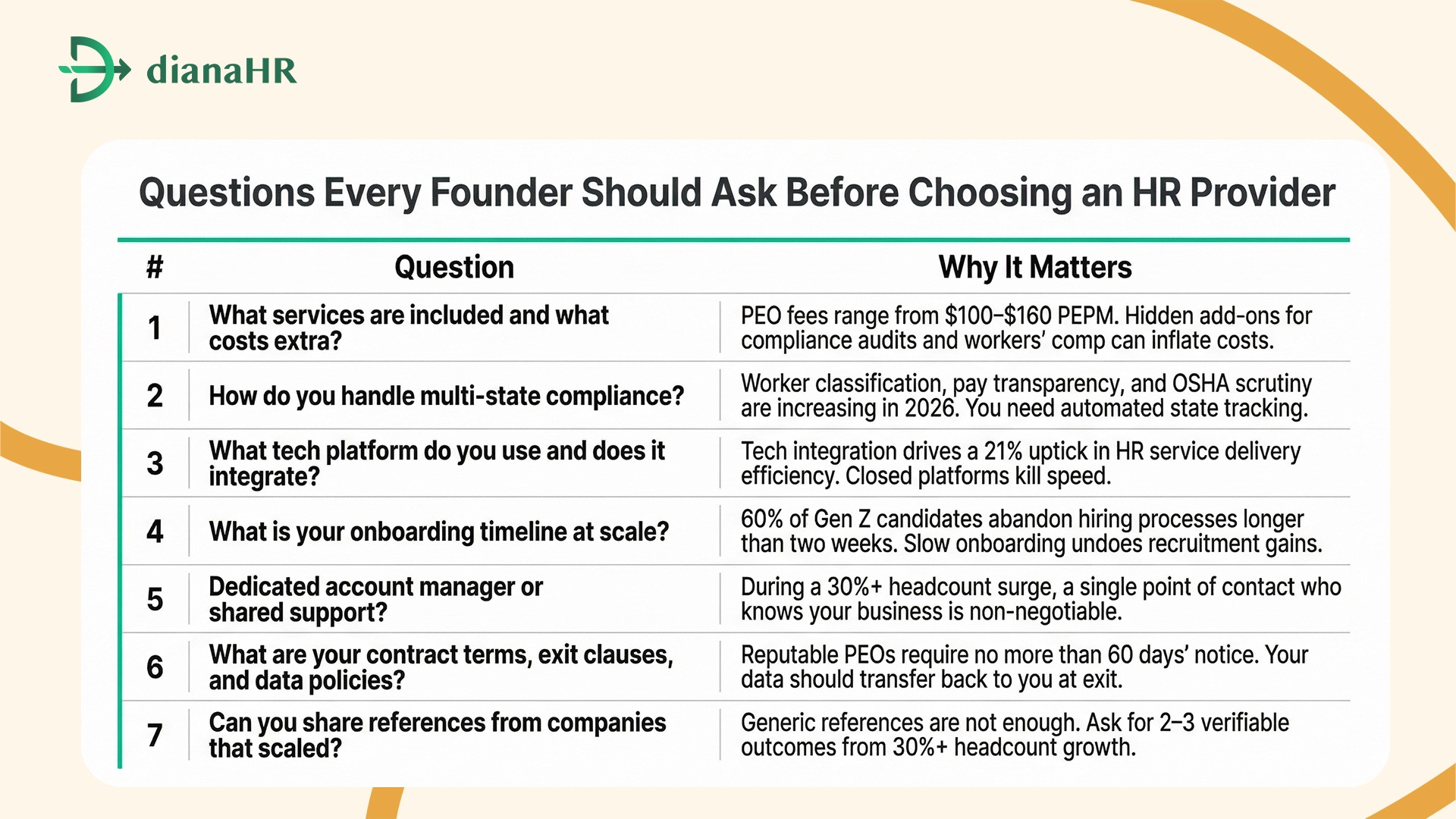
Here are 7 questions every hiring manager should ask when evaluating HR outsourcing services for hiring surge situations in 2026.
1. What Specific HR Outsourcing Services Are Included and What Costs Extra?
Pricing structures vary widely across every HR outsourcing company. Some bundle everything into a flat fee. Others use a per-employee-per-month (PEPM) model with add-on charges for specific services.
Here is what to expect in 2026: full professional employer organization (PEO) services typically cost $100–$160 per employee per month. This covers payroll outsourcing, benefits administration, compliance support, and HR guidance. Basic payroll platforms start much lower, around $20–$40 PEPM, but strip out compliance, workers’ comp, and dedicated support (ADP, 2026).
Ask your potential provider these specific questions:
Is compliance auditing included or billed separately?
What happens with mid-year benefits enrollment changes?
Are workers’ comp adjustments built into the base fee?
Do you charge extra for state registrations during multi-state expansion?
Red flag: Any HR outsourcing company that is vague about add-on fees for compliance audits, workers’ comp, or onboarding support. If you cannot get a line-item breakdown before signing, walk away.
2. How Do You Handle Multi-State Compliance During Rapid Scaling?
In 2026, organizations face increasing scrutiny around worker classification, pay transparency, OSHA standards, and employment eligibility verification. If you are scaling across multiple U.S. states, your HR outsourcing company must track regulations at the state and local level in real time.
A strong compliance partner will have dedicated compliance staff and automated state-by-state regulatory tracking. They should also provide proactive alerts when laws change in any state where you have employees.
What to look for in a good answer:
Automated tracking for pay transparency laws across all 50 states
Dedicated compliance officers (not generalists)
I-9 verification and OSHA compliance support built into the service
Multi-state compliance is one of the main reasons startups turn to an HR outsourcing company early in their growth cycle.
3. What Technology Platform Do You Use, and Does It Integrate With Our Systems?
Your HR outsourcing company should not force you to abandon your existing HRIS, ATS, or payroll tools. Technology compatibility directly affects how fast you can scale.
Workplace technology integration has driven a 21% uptick in HR service delivery efficiency, according to Technavio. That efficiency disappears if your provider uses a closed platform that does not connect to your current systems.
Ask these questions before you commit:
Does your platform support API integrations with tools like Gusto, ADP, Rippling, or BambooHR?
Do employees get self-service portals for pay stubs, benefits, and PTO requests?
Can you run real-time reports and export data without manual workarounds?
A good HR outsourcing company should provide seamless integrations and a managed HR experience that works with your tech stack. If they require a full tool migration, factor that cost and timeline into your decision.
4. What Is Your Onboarding Timeline for New Hires at Scale?
During a hiring surge, onboarding 20–50 employees per week is common. That means your HR outsourcing company needs to set up payroll, benefits administration, and I-9 verification fast and at volume.
Speed matters more than you think. 60% of Gen Z candidates will abandon a hiring process that takes longer than two weeks from application to offer. Slow onboarding from your vendor can undo every recruitment gain your team made.
Get specific answers on these points:
What is your average time to fully onboard a new employee (payroll + benefits + compliance)?
Can you handle batch onboarding of 20+ hires per week?
What is the process for I-9 verification and background checks at scale?
If the answer is “it depends” without any benchmarks, that is a sign the provider has not handled HR outsourcing services for hiring surge scenarios before.
5. Do You Assign a Dedicated Account Manager or Use a Shared Support Pool?
During a surge, you need a single point of contact who knows your business. A rotating help desk slows down every decision. Ask your HR outsourcing company exactly who will manage your account.
Stratus HR recommends that any professional employer organization should assign a dedicated representative who is an expert in the HR field. This person should understand your industry, your headcount goals, and your workforce scalability plan.
What to confirm:
Will I have one named account manager?
What is their response time SLA?
What happens if that person is unavailable or leaves the company?
Shared support pools work fine for low-volume periods. But when you are scaling by 30%+ headcount, a dedicated manager is non-negotiable for any serious HR outsourcing company.
6. What Are Your Contract Terms, Exit Clauses, and Data Transfer Policies?
Lock-in contracts with steep exit fees are a real risk. Before signing with any HR outsourcing company, get every term in writing.
Reputable PEOs typically require no more than 60 days’ notice to terminate. Well-structured professional employer organization agreements should specify that any data collected during the relationship transfers back to you when the relationship ends, and you can exit without owing exit fees.
Specific questions for vendor evaluation:
What is the notice period to terminate the contract?
Are there early termination fees?
Will you transfer all employee data, payroll records, and compliance documentation upon exit?
Is there an auto-renewal clause?
Red flag: Any HR outsourcing company that won’t share contract terms before the sales process ends. Transparency in exit terms is a sign of confidence in their service quality.
7. Can You Share Client References From Companies That Scaled During a Hiring Surge?
Generic references are not enough. Ask for references from companies in a similar industry that went through a 30%+ headcount increase.
A credible HR outsourcing company should be able to provide at least 2–3 references with verifiable outcomes. You want to hear specifics: how many employees were onboarded per week, what compliance issues came up, and how the provider handled them.
When speaking with references, ask the following:
How fast was their onboarding turnaround during peak hiring?
Did you experience any payroll errors or compliance gaps?
Would you sign with this provider again?
How responsive was your dedicated account manager during the surge?
If a provider cannot produce surge-specific references, they likely lack the infrastructure to support HR outsourcing services for hiring surge demand. Move on.
Top 5 HR Outsourcing Companies in the U.S.A. for 2026
Choosing the right HR outsourcing company depends on your size, industry, and growth speed. Here are five providers that stand out in 2026 based on service depth, technology, and compliance support.
Quick Glance: Top 5 HR Outsourcing Companies in the U.S.A. (2026)
Company | Best For | Key Strength | Rating |
DianaHR | Startups and SMBs scaling fast across multiple states | AI-powered compliance + dedicated HR specialist | ★ 4.9/5 |
ADP TotalSource | Enterprise-grade payroll infrastructure | 50-state tax law automation | ★ 4.3/5 |
TriNet | Regulated industries, 5–1,000 employees | IRS-certified PEO, ESAC accredited since 1995 | ★ 4.4/5 |
Insperity | Mid-market companies wanting tech + people | HR360 solution, Workday-backed stack | ★ 4.2/5 |
Paychex | Multi-state expansion with complex payroll | Paychex Flex with AI-driven talent acquisition | ★ 4.1/5 |
Each offers a different approach to managed HR and workforce scalability.
1. DianaHR
Overview: DianaHR is an AI-powered HR-as-a-Service platform built to simplify HR outsourcing company operations for small and mid-sized businesses across technology, healthcare, nonprofits, retail, and professional services.
Key Features:
AI-Driven Compliance Management: Automates payroll taxes, benefits, and registrations for multi-state HR outsourcing company operations across 40+ U.S. states.
Human-in-the-Loop Expertise: Every client gets a dedicated HR specialist who manages onboarding, policies, and people operations.
Smart Task Automation: Reduces manual HR workloads by up to 60%, saving businesses 15+ hours every week.
Services Offered: Payroll processing, benefits administration, compliance management, recruitment process outsourcing, onboarding, fractional HR
Industries Catered: Technology, Healthcare, Nonprofits, Retail, Professional Services
Client Review: ★★★★★ 4.9/5
2. ADP TotalSource
Overview: ADP TotalSource acts as a leading professional employer organization for small teams, simplifying workforce management by taking on co-employment risks with automated onboarding synced with 50-state tax laws.
Key Features:
Enterprise-grade payroll infrastructure with 50-state tax compliance
PEO administrative fees range from $40 to $160 per employee per month (ADP, 2026).
Services Offered: Payroll, tax filing, benefits administration, risk management, compliance, HR guidance
Industries Catered: All industries, best for companies needing enterprise-grade payroll
Client Review: ★★★★ 4.3/5
3. TriNet
Overview: TriNet is an IRS-certified PEO with ESAC accreditation since 1995 and the TrustRadius Buyer’s Choice Award 2026. Strong fit for regulated industries with 5–1,000 employees.
Key Features:
Industry-specific compliance expertise for regulated sectors
ESAC accreditation and IRS-certified PEO status for financial reliability
Services Offered: Payroll, benefits administration, compliance, HR consulting, risk mitigation
Industries Catered: Financial services, life sciences, technology, professional services
Client Review: ★★★★ 4.4/5
4. Insperity
Overview: Insperity stands out with its HR360 solution and a Workday-backed tech stack that combines technology with a high level of human support for HR outsourcing services for hiring surge scenarios.
Key Features:
Workday-powered technology platform for real-time workforce data
Tech-plus-people approach with dedicated HR specialists
Services Offered: Payroll, benefits administration, performance management, HR consulting, training
Industries Catered: Mid-market companies across all sectors
Client Review: ★★★★ 4.2/5
5. Paychex
Overview: Paychex handles multi-state tax filings, real-time compliance monitoring, and AI-driven talent acquisition through its Paychex Flex platform.
Key Features:
Paychex Flex platform with AI-driven recruitment process outsourcing
Real-time compliance monitoring for complex multi-state payroll
Services Offered: Payroll, tax filing, compliance, benefits administration, talent acquisition, onboarding
Industries Catered: Businesses expanding across state lines with complex payroll needs
Client Review: ★★★★ 4.1/5
Conclusion
Picking an HR outsourcing company during a hiring surge is a high-stakes decision. The 7 questions above give you a clear framework to separate vendors who can handle scale from those who will slow you down.
Focus on compliance depth, onboarding speed, technology fit, and transparent contracts. The cost of getting it wrong (payroll errors, compliance fines, early turnover) is far higher than the time it takes to vet properly.
Request a free consultation with DianaHR to get a custom HR outsourcing company plan built for your hiring surge.
FAQs
What does an HR outsourcing company actually do?
An HR outsourcing company manages some or all of your HR functions externally. This typically includes payroll outsourcing, benefits administration, compliance management, recruitment support, and onboarding. Some operate as PEOs (professional employer organizations) that act as co-employers, while others offer a-la-carte services based on your needs.
How much does it cost to hire an HR outsourcing company in 2026?
Costs depend on the service level. Basic payroll platforms start at $20–$40 per employee per month. Full PEO services covering payroll, benefits, compliance, and HR support typically range from $100–$160 per employee per month (ADP, 2026). Always ask about add-on fees for compliance audits, workers’ comp adjustments, and mid-year changes.
How do I choose an HR outsourcing company during a hiring surge?
Focus on five things: onboarding speed for batch hires, multi-state compliance capabilities, technology integration with your existing tools, a dedicated account manager (not shared support), and transparent exit clauses. Ask for references from companies that scaled headcount by 30%+ in a similar timeframe. Knowing how to choose an HR outsourcing company saves you from compliance gaps and wasted spend.
What is the difference between an HRO and a PEO?
An HRO (HR outsourcing provider) handles specific HR tasks like payroll or recruitment. A PEO (professional employer organization) enters a co-employment relationship, taking on legal employer responsibilities for tax filings, workers’ comp, and benefits. PEOs are better for small to mid-sized businesses that want a full HR infrastructure without building one internally.
Can an HR outsourcing company handle compliance across multiple U.S. states?
Yes, but not all providers do it well. Ask if the vendor has automated state-by-state regulatory tracking, dedicated compliance staff, and experience managing pay transparency laws, OSHA requirements, and employment eligibility verification across the states where you are hiring. A strong compliance partner will have these systems built into their service.
What red flags should I watch for when signing with an HR outsourcing company?
Watch for vague pricing with unexplained add-on fees, no dedicated account manager, long lock-in contracts with steep exit fees, no client references from companies that scaled during a hiring surge, and outdated technology that does not integrate with your existing HR or payroll tools. These are signs the HR outsourcing company cannot handle workforce scalability demands.
Share the Blog on: