Managing your company’s "paper trail" means more than just filing folders. You probably know that HR document management now functions as a digital brain for your business. Between 2024 and 2025, the way companies handle files changed fast.
Most leaders now make AI-driven automation their main goal for efficiency. If you still treat employee records management as just "storing PDFs," you might face big risks. Recent data shows businesses with outdated systems face higher penalties during audits.
Experts say modern tools audit your data in real-time. This guide shows you how to build a HR document management system that protects your company and predicts your needs.
The Invisible Engine: What HR Document Management Truly Is in 2026
Modern HR document management does more than just hold data. Today, your HR document management system acts as an active participant in your business.
You need secure file storage that supports paperless HR workflows to keep your team moving.
A) From Static Storage to Dynamic Intelligence
Systems now "read" every file you upload. Instead of a person typing in names or dates, the software uses compliance automation to scan your cloud-based HR records.
It identifies key details in your digital employee files instantly. This creates audit-ready documentation without any manual data entry.
B) The Full Lifecycle Approach
Effective HR document management tracks a worker from their first application to the day they leave.
Onboarding: Use e-signature integration to get new hire forms signed fast.
Employment: Store hybrid work documentation and performance reviews in one central spot.
Retention: The system follows your document retention policy on autopilot to delete old files.
C) Breaking the "Data Silo" Myth
Your employee records management shouldn't live on an island. Strong HR document management connects directly with your payroll and benefits tools. This ensures data privacy in HR remains consistent across your whole company.
By moving away from isolated files, you turn your HR document management into a streamlined asset. This transition is vital because failing to update your records leads to serious legal problems.
Why Your Current Employee Records Management Is a Hidden Liability
Sticking to old ways of handling files creates risks you might not see yet. If your employee records management relies on basic folders, you are likely sitting on a compliance time bomb.
In 2026, HR document management requires more than just a password to keep things safe.
A) The Compliance Tsunami
Strict privacy laws now mean manual filing is a legal trap. Whether it is the EU AI Act or local state rules, you must prove how you handle data privacy in HR.
An outdated HR document management system cannot track these changes. If you cannot produce audit-ready documentation in minutes, you face heavy fines.
B) The High Cost of "Fast" Retrieval
Searching for a single form in a messy system wastes time. HR teams without a centralized HR document management hub spend hours every day just looking for files.
In a fast-paced market, this lag is a drain on your budget. Moving to paperless HR ensures you find any digital employee files in seconds.
C) Security Beyond the Password
Standard folders are no longer enough for secure file storage. You need a "Zero Trust" setup where the system verifies every user. This protects sensitive cloud-based HR records from internal and external leaks. Without this, your HR document management leaves your company open to data breaches.
D) Audit Readiness as a Default State
Imagine never stressing over a surprise audit. A modern HR document management system tracks every view and edit automatically. This creates a permanent trail for your document retention policy.
You remain "always ready" because your employee records management does the heavy lifting for you. Reliable security and speed are the base of a strong business. To get there, you need specific tools like e-signature integration and automated alerts to stay ahead.
5 Must-Have Features for a 2026 HR Document Management System
Selecting the right tools for your HR document management makes a massive difference in your daily workload. You need a setup that handles the heavy lifting so you can focus on your people.
Here are the specific features your HR document management system must have to stay competitive this year.
1. AI-Driven Auto-Classification
Forget about naming files manually. A modern HR document management system identifies documents the moment you upload them.
It recognizes a "W-4" or an "Offer Letter" instantly.
It sorts digital employee files into the right folders automatically.
This feature ensures your cloud-based HR records stay organized without human error.
2. Predictive Retention Alerts
Your HR document management should tell you when to delete files. New laws mean you cannot keep data forever. The system uses compliance automation to track your document retention policy.
It sends a notification when a file reaches its legal limit, helping you maintain data privacy in HR and avoid "data hoarding" risks.
3. Universal E-Signature & Mobile Integration
Work happens everywhere now. Your HR document management system needs built-in e-signature integration that works on any phone.
Candidates sign onboarding papers from their mobile browser.
Managers approve hybrid work documentation while on the go.
This creates a truly paperless HR experience for everyone.
4. Role-Based Access Control (RBAC)
Security is about who sees what. Good HR document management uses granular permissions. A manager might see a performance review but never a medical record. This provides secure file storage that protects sensitive info while keeping your audit-ready documentation accessible to the right people.
5. Instant Audit Reporting
You shouldn't have to scramble when an auditor calls. A modern system generates audit-ready documentation with one click. It tracks every view and edit, proving that your employee records management follows the law.
This feature turns a week of work into a few seconds of clicking.
5 Essential Features for a Modern HR Document Management System At a Glance:
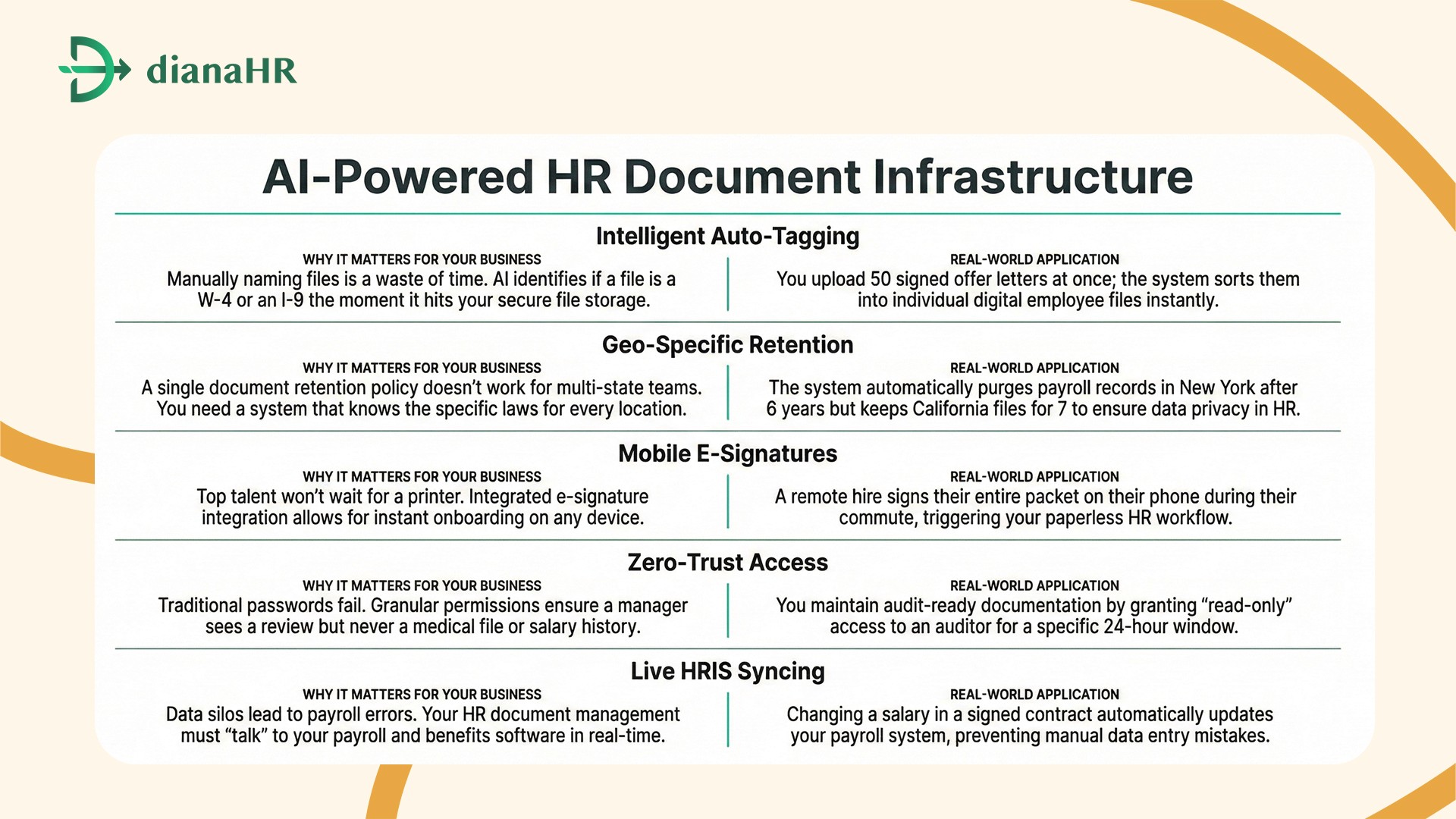
Having these five features ensures your employee records management is both fast and safe. With these tools in place, you can easily manage complex rules across different locations.
Secure and Compliant: Managing Multi-State HR Records with DianaHR
Managing HR document management across 50 states is a major challenge in 2026. DianaHR simplifies this by merging automation with expert support, helping you master employee records management while saving 15–20 hours every week.
AI-Driven Compliance Management: Automatically handles taxes and registrations for your cloud-based HR records in over 40 states.
Human-in-the-Loop Expertise: You get a dedicated specialist to tailor your document retention policy and onboarding.
Seamless Integrations: Connects your HR document management system with Gusto, ADP, or Rippling instantly.
Smart Task Automation: Cuts manual paperless HR workloads by 60%, letting you focus on growth.
By automating these complex tasks, DianaHR ensures your data privacy in HR remains ironclad as you scale. Contact DianaHR to see how we automate your compliance and reclaim your time.
Conclusion
Modern HR document management keeps your business running smoothly. Still, many teams struggle with messy digital employee files or lost folders. Messy employee records management creates a huge burden for your staff.
Missing one signature or failing a document retention policy check invites disaster. You face massive legal fines and lawsuits if your data privacy in HR fails. One lost file during an audit leads to a total compliance meltdown that ruins your reputation.
DianaHR fixes these risks by offering secure file storage and compliance automation. We transform your HR document management into a stress-free process. You get audit-ready documentation without the constant fear of legal traps.
Connect to DianaHR today to automate your compliance and turn your document management into a stress-free growth engine.
FAQs
1. What is the difference between an HRIS and a DMS?
An HRIS manages employee data like pay rates, while an HR document management system handles digital employee files and legal retention. In 2026, leading firms use a DMS for secure file storage that integrates directly with their payroll and HRIS tools.
2. How long should I keep employee records in 2026?
Follow a strict document retention policy: keep general files for one year post-termination, payroll for three, and OSHA logs for five. Use compliance automation to manage cloud-based HR records and ensure you always have audit-ready documentation for federal inspections.
3. Is cloud-based storage secure enough for medical records?
Yes, but only if it uses "Zero Trust" and MFA. For data privacy in HR, your HR document management must feature end-to-end encryption. This creates secure file storage that protects sensitive PII from breaches while maintaining high accessibility for authorized users.
4. Can a document management system help with remote hiring?
Absolutely. By using e-signature integration, your HR document management allows remote hires to sign and upload sensitive forms via mobile. This creates a paperless HR experience that keeps your employee records management organized and compliant from any location.
5. Does AI in HR document management create bias?
No, because the AI focuses on compliance automation and filing. It identifies digital employee files or extracts metadata from cloud-based HR records. This streamlines your HR document management system without involving AI in subjective hiring or disciplinary decision-making processes.
Share the Blog on: