First impressions at work now happen through a screen. Your employee onboarding process determines if a new hire stays. Research shows a strong employee onboarding process improves employee retention by 82%.
Still, 88% of businesses fail to provide a good experience. Gallup found only 12% of employees like their new hire orientation. One in three people quit before day 90. Today, onboarding automation and Agentic AI change the experience from a checklist to a personal path.
This guide helps you use HR technology and pre-boarding to keep your best people. Your employee onboarding process makes the difference.
The Hidden Trap of "Day One" Admin
Spending the first eight hours on tax forms and NDAs creates a bad employee onboarding process. This creates a bureaucratic feel that kills excitement.
High-growth teams now use onboarding automation to move these tasks to the pre-boarding phase.
A) The Psychological Cost of Paperwork Paralysis
Heavy paperwork on day one is a red flag. It tells new hires that your company values forms more than people. This mental load causes fatigue before they even meet the team.
You want your employee onboarding process to focus on social ties, not staplers.
B) Shifting to a Digital-First Pre-boarding Strategy
Smart companies finish 100% of compliance work before the start date. Use onboarding software to handle these steps:
Send digital I-9 and W-4 forms via secure portals.
Provide a digital handbook for early reading.
Set up IT accounts and hardware access remotely.
C) The 54-Task Burden: Avoiding Cognitive Load
The average hire faces 54 distinct tasks. You must "chunk" this information to avoid burnout. A better employee onboarding process breaks these down into small, daily goals.
This improves employee retention because the hire feels successful rather than buried. By clearing the administrative hurdles early, you free up time to focus on the human side of the employee onboarding process.
Why Your Employee Onboarding Process Fails the "Human Test"
Technical tools help, but a great employee onboarding process must feel personal. Many companies focus so much on onboarding automation that they forget to build real connections.
High employee retention comes from making people feel like they belong, not just like they have a login.
A) The "Culture Gap" in Remote and Hybrid Teams
Remote onboarding is more than just shipping a laptop. Many remote workers feel isolated because they miss out on office energy. To fix this, your employee onboarding process must prioritize cultural integration.
Schedule virtual coffee chats with team members.
Share videos of company traditions and values.
Use HR technology to set up "random meet" invites.
Closing this gap ensures your remote onboarding builds a loyal "tribe" rather than just a group of contractors.
B) Solving the Mentorship and Peer-Connection Deficit
Manual buddy systems often fail because people are busy. Modern onboarding software now automates mentorship programs by matching hires with peers based on shared interests or career goals.
A "work buddy" helps a new hire learn the unwritten rules of the office. Studies show that solid mentorship programs increase productivity and lower the chances of someone quitting early.
C) The "Front-Loaded" Fallacy: Why Day 7 is as Important as Day 1
Most companies dump all the info in week one and then stop. This is a mistake. A successful employee onboarding process requires a 30-60-90 day plan.
30 Days: Focus on learning the tools and meeting the team.
60 Days: Start taking on small projects with regular manager check-ins.
90 Days: Own responsibilities and suggest improvements.
Using a long-term 30-60-90 day plan ensures employee retention stays high because the support doesn't vanish. Regular manager check-ins keep the momentum going through the first three months.
Building these human connections sets the stage for the next step: using advanced AI to personalize the journey.
The following table breaks down the specific reasons why modern programs lose their human touch and how you can fix them to improve employee retention.
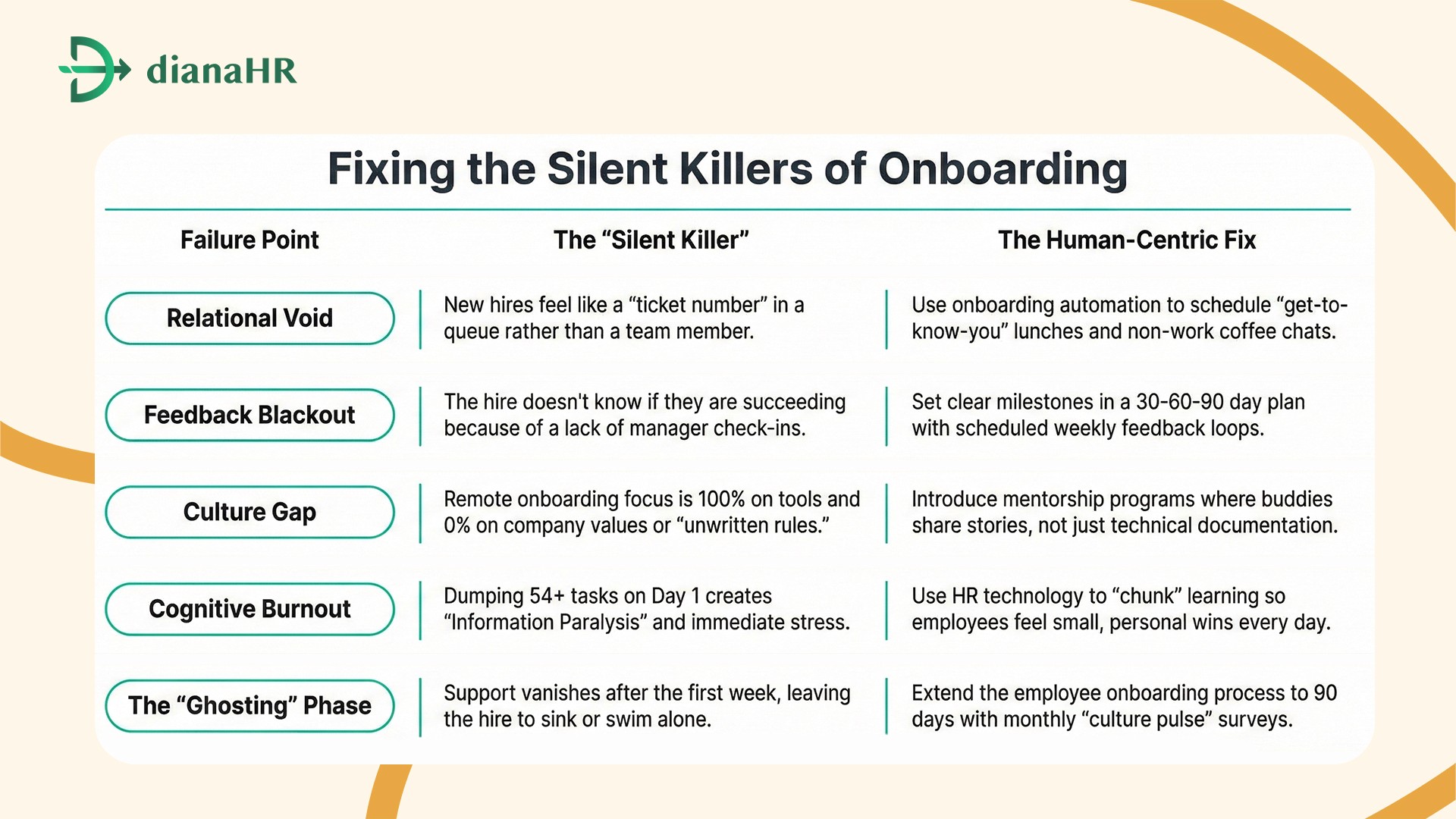
Focusing on these human elements ensures your employee onboarding process builds a team, not just a staff list.
Mastering the 2026 "Agentic AI" Onboarding Trend
Advanced onboarding automation now moves beyond simple tasks. Goal-driven agents manage your employee onboarding process by taking real action across systems to save time and reduce manual errors.
A) Beyond Simple Automation: Personalized Learning Paths
HR technology no longer uses generic training. Today, onboarding software creates custom paths for every role.
Agents track skills in real-time.
New hires get modules that fit their learning style.
Content adjusts based on new hire orientation results to keep the employee onboarding process efficient. This level of care keeps employee engagement high and stops people from feeling like a number.
B) The Rise of Real-Time Compliance Auditing
Manual checks are history. A smart employee onboarding process uses agents to watch tax forms and safety docs 24/7.
Systems flag missing signatures instantly.
Real-time audits ensure you stay legal.
Agents nudge employees so HR doesn't have to.
Automation handles the bulk of the pre-boarding work.
C) The "Always-On" Feedback Loop
Using AI for employee engagement helps find issues early. Agents analyze chat data to alert leaders before a hire becomes a "flight risk," which directly improves employee retention.
DianaHR Automates Error-Free New Hire Setups
Scaling your team shouldn't mean scaling your stress. DianaHR acts as your partner in the employee onboarding process, turning complex tasks into a streamlined experience through smart onboarding automation.
AI-Driven Compliance Management: Automates payroll taxes and registrations for multi-state operations during pre-boarding.
Human-in-the-Loop Expertise: You get a dedicated HR specialist to manage your employee onboarding process and people operations.
Seamless Integrations: Works with tools like Gusto and ADP, so you don't have to switch your current HR technology.
Smart Task Automation: Saves 15+ hours weekly by handling repetitive employee onboarding process steps.
Scalable People Operations: Ensures consistent cultural integration and compliance as your startup grows across new locations
Ready to streamline your team’s growth? Explore how DianaHR simplifies your employee onboarding process and saves you hours every week.
Conclusion
An effective employee onboarding process represents the soul of your company culture. Unfortunately, many businesses rely on outdated, manual new hire orientation that leaves employees feeling like just another number.
When you ignore the signs of "onboarding drift," the consequences are severe: disengagement, low morale, and talent walking out the door before day 90. This turnover drains your budget and kills team momentum.
Avoiding these mistakes is the only way to protect your growth. DianaHR solves this by combining onboarding automation with human expertise, ensuring your employee retention stays high while you focus on leading your team.
Discover how DianaHR can transform your employee onboarding process into a growth engine for your business.
FAQs
1. How long should the onboarding process actually last?
A successful employee onboarding process should last at least three full months. Using a 30-60-90 day plan allows new hires to settle in gradually while reaching specific milestones. This long-term support helps maintain high employee engagement and ensures long-term career success.
2. What is the difference between orientation and onboarding?
New hire orientation is just a single event focused on admin tasks. Conversely, the employee onboarding process is a comprehensive journey. It emphasizes cultural integration and role mastery. Investing in a complete process rather than a quick tour ensures your team thrives.
3. Can AI replace the human element of onboarding?
No, AI can never replace human connection. In your employee onboarding process, HR technology handles the boring paperwork so you can focus on mentorship programs. This balance allows leaders to spend quality time building real relationships with every new team member.
4. Why is pre-boarding so critical for retention?
Pre-boarding is vital because it stops "new job anxiety" before it starts. By using onboarding automation and onboarding software, you can finish all legal forms early. This ensures the employee onboarding process feels welcoming and professional from the very first interaction.
5. What is the #1 mistake in remote onboarding?
The biggest mistake in remote onboarding is ignoring the social side. Without team connections, employee retention drops significantly. Use manager check-ins to build a strong bond. Ensure your employee onboarding process makes remote workers feel like a valued part of the tribe.
Share the Blog on: