88% of employees now value wellbeing benefits as much as their base salary, per the 2025 State of Wellbeing report. At the same time, insurance premiums are set to rise 18% in 2026, per Aflac research. That is not a small line item problem. It is a structural one.
Most founders don't fail at benefits because they stop caring. They fail because benefits administration has become too complex to manage without expert help. Spreadsheets, carrier portals, and state-specific tax notices pile up fast.
An employee benefits broker changes that equation entirely. This guide will explore what a modern broker actually does, how to pick the right one, and which platforms are worth your time in 2026.
What an Employee Benefits Broker Actually Does
Most people think a broker just sells insurance. That is not what a good employee benefits broker does in 2026. A modern employee benefits broker sits between you, the carriers, and the compliance calendar, making sure none of those three things damage your payroll or your headcount.
A) The Strategic Shield Against Rising Costs
Your employee benefits broker's first job is to stop you from overpaying. Here is how they do it:
1. Workforce demographic analysis: They study your team's age range, health utilization patterns, and claims history to predict what your people will actually use. This feeds directly into smarter insurance carrier negotiations.
2. Healthcare cost containment: They flag high-cost drivers early, like specialty drug usage, and suggest plan changes before your next renewal hits.
3. Plan design optimization: A good employee benefits broker recommends structures like HSAs or self-funded arrangements that cut your tax liability while keeping group health insurance coverage competitive.
4. Open enrollment management: They prepare your workforce before the window opens, reducing late enrollments, missing dependents, and carrier sync errors that inflate your premiums.
An employee benefits broker who waits until open enrollment to start these conversations is already behind. The ones worth hiring work on your retention strategy year-round.
B) Orchestrating Solid People Operations
Benefits do not live in isolation. Every hire, every state expansion, and every payroll run touches your benefits administration setup.
A skilled employee benefits broker keeps all of it connected:
1. HRIS integration: They confirm your benefits platform syncs correctly with your payroll system, so data does not break in transit.
2. Compliance monitoring: Every time you hire across state lines, workers' comp classifications, tax withholdings, and benefits administration registrations need updating. Your broker handles that automatically.
3. ACA and HIPAA oversight: A broker monitors your exposure continuously and flags issues before they turn into penalties, protecting your fiduciary duty obligations.
4. Onboarding coordination: New hires should not be chasing HR for insurance cards. A good employee benefits broker makes sure group health insurance is active before day one.
5. Workforce management across generations: Your team likely spans three or four generations. Each values different things. Your broker builds a package that covers that spread without blowing the budget, directly strengthening employee wellbeing.
Strong people operations only run smoothly when someone owns the connective tissue between payroll, compliance, and coverage.
Knowing what a broker does is one thing. Finding one worth hiring in 2026 requires a sharper filter, and the selection criteria have changed.
Deciphering the Code: How to Choose Your Next Partner
Picking the wrong employee benefits broker does not just cost you money at renewal. It costs you time, compliance exposure, and employee trust.
Here is what actually separates a strategic partner from a vendor who just sends you PDFs once a year.
1. The Tech-Forward Filter: AI vs. Manual Entry
The first question to ask any broker candidate is simple: how does your system handle data?
If the answer involves emailing spreadsheets or filling out carrier PDFs manually, that is a red flag. Manual benefits administration is a liability in 2026, not a process.
Here is what a tech-forward employee benefits broker should offer instead:
1.Automated HRIS integration: Your broker's platform should sync directly with your payroll system. Every new hire, termination, or life event should update automatically across benefits administration records.
2. Human-in-the-Loop validation: Automation without oversight creates errors that surface at the worst time, usually during open enrollment or a compliance audit. The right broker uses AI to catch data issues before they reach the carrier.
3. SBC document automation: Summary of Benefits and Coverage documents used to require hours of manual review. AI-powered brokers extract and compare plan data in minutes, giving you faster, more accurate quotes.
4. Real-time compliance monitoring: Multi-state workforce management means your tax withholdings, workers' comp classifications, and registration requirements shift constantly. Your broker's system should track those changes automatically, not wait for you to notice them.
A broker still operating on manual entry is not just inefficient. They are passing their operational risk directly onto your people operations team.
2. Fee Transparency: The End of Hidden Commissions
For years, broker compensation worked in the carrier's favor, not yours. That is starting to change, but you still need to ask the right questions.
Here is what to look for when reviewing how your employee benefits broker gets paid:
1. CAA disclosure compliance: Under the Consolidated Appropriations Act, any broker expecting $1,000 or more in direct or indirect compensation must provide written disclosure to the plan fiduciary. Ask for this document upfront. If they hesitate, move on.
2. Commission structure clarity: Some brokers earn a percentage of your premium. That means when your premiums go up, their income goes up too. That structure conflicts directly with your healthcare cost containment goals. A flat per-employee-per-month fee or a flat advisory fee removes that misalignment.
3. Indirect compensation disclosure: Brokers can also receive bonuses, carrier incentives, and non-cash rewards for keeping clients with the same insurer. These do not always show up in the basic commission disclosure. Ask specifically about contingent compensation tied to insurance carrier negotiations.
4. Fiduciary duty confirmation: Ask directly whether your broker assumes fiduciary duty status for your plan. Most do not, and that matters. A broker without fiduciary accountability has less legal obligation to act in your best interest.
In December 2025, class action lawsuits were filed against four employers and their brokers for failing to monitor commissions, use competitive bidding, or leverage plan size to reduce costs. That legal pressure is pushing the industry toward transparency faster than any regulation has managed so far.
Once you know what to look for, the next step is knowing which platforms in 2026 actually deliver on these standards.
Top 5 Employee Benefits Broker Solutions to Watch
Not every employee benefits broker platform is built the same. Some handle global compliance, others focus on cost containment for small teams.
Top 5 Employee Benefits Broker Solutions at a Glance
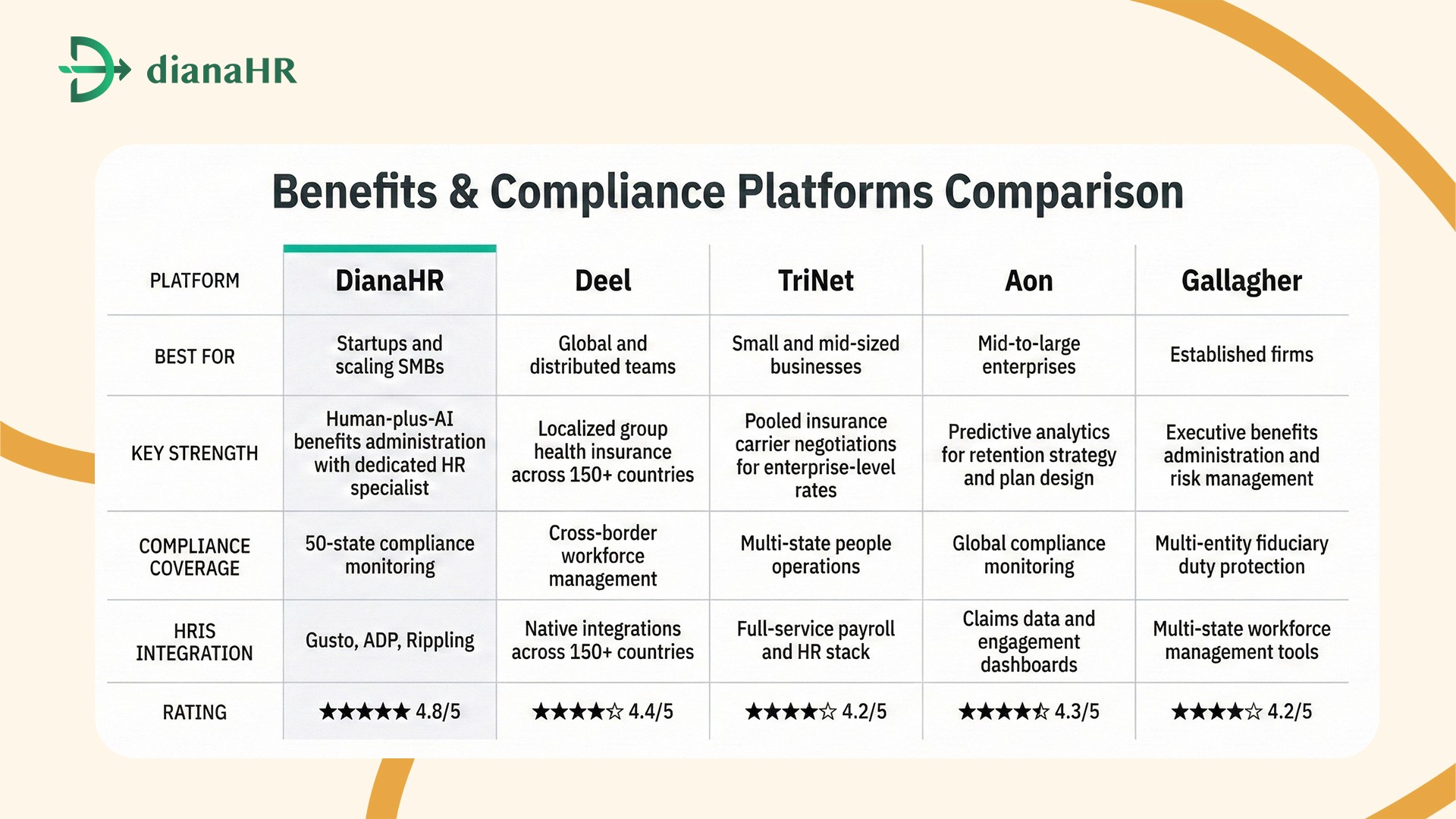
Here are the five solutions leading the market in 2026, starting with the one redefining how people operations and benefits administration work together.
1. DianaHR: The "Human-Plus-AI" Hybrid
Overview: DianaHR closes the gap traditional employee benefits brokers leave open. It pairs agentic AI with a dedicated HR specialist who handles benefits administration, payroll sync, and 50-state compliance monitoring in one unified workflow.
Key Features:
Agentic AI reads offer letters and auto-fills payroll and group health insurance registrations, eliminating manual data entry from day one.
A dedicated HR co-pilot handles open enrollment, employee queries, and real-time workforce management updates across all 50 states.
Human-in-the-Loop validation catches carrier sync errors before they affect employee wellbeing or trigger compliance penalties.
Best For: Startups and scaling SMBs that need full people operations support without hiring a full in-house HR team.
Industries Catered: Technology, Healthcare, Nonprofits, Professional Services, Retail, Finance.
Client Review: ★★★★★ 4.8/5
2. Deel: The Borderless Specialist
Overview: Deel is built for teams operating across multiple countries. It manages localized benefits administration, employment contracts, and compliance monitoring so your global hires receive culturally relevant, legally sound packages without a local legal team.
Key Features:
Localized group health insurance and benefits packages across 150+ countries, each aligned to local labor laws and cultural expectations.
Automated workforce management tools handle contractor and full-time employee classifications, reducing misclassification risk across borders.
Built-in HRIS integration syncs employment data, payroll, and benefits records in real time across all entities.
Best For: Companies with distributed or international teams that need an employee benefits broker solution with deep cross-border compliance monitoring built in.
Industries Catered: Technology, SaaS, Media, E-commerce, Financial Services, Remote-First Organizations.
Client Review: ★★★★☆ 4.4/5
3. TriNet: The SMB Growth Engine
Overview: TriNet pools thousands of small businesses together to give them the negotiating power of a large enterprise. It delivers Fortune 500-level group health insurance and benefits administration to teams that could not access those rates on their own.
Key Features:
Pooled buying model gives small teams access to premium insurance carrier negotiations that significantly reduce per-employee healthcare cost containment burdens.
Full-service people operations platform covers payroll, compliance monitoring, and open enrollment management under one roof.
Dedicated HR specialists support workforce management and employee wellbeing programs tailored to each client's industry and headcount.
Best For: Small and mid-sized businesses that need enterprise-grade benefits administration and group health insurance options without the overhead of a large HR department.
Industries Catered: Technology, Life Sciences, Financial Services, Nonprofits, Professional Services, Retail.
Client Review: ★★★★☆ 4.2/5
4. Aon: The Data-First Decision Maker
Overview: Aon brings deep predictive analytics to benefits administration, helping large organizations make data-driven decisions on plan design. Their platform connects workforce management data directly to retention strategy outcomes.
Key Features:
Predictive analytics engine identifies which group health insurance and non-medical benefits drive the highest employee wellbeing scores for your specific industry and workforce demographics.
Advanced insurance carrier negotiations backed by global market data, giving clients access to rates and plan structures unavailable through standard broker channels.
Integrated HRIS integration tools connect claims data, engagement metrics, and benefits utilization into a single dashboard for smarter people operations planning.
Best For: Mid-to-large enterprises that want a data-obsessed employee benefits broker partner to drive measurable ROI from every benefit dollar spent.
Industries Catered: Financial Services, Healthcare, Manufacturing, Energy, Technology, Legal, Higher Education.
Client Review: ★★★★☆ 4.3/5
5. Gallagher: The Risk Mitigation Leader
Overview: Gallagher focuses on long-term risk management and executive benefits administration. Their strength lies in complex insurance carrier negotiations and protecting leadership pipelines through structured employee wellbeing programs.
Key Features:
Specialized executive benefits packages designed around fiduciary duty compliance, deferred compensation, and long-term retention strategy for senior leadership teams.
Enterprise-grade compliance monitoring covers multi-state workforce management, ACA obligations, and HIPAA exposure across complex organizational structures.
Dedicated advisory teams handle healthcare cost containment, open enrollment planning, and HRIS integration for established firms managing large, distributed workforces.
Best For: Established mid-to-large firms that need an employee benefits broker with deep risk management expertise and a strong focus on executive people operations and long-term compliance protection.
Industries Catered: Construction, Manufacturing, Healthcare, Legal, Higher Education, Financial Services, Real Estate.
Client Review: ★★★★☆ 4.2/5
How DianaHR's HR Specialists Manage Benefits Administration and Compliance
DianaHR is an AI-powered HR-as-a-Service platform built to simplify employee benefits broker operations for small and mid-sized businesses across technology, healthcare, nonprofits, retail, and professional services.
We combine intelligent automation with expert HR guidance, cutting HR costs by up to 60% and saving 15-20 hours per week on benefits administration tasks.
Special Capabilities:
AI-Driven Compliance Management: Automates payroll taxes, group health insurance registrations, and multi-state compliance monitoring across 40+ U.S. states.
Human-in-the-Loop Expertise: Every client gets a dedicated HR specialist managing open enrollment, onboarding, and people operations workflows.
Seamless HRIS Integration: Connects directly with Gusto, ADP, and Rippling without tool migration, keeping workforce management data clean and current.
Scalable People Operations: Built for startups and SMBs expanding across multiple locations, ensuring retention strategy consistency and fiduciary duty protection at every stage.
These capabilities transform employee benefits broker management from a back-office burden into a streamlined, data-driven process.
Explore how DianaHR simplifies benefits administration and helps your business scale faster. Visit DianaHR.
Conclusion
Employee benefits are no longer a perk. They are a baseline expectation. The challenge is that benefits administration has too many moving parts. Carriers, compliance calendars, payroll systems, and state registrations rarely talk to each other without someone managing the gaps.
When those gaps go unmanaged, costs climb, employees lose trust, and compliance penalties follow.
DianaHR's dedicated HR specialists handle those gaps automatically, keeping your people operations clean, compliant, and running without the manual drag.
Let's connect with DianaHR and put your benefits administration on autopilot — book a free consultation at getdianahr.com today.
FAQs
Q1: What is the difference between an employee benefits broker and an agent?
An agent represents one insurance carrier. An employee benefits broker represents you. They shop the entire market, handle insurance carrier negotiations, and recommend group health insurance plans based on your workforce needs, not the carrier's sales targets.
Q2: How does an employee benefits broker actually save money?
A good employee benefits broker uses underwriting leverage and claims data to negotiate lower premiums. They also recommend plan structures like HSAs that reduce your tax liability while keeping healthcare cost containment and employee wellbeing goals intact.
Q3: Can an employee benefits broker help with multi-state compliance?
Yes. A qualified employee benefits broker monitors compliance monitoring requirements across all 50 states. Every time you hire across state lines, they update your benefits administration, workers' comp classifications, tax withholdings, and group health insurance registrations automatically.
Q4: When should a small business hire an employee benefits broker?
The moment you hire your first full-time employee. Delaying benefits administration setup leads to messy people operations data, gaps in workforce management, and expensive compliance fixes that a good employee benefits broker would have prevented from day one.
Q5: Is there a fee to use an employee benefits broker?
Many employee benefits brokers earn commissions directly from carriers, meaning there is often no direct cost to you for basic benefits administration services. Always request a full fiduciary duty disclosure covering both direct and indirect compensation before signing anything.
Share the Blog on: