Rules for a 1099 form for employee filings just changed. For 2026, regulators updated the Department of Labor final rule to end worker misclassification. You must decide if your independent contractor is actually a W-2 employee under the new economic reality test.
Failing this check leads to expensive back taxes and unpaid payroll taxes. The IRS now charges $340 for every missing 1099 form for employees. You need audit-proof documentation and a clear IRS Form 1099-NEC process.
This guide helps you file a 1099 form for employees safely while tracking behavioral control, financial control, and the ABC test.
The $2,000 Threshold and the 2026 Evolution of the 1099 form for employee
The rules for reporting payments just saw their biggest update in decades. You need to understand how these changes affect your paperwork and filing systems to stay compliant.
1. Understanding the OBBBA Threshold Shift
The biggest change this year is the One Big Beautiful Bill Act (OBBBA). For a long time, you had to file a 1099 form for employee services if you paid an independent contractor $600 or more.
Starting with payments made in 2026, that limit jumps to $2,000. This higher bar reduces the number of forms you need to send, but it doesn't change your tax liability. Even if a payment is under the limit, the IRS still expects you to track it.
2. The Move to the IRIS System
The IRS is retiring the old FIRE system. You must now use the Information Returns Intake System (IRIS) for electronic filings. IRIS is a web-based platform that allows you to upload data directly or enter it manually.
If you typically file a 1099 form for employee compensation through third-party software, verify that your provider supports the IRIS technical standards.
3. Picking the Right Form: IRS Form 1099-NEC vs. 1099-MISC
Choosing the wrong form is a fast way to trigger an audit. Here is how to keep them straight:
IRS Form 1099-NEC: Use this for non-employee compensation. If you pay a freelancer for their work, this is your primary tool.
IRS Form 1099-MISC: Use this for other payments like rent, prizes, or legal proceeds.
Using a 1099-MISC for a contractor's services is a red flag for worker misclassification. Always double-check your records before submitting a 1099 form for employee data.
Once you know which form to use, you must look at the nature of the relationship itself to avoid legal trouble.
Decoding the "Economic Reality" to Prevent Worker Misclassification
Regulators look past your contracts to see how the work happens every day. You must prove your independent contractor is truly in business for themselves to avoid a 1099 form for employee audit. If you fail to do this, you might end up paying heavy back taxes.
1. The Six-Factor Economic Reality Test
The Department of Labor final rule uses a six-factor economic reality test to determine if a person is a W-2 employee. This test focuses on economic dependence.
If the worker relies only on your business for income, you likely have a worker misclassification problem.
To stay safe when filing a 1099 form for employee, check these points:
Managerial Skill: Can the worker use their business skills to make more money?
Investments: Does the worker buy their own equipment or rent their own space?
Work Duration: Is the job a one-off project or a permanent role?
Nature of Control: Who sets the rules and the schedule?
Integration: Is the work a core part of what your company does?
Specialized Skill: Does the worker bring a unique talent they use for other clients?
2. Behavioral Control: The "How, When, and Where"
Check if you manage the "how, when, and where" of the work. Providing mandatory training or setting specific hours shows behavioral control. This level of direction means you should not use a 1099 form for an employee for this worker.
A real independent contractor maintains their own schedule and uses their own methods to finish the job.
3. Financial Control and the "Opportunity for Profit or Loss"
A real contractor should have the chance to make a profit or lose money. If you provide all tools and pay for every expense, you exercise financial control.
This often leads to demands for payroll taxes from the IRS. Ensure your 1099 form for employee filings is backed by proof that the worker has their own business expenses.
4. The Permanency Factor
Long-term, indefinite roles are risky for worker misclassification. Projects should have a set finish line to stay compliant. Always keep audit-proof documentation to support your 1099 form for employee choices, especially when a contract lasts more than a few months.
You must also verify if your state uses the ABC test before issuing an IRS Form 1099-NEC.
Comparison Table: Economic Reality Test for Proper Classification
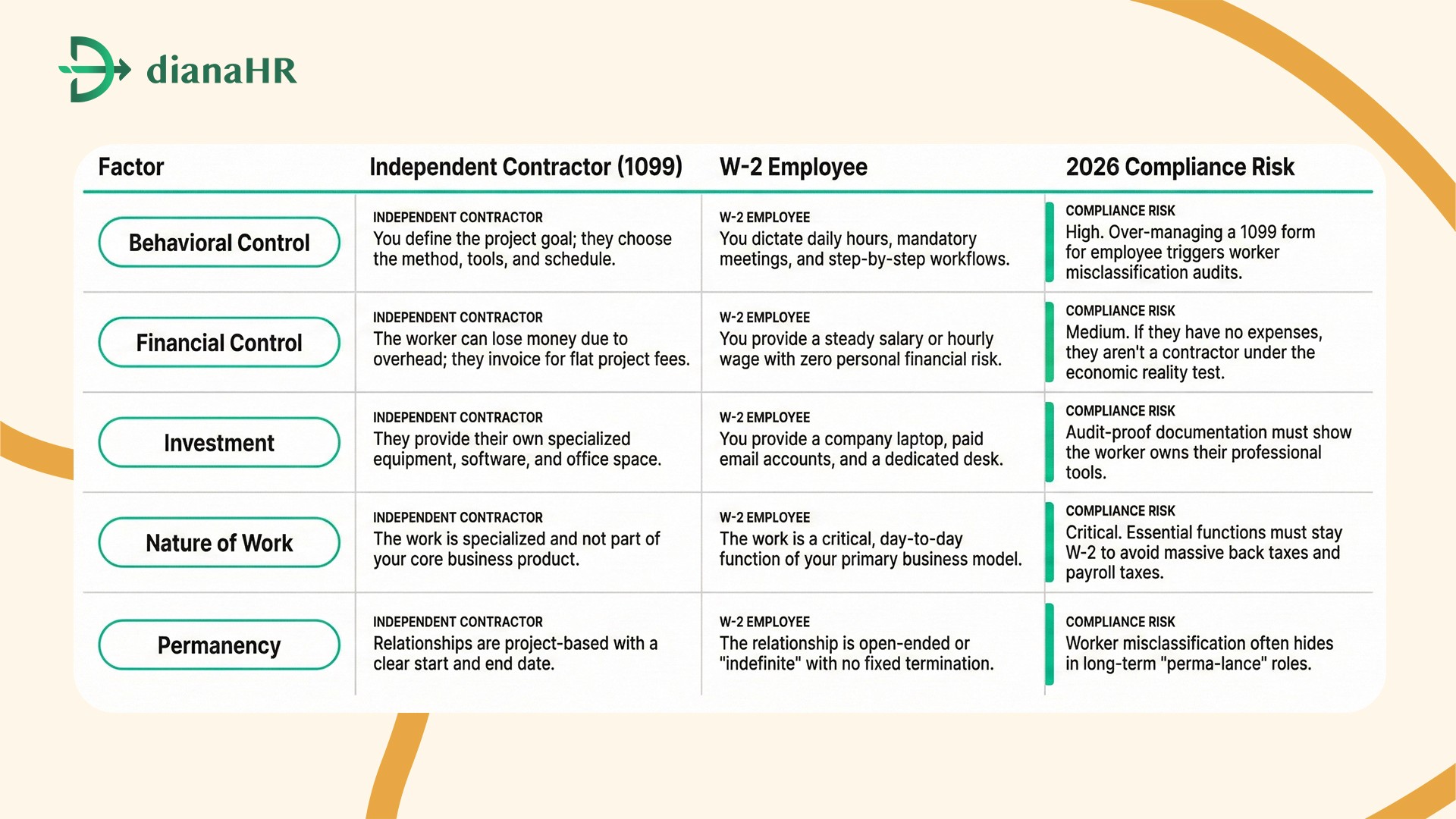
Use this table to audit your workforce and ensure every 1099 form for employee filing stands up to a Department of Labor final rule inspection.
The "Silent Killers" of Independent Contractor Compliance
Filing a 1099 form for employee types involves more than just hitting a deadline. Small mistakes in how you treat an independent contractor can create massive legal gaps. You must identify these "silent killers" before they turn into a full-scale IRS audit.
1. The ABC Test: The Strictest Standard
Many states now use the ABC test to define employment. This is much harder to pass than the federal economic reality test.
To avoid worker misclassification, you must prove three things:
A: The person is free from your control and direction while they work.
B: The work happens outside your usual course of business. For example, a lawyer is a contractor for a retail store, but a cashier is not.
C: The worker has their own established trade or business in the same field.
2. The Hidden Risk of "Hybrid" Benefits
You might want to offer perks like health stipends or paid time off to keep your talent happy. However, providing "contractor benefits" is a major red flag for worker misclassification. If you treat someone like a W-2 employee by giving them benefits, the IRS expects you to pay payroll taxes for them. Keeping a clean line between employee benefits and contractor fees is essential for audit-proof documentation.
3. The W-9 "Verification Void"
Never issue a 1099 form for employee services without a verified W-9 on file. In 2026, the IRS requires real-time Taxpayer Identification Number (TIN) matching.
If you pay someone without a TIN, you face backup withholding requirements and higher fines.
Pro Tip: Collect the W-9 before you send the first payment.
Audit Risk: Missing TINs are the first thing an automated IRS system flags in your IRS Form 1099-NEC filings.
Setting up these guardrails manually is difficult, which is where specialized tools help your business stay safe.
How DianaHR Prevents Costly Worker Misclassification
Managing a 1099 form for employee filings while dodging audits is a heavy burden. DianaHR acts as your compliance engine, reducing HR costs by 60% and saving you 20 hours weekly on independent contractor management.
Our platform automates the transition to the new IRS Form 1099-NEC standards and ensures audit-proof documentation.
AI Compliance: Automates payroll taxes and multi-state registrations to stop worker misclassification.
Expert Support: Dedicated specialists manage your policies and people operations.
Easy Integration: Syncs with ADP and Gusto to handle 1099 form for employee data without tool migration.
Smart Automation: Cuts repetitive admin tasks by 60%.
DianaHR transforms back-office risks into a streamlined, data-driven process.
Explore how DianaHR simplifies the 1099 form for employee processes and helps your business scale faster → DianaHR.
Conclusion
The 2026 tax year brings a zero-tolerance approach to the 1099 form for employee reporting. Relying on casual agreements or outdated filing thresholds creates dangerous gaps in your audit-proof documentation.
If the IRS or DOL finds a worker misclassification error, you face aggressive back taxes, interest, and civil penalties that can bankrupt a small firm. This isn't just a paperwork issue; it’s a financial threat to your business.
DianaHR eliminates this risk by automating your independent contractor workflows and tracking the economic reality test in real-time. We help you stay compliant across 40+ states, ensuring your IRS Form 1099-NEC filings are accurate and secure.
Connect to DianaHR to automate your 1099 form for employee workflows and protect your business from worker misclassification risks today
FAQs
1. What is the new 1099 form for employee threshold for 2026?
The OBBBA triples the IRS Form 1099-NEC threshold to $2,000 for 2026 payments. This update helps you avoid a 1099 form for employee filing for smaller projects, though you must still track every independent contractor payment for your internal audit-proof documentation.
2. Can I be fined if an independent contractor signs a waiver?
Yes. You cannot "contract away" legal requirements. If your independent contractor fails the economic reality test, a waiver won't stop worker misclassification fines. Regulators prioritize actual behavioral control and financial control over any signed document during a compliance audit.
3. What is the main difference between 1099-NEC and W-2?
A W-2 is for employees where you manage payroll taxes. A 1099 form for employee types—specifically the IRS Form 1099-NEC—is for an independent contractor. Misidentifying these leads to back taxes if the Department of Labor final rule isn't met.
4. How does the ABC test work?
The ABC test is a strict three-part check. To avoid worker misclassification, you must prove the worker is free from your behavioral control, performs work outside your core business, and operates an independent trade. This standard often overrides federal guidelines.
5. Is there a penalty for late 1099 filing in 2026?
Yes. The IRS imposes tiered penalties for every late 1099 form for employee. These range from $60 to $340 per form. Using the new IRIS system correctly and maintaining audit-proof documentation is the only way to prevent these costly automated fines.
6. Does providing equipment make someone an employee?
Providing tools often proves financial control, a key factor in the economic reality test. If you supply a laptop or office space, the worker looks like a W-2 employee. To prevent worker misclassification, contractors should ideally provide their own specialized equipment.
Share the Blog on: