Moving from candidate to productive team member happens fast in 2026. Data shows that solid onboarding automation boosts employee retention by 82%. It grows productivity by 70%.
Yet, most employees say their companies fail at this. This gap hurts employee engagement and causes people to quit early. Many new hires decide their future within their first month. Today, hiring automation fixes this problem. Tools like agentic AI manage the human side of the work.
This tech removes admin tasks. It makes pre-boarding easy. You turn a signed offer into a long career by using onboarding automation to focus on the person. This guide shows how these tools improve new hire orientation.
Why Effective Hiring Starts with Pre-boarding
You win or lose a new hire before they clock in. Pre-boarding creates a professional bond that stops people from looking for other jobs.
1. Eliminating the "Ghosting" Risk with Immediate Automation
Ghosting remains a big problem. Onboarding automation stops candidates from disappearing. Use agentic AI to send welcome messages and ship laptops immediately. This type of hiring automation keeps people excited.
Here is what you can automate:
Send a personalized welcome video from the CEO.
Grant access to internal communication tools early.
Set up real-time tracking for office equipment.
2. The 100% Digital Paperwork Threshold
Wasting the first day on tax forms is a mistake. Use onboarding automation to finish all files before the start date. This keeps new hire orientation focused on cultural integration. When you use onboarding automation for compliance, employee retention increases because the first day feels productive.
3. Skill-Mapping Before the Start Date
Start workforce planning as soon as the offer is signed. Agentic AI checks skills during the pre-boarding phase. This helps you build a solid 30-60-90 day plan for every role. Onboarding automation delivers specific training modules that support talent development. This ensures your team stays sharp and ready.
Getting the paperwork out of the way allows you to focus on the human side of the business.
Beyond the Checklist: Leveraging Onboarding Automation for Cultural Gravity
Most companies treat the first week like a long list of chores. You can use onboarding automation to build a sense of belonging instead. Skip the boring boxes and focus on making people feel welcome.
This strategy helps the new hire adjust to your team faster and strengthens your cultural integration.
1. The AI "Buddy" Match: Solving the Social Deficit
In a hybrid work setting, people often feel lonely during their first week. Use HR technology to match new hires with mentors based on personality and shared interests. Onboarding automation schedules these coffee chats automatically.
Matches are based on behavioral data rather than just department.
The system triggers automatic calendar invites for the first three weeks.
Encourages a "safe space" for questions outside of formal management.
This boosts employee engagement by building real human connections early in the process.
2. Drip-Feeding Culture
Avoid dumping too much data on new hires at once. Use hiring automation to send small, digestible bits of info over their first month. This method helps with long-term talent development and makes new hire orientation feel natural.
You can share company history or team traditions through these automated "nudges" to keep the pre-boarding momentum alive.
3. The "First Win" Workflow
Set up onboarding automation to prompt managers to assign a small, meaningful task by Day 3. Completing a real project quickly improves employee retention. It proves to the hire that they contribute value. This approach works as a vital part of a strong 30-60-90 day plan.
4. Real-Time Sentiment Auditing
Agentic AI runs short pulse surveys to see how people feel about their start. If a hire feels lost, the system alerts HR immediately. This proactive hiring automation keeps employee retention high and ensures your workforce planning stays on track.
Building these cultural roots ensures your team remains strong and connected.
The 90-Day Marathon: Automating Long-Term Employee Retention
Stopping after the first week is a mistake that hurts your team. You need to support new hires for at least ninety days to ensure they stay.
Using onboarding automation makes this long process manageable. Onboarding automation removes the manual work of following up with every individual.
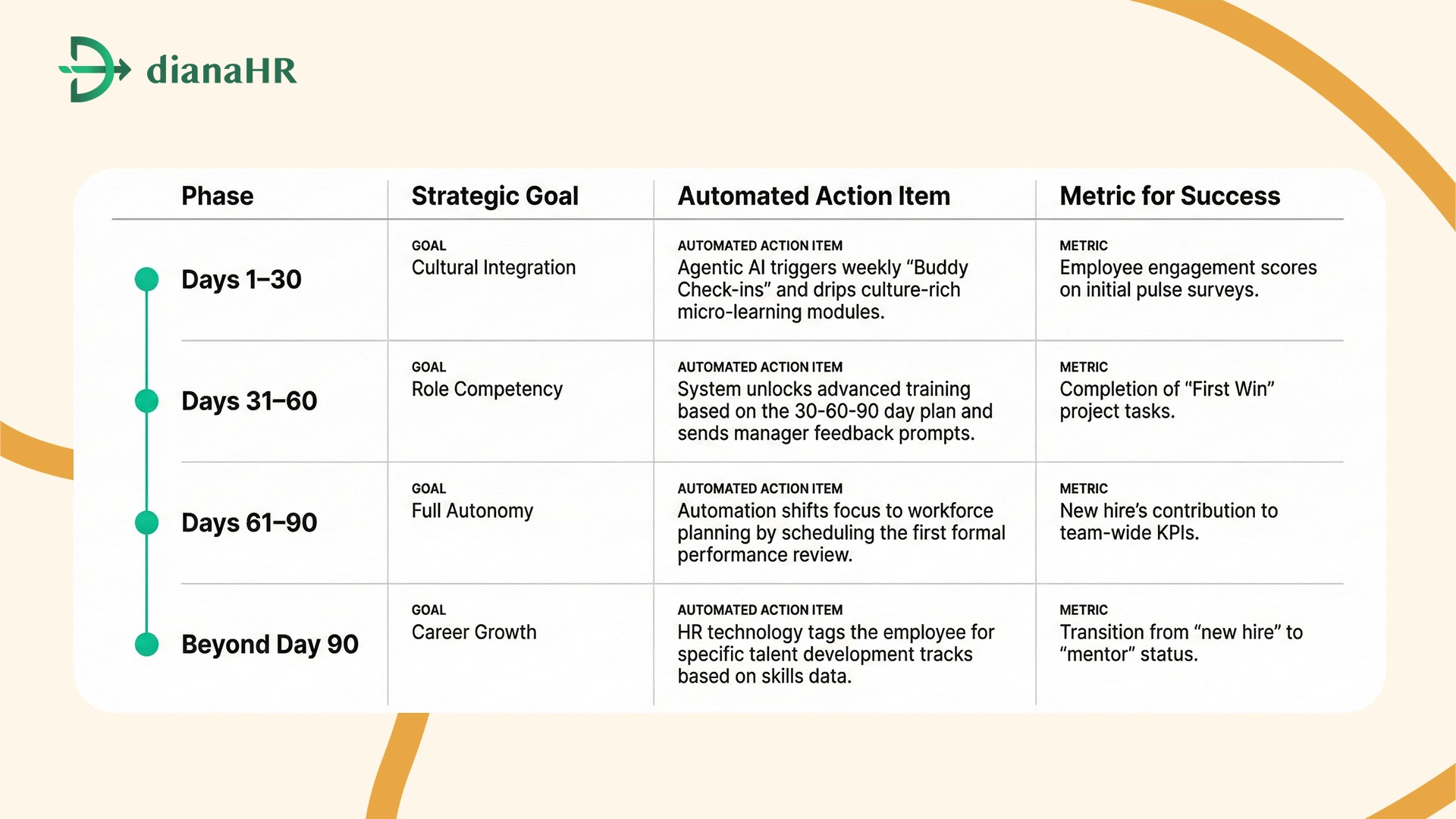
1. The Automated 30-60-90 Day Plan
Onboarding automation helps you track progress long after the first day. By using HR technology, you ensure your new hire moves through a clear 30-60-90 day plan. This keeps them focused on talent development goals and prevents them from feeling lost.
2. Predictive Analytics and the "Flight Risk" Zone
Data helps you catch problems before people quit. Agentic AI analyzes employee engagement signals throughout the second month. If the system sees a dip in activity, it alerts HR. This proactive hiring automation allows you to fix issues early and boost employee retention.
3. Closing the Handoff Gap
Onboarding automation ensures that the promises made during interviews reach the hiring manager. This creates a smooth transition from candidate to team member. It supports workforce planning by aligning expectations with reality and improving cultural integration.
4. Manager Accountability
Managers are busy, but onboarding automation sends gentle nudges to ensure they hold regular meetings.
Automated prompts provide talking points for 1:1 sessions.
The system tracks completion rates for check-ins.
Alerts go out if a manager misses a key milestone.
Keeping the momentum for three months turns a new hire into a loyal employee.
How DianaHR Automates Your Onboarding Workflows
Managing complex tasks is easier with DianaHR. Our platform simplifies onboarding automation for small and mid-sized businesses. By using hiring automation, you can reduce HR costs by 60% and save up to 20 hours every week.
Our HR technology ensures you stop chasing paperwork and start building a high-performing team.
DianaHR offers specialized features to improve your new hire orientation:
AI-Driven Compliance: Automatically manages taxes and benefits for onboarding automation across 40+ states.
Human-in-the-Loop: You get a dedicated specialist to handle policies and workforce planning.
Seamless Integrations: Connects with tools like Gusto or ADP to keep your data synced.
Smart Task Automation: Uses agentic AI to remove repetitive admin work from your daily schedule.
Explore how DianaHR simplifies your onboarding automation today.
Conclusion
Onboarding automation helps you scale your team without losing the human touch. Without it, you face manual errors, lost paperwork, and inconsistent messaging. These gaps frustrate new hires and lead to immediate turnover.
If people quit in their first month, you lose thousands in recruitment costs and damage your brand reputation. This failure creates a revolving door that drains your energy and stunts growth.
DianaHR fixes these issues by using hiring automation and agentic AI to manage the heavy lifting. We streamline your compliance and new hire orientation, allowing you to focus on your people while we handle the process.
Connect to DianaHR to see how our hiring automation tools simplify your onboarding automation and help you build a more productive team today.
FAQs
1. What is the difference between orientation and onboarding?
New hire orientation is a quick event for paperwork. Onboarding automation covers a 90-day talent development journey. This long-term workforce planning strategy ensures cultural integration and builds employee engagement. Using agentic AI makes this transition smooth and supports your 30-60-90 day plan.
2. How does automation improve employee retention?
Hiring automation removes friction during pre-boarding. This consistency boosts employee retention by making new hires feel valued immediately. By using HR technology to manage employee engagement, you ensure better cultural integration and lower turnover rates across your entire hybrid work team.
3. Can onboarding automation work for small teams?
Small teams benefit from onboarding automation. It allows you to provide professional new hire orientation without a huge staff. Hiring automation tools like DianaHR handle compliance and workforce planning, freeing you up to focus on talent development and business growth.
4. What is "Agentic" Onboarding?
This involves agentic AI managing tasks based on specific context. This HR technology proactively adjusts your 30-60-90 day plan or schedules pre-boarding tasks. It improves hiring automation by handling the logic behind onboarding automation, ensuring every hire feels supported and connected.
5. When should the onboarding process start?
Effective onboarding automation starts at pre-boarding, right after a candidate signs. Use hiring automation to deliver culture-rich content early. This approach builds employee engagement and sets a strong foundation for your 30-60-90 day plan even before the official start date.
6. Does automation make the process feel "cold"?
Onboarding automation makes the process more human. By using agentic AI for forms, you save time for mentorship and cultural integration. This focus on employee engagement improves employee retention and makes new hire orientation feel personal, even in a hybrid work setup.
Share the Blog on: