Stop thinking of HR management as just paperwork. By 2026, human resource management shifted toward a digital model. Companies now use advanced HRIS platforms to handle talent acquisition and onboarding.
Modern HR technology changes how you lead teams. Most leaders agree that HR management now drives business results. This involves modern HR management functions like workforce planning and people analytics.
You need a system that handles HR compliance without the stress. Our guide shows you what works today. We explain how to improve employee engagement and performance management. We also look at skills-based hiring.
What Is HR Management? Definition and Strategic Scope in 2026
You need to view HR management as the engine of your business, not just a support desk. It now dictates how your company scales and adapts.
The Core Definition of Human Resource Management
Human resource management is the strategic design and implementation of policies that govern how you recruit, develop, and retain employees. In 2026, HR management will act as a cross-functional business discipline.
It links workforce capability directly to financial results. You use HR management functions to ensure every hire fits your long-term goals.
Modern HR management focuses on:
Workforce planning to map out future talent needs.
People analytics to track productivity and turnover trends.
HRIS integration to keep all employee data in one place.
How HR Management Has Shifted From Administrative to Strategic in 2026
The days of manual record-keeping are over. 89% of companies have restructured their HR management to eliminate silos. You no longer manage recruitment, onboarding, and performance management as separate tasks.
Instead, you use an integrated HRIS to see how these functions impact each other. With a solid definition in place, let's look at the specific responsibilities that define your daily operations.
Core HR Management Functions and Human Resource Management Responsibilities in 2026
You need to master specific HR management functions to keep your business competitive. These responsibilities ensure your team stays productive and your company stays legal.
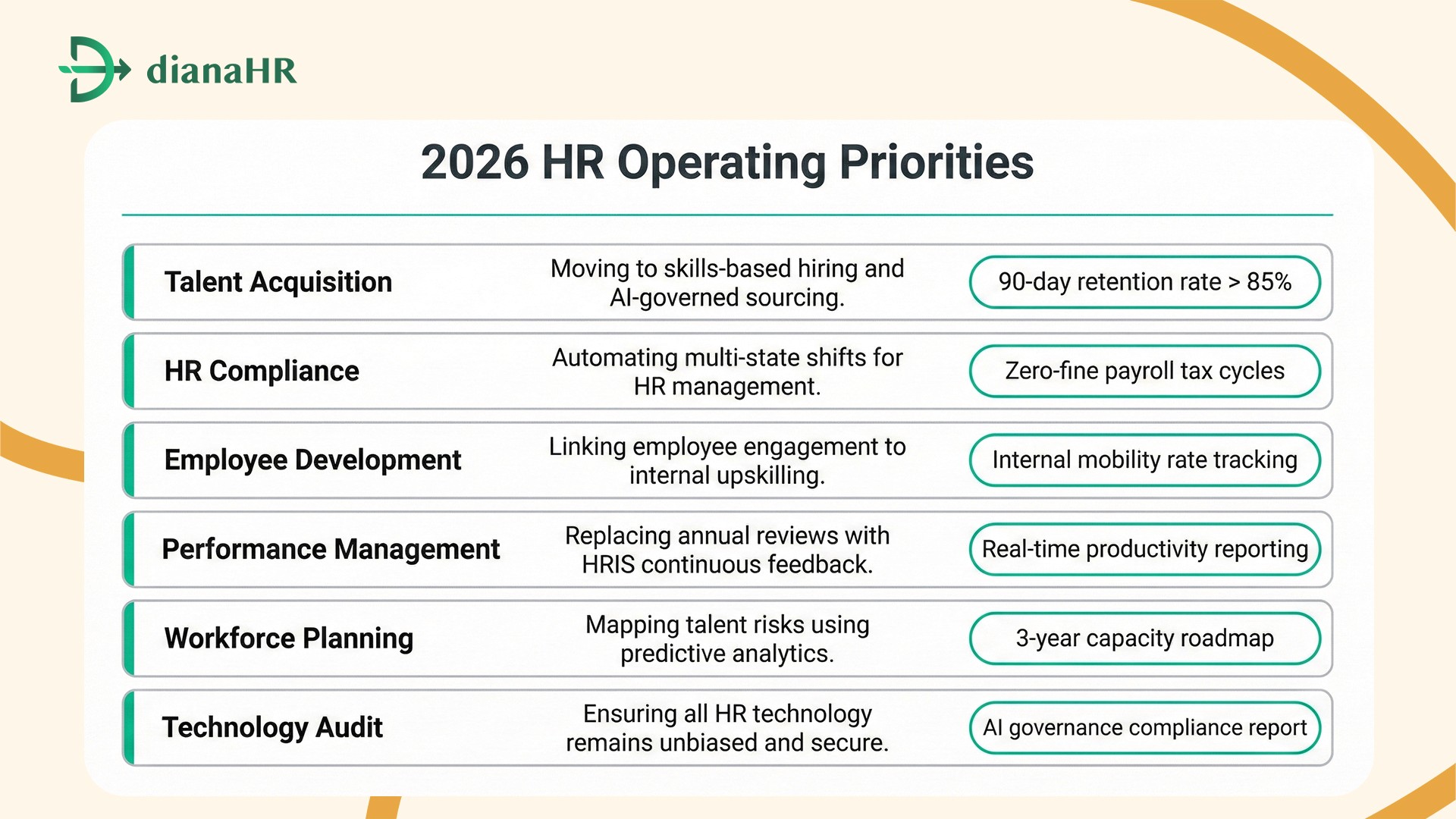
1. Talent Acquisition and Skills-Based Hiring
In 2026, HR management focuses on skills-based hiring. You no longer look just at degrees. You look at what a person can actually do. Most companies now use HR technology like AI-assisted sourcing to find talent.
However, you must lead the HR compliance review to prevent bias in these tools. Use your HRIS to track key metrics like your 90-day new hire retention rate. If your time-to-hire exceeds 44 days, your human resource management process needs a fix.
2. Payroll, Compliance, and Benefits Administration
HR management owns the most legally sensitive parts of your business. You must handle multi-state HR compliance without errors.
New Mandates: States like Delaware, Maine, and Minnesota now require specific family leave payments.
Financial Caps: Manage the Social Security wage base of $184,500 and a $7,500 Dependent Care FSA cap.
Strategic Benefits: Use people analytics to see if your wellness plans actually improve employee engagement.
3. Performance Management and Employee Development
Old-school annual reviews fail. Modern HR management uses continuous feedback linked to your HRIS.
Upskilling as Retention: Workers are 60% more likely to stay if you offer rapid training.
Real-time Data: Use your HR technology to track performance daily, not yearly.
Growth Design: Build performance management systems that focus on future potential rather than past mistakes.
4. Workforce Planning and People Analytics
Only 12% of leaders do this well, which gives you an edge. Effective HR management means you forecast talent gaps before they hit your bottom line. Use people analytics to track voluntary attrition and internal mobility.
Present this data to your CEO as strategic intelligence. When you master workforce planning, you move from counting heads to building a map of your company’s future potential.
Core HR Management Functions: 2026 Quick Glance
Now that you know the core responsibilities, you must identify what makes these functions actually work.
What Separates Effective HR Management From Outdated HR Management in 2026
You need to know if your HR management is helping or hurting your growth. By 2026, the gap between high-performing teams and administrative cost centers has widened.
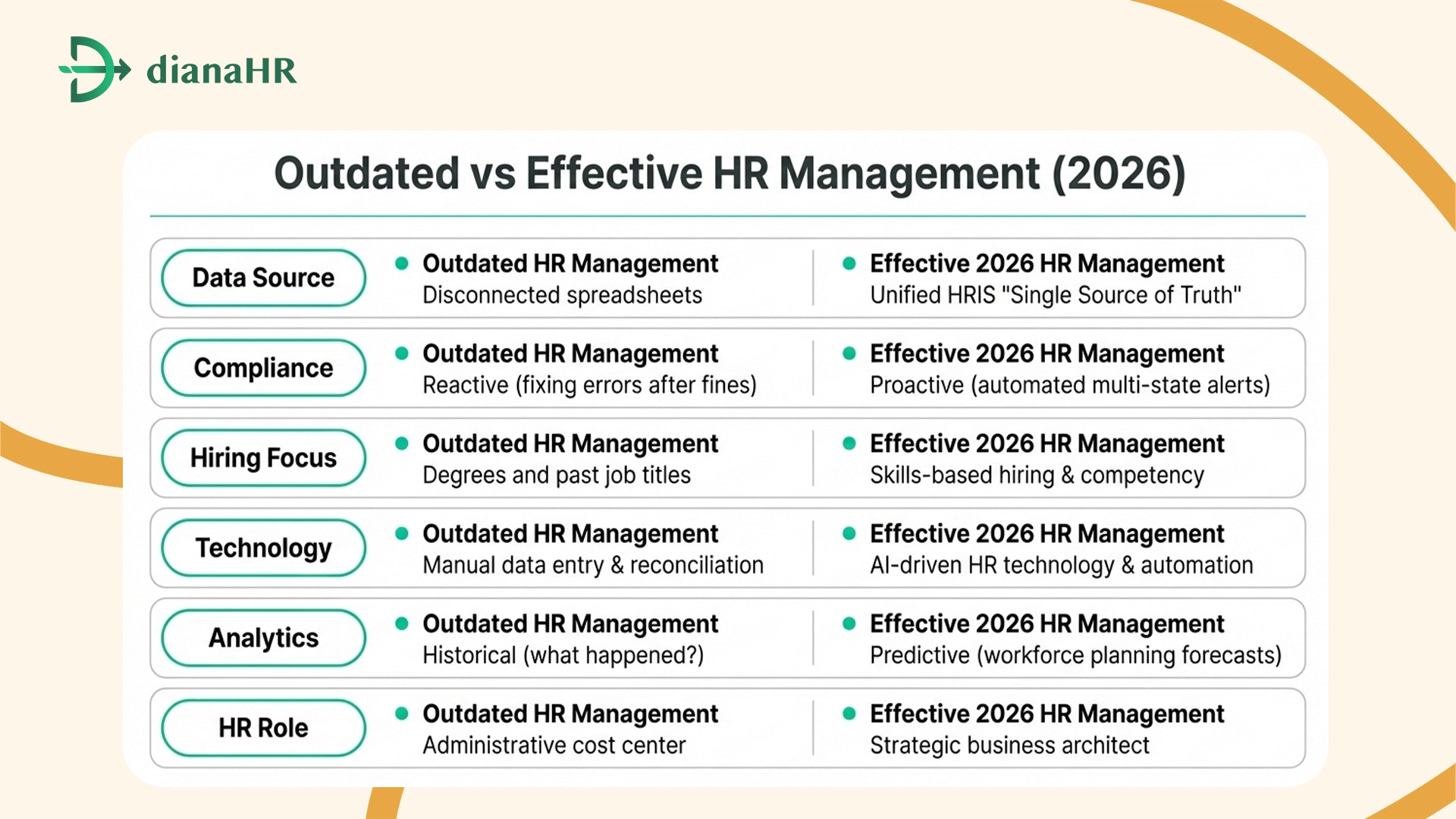
A) Three Operational Gaps That Signal Outdated HR Management
Outdated human resource management relies on manual habits that waste time. If you see these signs, your HR technology is failing you:
Gap 1. Disconnected Systems: Nearly 6 in 10 employers underutilize their HRIS. If you run payroll in one tool and onboarding in another, you waste hours on data reconciliation.
Gap 2. Reactive Compliance: Waiting for a violation notice is a liability. With 17 states mandating paid sick leave and new 2026 benefits in Delaware and Minnesota, you cannot afford to miss a deadline.
Gap 3. No Predictive Analytics: Outdated HR management functions only report what happened last month. You need to forecast talent risks 90 days out to prevent project stalls.
B) What Effective HR Management Looks Like in Practice in 2026
Top teams use a single HRIS to see everything. They lead talks on workforce planning and employee engagement. Your HRIS can also handle HR technology issues like onboarding and skills-based hiring.
Moving from reactive data to predictive analytics helps you spot risks. Effective HR management means you see what comes next.
To close these gaps, you need a system that handles the heavy lifting for you.
How DianaHR Handles the HR Management Work That Slows Most Small Businesses Down
You need a system that removes the administrative burden of HR management. DianaHR provides the essential infrastructure for human resource management by combining AI with human expertise.
Our platform simplifies HR management functions so you can focus on growth.
Special Capabilities of DianaHR:
AI-Driven Compliance: Automates payroll taxes and multi-state HR compliance across 40+ states.
Human-in-the-Loop: A dedicated specialist manages your onboarding and employee engagement policies.
Seamless Integrations: Works with your existing HRIS like Gusto or ADP without migration.
Smart Task Automation: Reduces your HR management workload by 60%, saving you 15+ hours weekly.
DianaHR turns human resource management into a streamlined, data-driven process. Explore how DianaHR automates your HR management and secures your human resource management workflows today.
Conclusion
Effective HR management demands a perfect balance between workforce planning and strict HR compliance. If you neglect these human resource management duties, you risk sudden employee attrition and legal penalties.
Outdated systems cause failed audits and lawsuits that drain your business capital. One missed state filing can halt your entire operation. Many companies collapse because they cannot handle the surge in HR technology demands.
DianaHR eliminates these risks by automating your onboarding and multi-state HR management functions. We fix your operational gaps so you can focus on growth.
FAQs
1. What is HR management and what does it include in 2026?
HR management includes talent acquisition, onboarding, and managing your HRIS. Modern human resource management uses people analytics to link worker skills to profits. These activities ensure you maintain HR compliance while using HR technology to automate your daily administrative tasks.
2. How is HR management different from traditional human resources?
Traditional HR processes papers, but HR management acts as a strategic business partner. You use HR management functions to forecast growth through people analytics. Effective leaders prioritize skills-based hiring and employee engagement to drive results instead of just tracking hours.
3. What is the role of AI in HR management in 2026?
AI improves HR management by automating onboarding and recruitment. HR technology helps you track employee engagement and predict turnover. Most teams use AI to manage HR compliance audits, which saves time and reduces errors in your daily operations.
4. What skills do HR management professionals need most in 2026?
You need data literacy and HRIS proficiency to lead HR management. Modern strategy requires mastering workforce planning and HR technology. Professionals who understand skills-based hiring are in high demand because they drive real growth and improve overall team performance.
5. What is the biggest challenge in HR management in 2026?
Managing multi-state HR compliance remains the toughest task in HR management. Most human resource management teams struggle to balance workforce planning with daily onboarding chores. You need an HRIS to handle these complex tasks without burning out your staff.
6. How does HR management software support modern HR operations?
An HRIS centralizes your data and HR technology automates onboarding, payroll, and HR compliance. Using software for your HR management functions reduces manual work, letting you focus on employee engagement and long-term workforce planning for your entire team.
Share the Blog on: