Modern roles of HR carry more weight than ever in 2026. Employers posted 30,300 positions last year, specifically for talent acquisition and learning and development.
Finding talent is hard because HR responsibilities now include HR analytics and workforce planning. Experts agree that human resources functions now blend with IT and data support.
This change turns the department into a business driver. You must understand the 11 roles of HR to build a productive team. This guide shows you what each function requires to succeed.
The 11 Core Roles of HR and Human Resources Functions That Drive Organizations in 2026
Modern human resources functions go beyond filing paperwork. You need a strategy that connects your people directly to your business goals. Here are the first four roles of HR that define success this year.
Responsibility 1 — Talent Acquisition and Recruitment Strategy
Modern talent acquisition requires a shift from reactive posting to proactive sourcing. In 2026, your team manages:
Sourcing Strategy: Using AI tools to find specialized talent.
Brand Execution: Selling the company culture to candidates.
Bias Audits: Checking job descriptions for inclusive language.
Roles of HR now analyze recruitment data to reduce the national 44-day average time-to-hire.
Responsibility 2 — Employee Onboarding
Proper onboarding sets the tone for the entire employee lifecycle. Your HR responsibilities include:
Verification: Collecting I-9 and tax documents digitally.
Integration: Providing system access and cultural context early.
Compliance: Maintaining electronic records to avoid $2,789 penalties.
Effective human resources functions use 90-day immersion plans to lower the 18% probationary turnover rate.
Responsibility 3 — Payroll Management and Multi-State Compliance
Payroll management is a high-stakes part of HR compliance for distributed teams. You must handle:
Wage Caps: Updating systems for the $184,500 Social Security base.
Tax Tracking: Managing withholding for remote workers across multiple states.
Reporting: Adjusting for the new $2,000 1099 threshold.
Roles of HR involve syncing these data points to ensure accurate, on-time pay cycles.
Responsibility 4 — Employment Law and HR Compliance
Maintaining HR compliance requires constant monitoring of federal and local mandates. Current human resources functions focus on:
Leave Laws: Managing paid family leave in states like Maine and Delaware.
Transparency: Including pay ranges in postings to meet new state requirements.
Governance: Auditing policies against the latest EEOC standards.
These HR responsibilities minimize legal exposure and build a culture of fairness.
Responsibility 5 — Compensation and Benefits Administration
Strategic compensation and benefits administration ensures your pay scales remain competitive and equitable. In 2026, roles of HR must manage:
Limit Updates: Adjusting HSA individual contributions to $4,400.
Equity Audits: Conducting pay gap analyses before posting open roles.
Benefit Strategy: Integrating 401(k) increases and mental health stipends.
These human resources functions use benefits administration to turn static paychecks into high-value retention tools.
Responsibility 6 — Performance Management
Modern performance management has moved away from rigid annual reviews toward continuous growth. Your HR responsibilities now focus on:
Feedback Loops: Building systems where managers provide real-time coaching.
KPI Frameworks: Aligning individual goals with workforce planning data.
Recognition: Linking specific behaviors to rewards to lower attrition.
Strong roles of HR prevent the feedback vacuum that causes top performers to seek new opportunities.
Responsibility 7 — Learning, Development, and Upskilling
The roles of HR in 2026 prioritize learning and development to close widening skill gaps. Effective teams deliver:
AI Training: Upskilling the workforce on generative tools and automation.
LMS Oversight: Managing platforms that track employee progress.
Internal Pipelines: Creating leadership paths that increase mobility.
Since most workers stay for better skills, these human resources functions act as a primary lever for long-term retention.
Responsibility 8 — Employee Relations and Conflict Resolution
Employee relations requires a balance of empathy and strict documentation. To maintain HR compliance, you must oversee:
Investigation Protocols: Resolving workplace complaints with clear EEOC-standard audits.
Algorithmic Oversight: Handling employee concerns regarding AI-driven performance ratings.
Policy Guidance: Advising managers on fair disciplinary actions.
These HR responsibilities serve as your first line of legal defense while fostering a safe and respectful workplace culture.
Responsibility 9 — Workforce Planning and People Analytics
Strategic workforce planning uses HR analytics to move from reactive hiring to predictive growth. In 2026, roles of HR focus on:
Headcount Modeling: Forecasting staffing needs 12–24 months in advance.
Mobility Tracking: Measuring internal promotion rates and skill shifts.
Attrition Analysis: Identifying why high performers leave specific departments.
By owning these human resources functions, you provide leadership with data-driven insights rather than guesses.
Responsibility 10 — HRIS Management and HR Technology
Managing an organization's HRIS is no longer just a technical task; it is a core strategic role. Your HR responsibilities include:
System Consolidation: Merging payroll, benefits, and performance into one source of truth.
Data Governance: Ensuring AI-driven insights remain accurate and unbiased.
Automation Adoption: Removing manual data entry across the employee lifecycle.
Effective roles of HR use these tools to recover operational capacity lost to legacy paperwork.
Responsibility 11 — DEIB, Workplace Culture, and Employee Experience
Modern human resources functions prioritize the employee experience to reduce voluntary turnover. Key initiatives involve:
Sentiment Tracking: Using frequent pulses to measure team engagement.
Inclusion Audits: Ensuring DEIB goals translate into actual hiring and pay equity.
Recognition Programs: Building cultures that celebrate specific, measurable wins.
Since 70% of professionals link experience to success, these roles of HR directly impact your bottom line through higher retention.
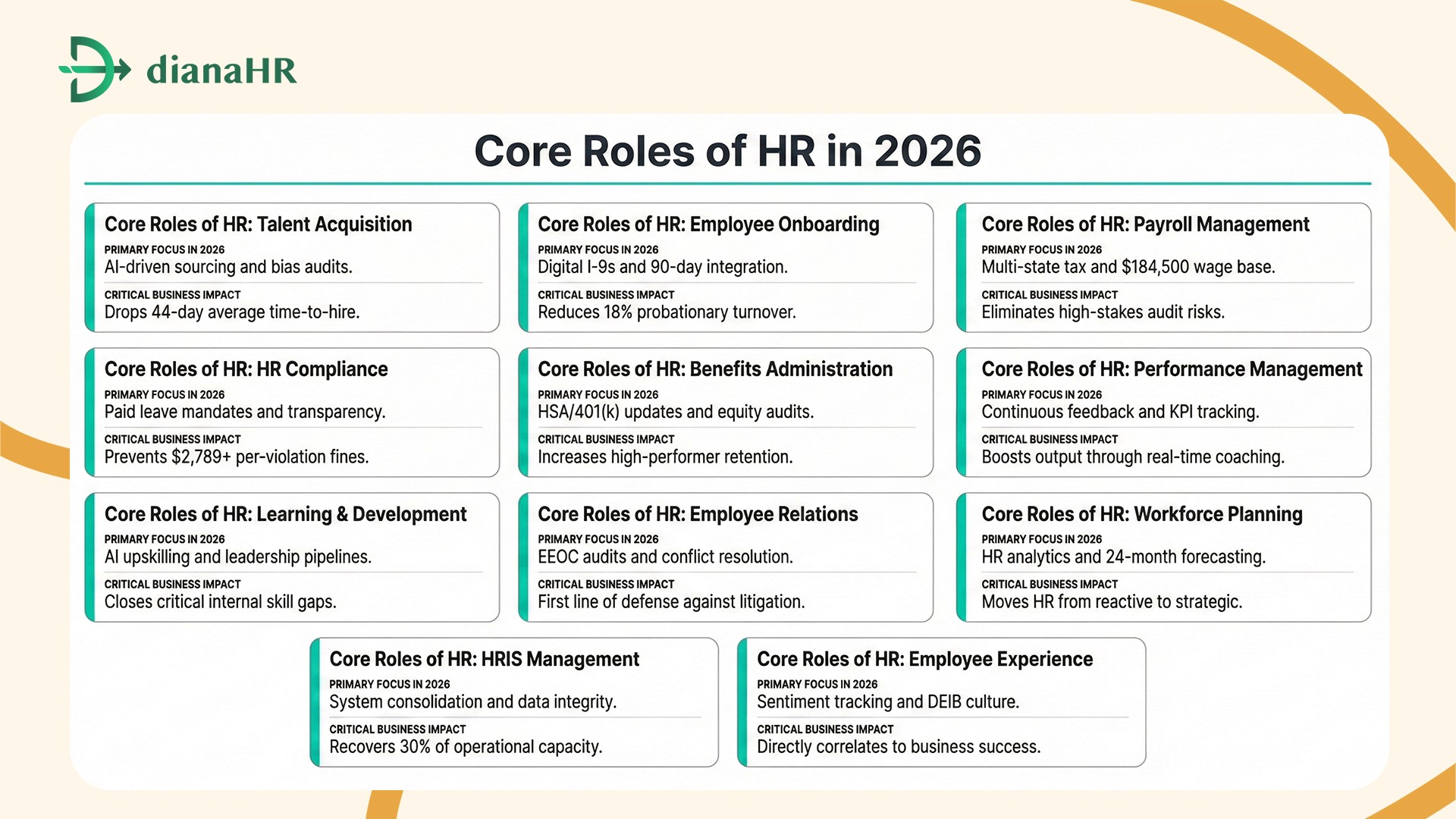
The 11 Core Roles of HR in 2026 At a Glance:
This table breaks down the essential human resources functions and the specific HR responsibilities required to maintain HR compliance and drive performance.
How DianaHR Covers the HR Responsibilities Most SMBs Struggle to Handle In-House
DianaHR simplifies the roles of HR for small businesses by combining automation with expert guidance. This platform reduces HR responsibilities costs by 60% and saves you 20 hours weekly. You can maintain HR compliance across 40 states while focusing on growth.
Compliance Automation: Manages taxes and benefits administration for multi-state payroll management.
Expert Support: Pairs you with a specialist to handle onboarding and policies.
Smart Integration: Works with tools like Gusto or ADP to streamline human resources functions.
Scalable Workflows: Automates repetitive tasks to simplify talent acquisition as you grow.
DianaHR transforms the roles of HR into a data-driven process that helps your business scale faster.
Explore how DianaHR simplifies the roles of HR and helps your business scale faster → DianaHR
Conclusion
Executing the roles of HR effectively in 2026 requires balancing constant legal shifts with high-stakes workforce planning. Most teams struggle with fragmented HR responsibilities, leading to missed HR compliance deadlines and payroll errors.
Ignoring these gaps triggers aggressive audits and massive fines that can cripple a growing business. Once you fall behind on human resources functions, employee trust erodes and attrition climbs.
DianaHR fixes this by consolidating your entire HR stack into one automated platform. It removes the risk of manual errors and ensures your business stays protected, allowing you to focus on your people rather than penalties.
Connect to a better way of managing your team by exploring how DianaHR handles your most complex roles of HR automatically.
FAQs
1. What are the key roles of HR in an organization in 2026?
The 11 core roles of HR in 2026 involve talent acquisition, onboarding, and payroll management. Modern HR responsibilities now include HR analytics, HRIS management, and workforce planning. These human resources functions ensure HR compliance while driving growth through learning and development.
2. What is the most important human resources function in 2026?
Maintaining HR compliance is the most vital among all human resources functions. With 17 states mandating paid leave, roles of HR must prioritize payroll management and benefits administration. Neglecting these HR responsibilities leads to massive legal fines and operational failure.
3. How have the roles of HR changed from 2024 to 2026?
Today’s roles of HR integrate AI into talent acquisition and performance management. Unlike 2024, human resources functions now focus on HRIS management and HR analytics to automate tasks. These updated HR responsibilities turn data into a strategic business advantage.
4. What HR responsibilities create the most legal risk for employers?
The highest-risk roles of HR include payroll management, I-9 verification, and HR compliance. Errors in benefits administration or multi-state tax tracking trigger heavy audits. Automating these human resources functions is necessary to protect your business from costly litigation.
5. How do HR responsibilities differ between small and large organizations?
Small firms often combine all roles of HR into one person, risking HR compliance gaps. Large companies use specialized teams for talent acquisition and HR analytics. Both benefit from HRIS management to streamline human resources functions and benefits administration.
6. Why is workforce planning now considered a core HR role?
Strategic workforce planning allows businesses to predict hiring needs using HR analytics. It is one of the roles of HR that prevents reactive hiring and reduces attrition. Owning these human resources functions ensures your team has the right skills.
7. What tools do HR teams need to manage all 11 key responsibilities in 2026?
Teams need a unified HRIS to handle payroll management, onboarding, and benefits administration. Using one platform for all roles of HR improves HR compliance and HR analytics. This consolidation simplifies human resources functions and saves dozens of hours weekly.
Share the Blog on: