Many business owners think outsourcing of payroll removes all legal risks. It doesn't. The IRS says you stay responsible for taxes and penalties even if you hire a payroll provider.
Alight’s 2024 report shows 53% of companies faced payroll penalties recently. About 51% still use spreadsheets for these tasks. This guide shows how outsourcing of payroll works. You will learn what your team keeps and how to maintain tax compliance and payroll accuracy.
We cover outsourced payroll services to help you avoid blind spots.
Outsourcing of payroll: what usually transfers to the provider
Moving tasks to a payroll provider helps you focus on growth rather than paperwork. While you keep the legal risk, the managed payroll model handles the daily grind. Most outsourced payroll services take over these specific operational duties.
1. Transaction processing and routine payroll execution
The core of outsourcing of payroll involves moving the pay cycle engine to an external partner. They handle gross-to-net calculations, check for variable pay like bonuses, and manage standard deductions for benefits.
Gross-to-net math: Automated systems calculate exactly what each person takes home after taxes.
Variable pay: Your partner processes commissions and reimbursements.
Off-cycle runs: Providers handle one-off payments for terminations or corrections.
For example, a 50-person company using payroll outsourcing for small business often saves 15 hours a month just by letting a vendor run these cycles and generate digital year-end forms.
2. Filing support and payment workflows
In 2026, outsourcing of payroll means your provider builds the "support" layer for government interactions. They prepare your tax forms and set up the payment files for bank transfers.
This includes managing statutory filings and keeping audit logs of every penny moved. Even though the provider does the work, remember that the legal duty to pay taxes stays with you.
3. Employee helpdesk and standard payroll reporting
Managing employee payroll queries is a major time sink for HR. Alight’s report shows 61% of payroll teams deal with constant questions about payslips or proof of income. Most outsourced payroll services solve this by offering an employee portal.
Your team gets access to:
Self-service stubs: Employees download their own payslips.
Income letters: Standardized forms for loans or housing.
Finance reports: Your leadership gets monthly data to track labor costs without digging through files.
Moving these tasks to a payroll provider improves payroll accuracy because it removes the risk of human error during manual data transfers.
While these administrative tasks move to your partner, you must remember that you cannot hand off the final legal bill.
Outsourcing of payroll does not transfer final accountability
Execution changes, but ownership stays with you. This part of outsourcing of payroll is the most misunderstood. The IRS sends account mail to your address, not the vendor's. If the payroll provider misses a task, your company pays the fine.
1. Tax liability, notices, and funding control stay with you
If a provider files late, the IRS penalizes your EIN. You must maintain tax compliance by checking the EFTPS. Verifying your own payments prevents payroll liabilities from piling up. You own the bank account, so you own the liability for every deposit.
2. Data approval, source inputs, and policy decisions stay with you
No vendor knows your internal policy. You must provide the source data for new hires, pay rates, and leave dates. Bad inputs cause errors that hurt payroll accuracy. You own the employee classification and final sign-off for every pay run.
3. Governance is the real line between smart outsourcing and risky outsourcing
"Payroll is an integral part of any business and can damage an organization’s reputation if something goes wrong," says Luca Saracino of Alight. You must set clear approval rules and bank cutoff ownership. Strong governance ensures payroll accuracy before the money leaves your account.
Payroll outsourcing for small business: where the handoff usually breaks
Small business teams often start outsourcing of payroll and assume the vendor owns the process. This assumption creates friction. Alight’s report shows that 24% of organizations operating in a single country still receive fines. Complexity is not just a multinational issue; it affects every payroll provider relationship.
1. Small business teams often outsource processing, not review
Founders often hand over the keys and stop looking. Even with outsourced payroll services, you need a final sign-off checklist. This list should cover:
Headcount Changes: Verifying new hires and terminations.
Cash Funding: Ensuring enough liquid capital for the pay run.
Benefit Deductions: Checking health insurance or retirement contributions.
Q1 payroll creates more room for mistakes due to bonus payouts and annual tax resets. Without your review, payroll accuracy suffers.
2. Cost savings disappear when exception handling is high
The real payroll outsourcing cost includes your time spent fixing inputs. If your finance lead spends hours re-running payroll or replying to employee payroll queries, your savings vanish. Compare vendor pricing against the internal hours lost to manual corrections:
Input Errors: Fixing incorrect hours or missing tax codes.
Re-runs: Paying fees for off-cycle corrections.
Communication Gaps: Endless email chains with the provider.
3. Employee trust drops fast when payroll accuracy slips
About 64% have experienced disruption from a payroll error. Managed payroll must be perfect to keep your team focused. Accuracy is a retention tool, not just a finance metric.
Payroll Outsourcing Handoff: Risk vs. Reality
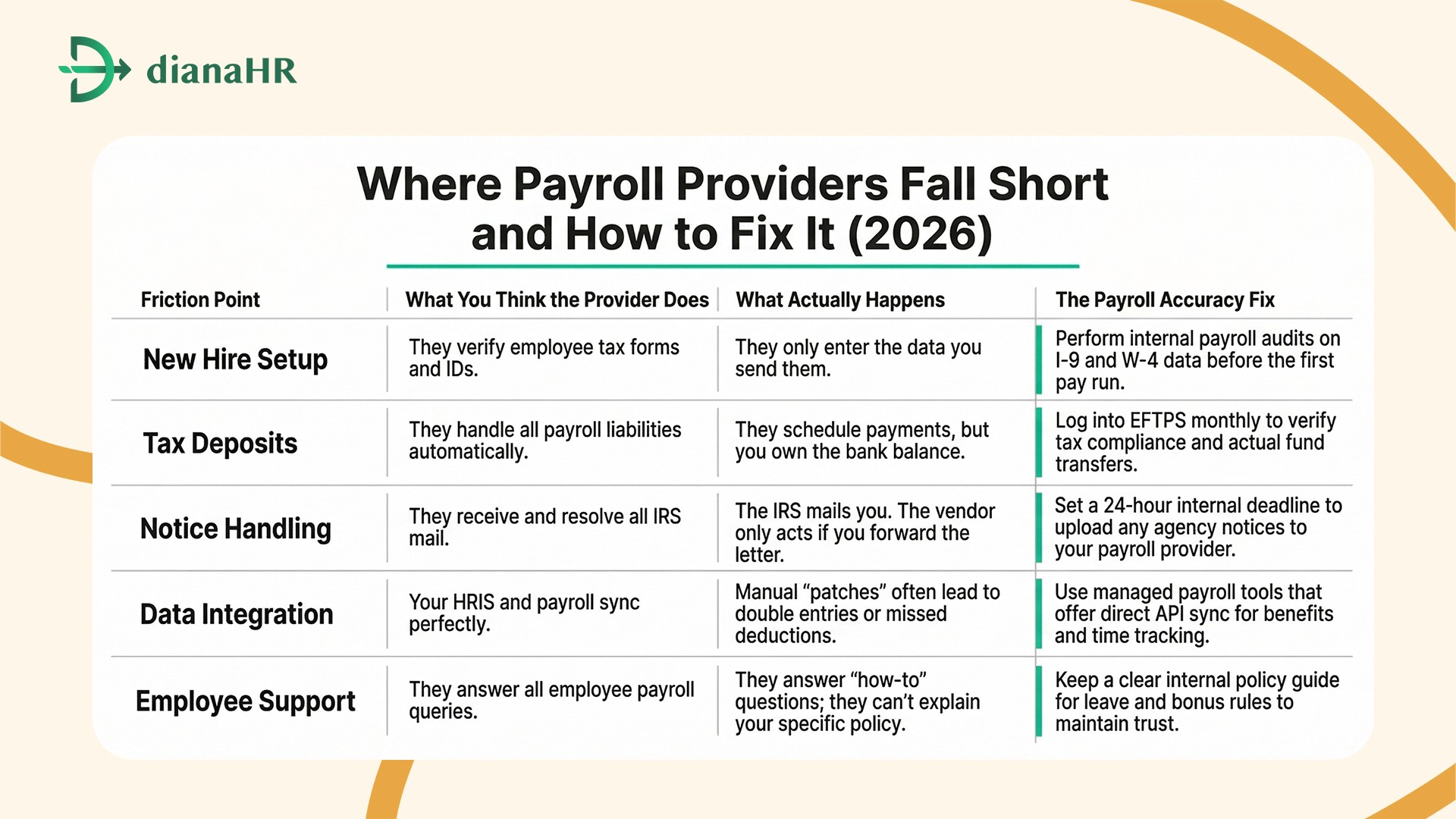
When the handoff breaks, your reputation as an employer takes the hit.
How to Choose Outsourced Payroll Services Without Creating a Compliance Gap
Choosing outsourced payroll services in 2026 requires looking at data controls, not just price tags. ADP reports that 58% of firms want AI for efficiency, yet only 41% integrate payroll with finance.
You need a payroll provider that offers visible proof of work. Effective outsourcing of payroll requires a system where you see the math before the money moves.
1. Ask what the provider does, then ask what you must still prove.
Do not just sign a service contract. You must build a responsibility matrix for your outsourcing of payroll so you know exactly where your team steps in. If you cannot prove a task was finished, you remain liable for the mistake. Use this checklist to verify ownership:
The Provider Processes: They run the gross-to-net math. You Prove Accuracy: Compare the final payroll register against your original attendance sheets before any funds move.
The Provider Files: They submit tax forms to agencies. You Prove Tax Compliance: Log into the Electronic Federal Tax Payment System (EFTPS) to confirm your payroll liabilities actually reached the IRS on time.
The Provider Issues Payments: They generate the ACH files. You Prove Funding: You authorize the bank transfer from your business account and confirm the final balance.
The Provider Manages Notices: They receive regulator letters. You Prove Resolution: Track the status of every tax notice to ensure it doesn't turn into a lien.
2. Review integration quality before pricing
Your outsourced payroll services must connect directly to your HRIS, attendance, and accounting software. If you manually move data between systems, you risk payroll accuracy.
3. Put audit rights and escalation timing in the contract.
Your agreement for outsourcing of payroll must include the following:
Correction Windows: Set a 24-hour limit for fixing employee payroll queries.
Security Logs: Request access to payroll audits of their data encryption and access logs.
Notice Handling: Set a strict deadline for the vendor to respond to IRS letters, especially during the Q1 payroll crunch.
The right model uses technology to prove
How DianaHR Helps You Outsource Payroll Without Losing Control.
DianaHR acts as the essential governance layer between your team and your payroll provider. We ensure outsourcing of payroll doesn't lead to compliance gaps.
Our AI-powered platform simplifies outsourced payroll services for small and mid-sized businesses, reducing HR costs by up to 60%.
AI-Driven Compliance: Automates statutory filings, taxes, and registrations across 40+ states to ensure tax compliance.
Expert Guidance: Every client gets a dedicated specialist to manage payroll audits and policy decisions.
Seamless Integrations: Works with tools like Gusto and ADP to maintain payroll accuracy without manual data entry.
Smart Automation: Saves 15–20 hours per week by handling employee payroll queries and repetitive outsourcing of payroll tasks.
DianaHR helps you decide what the vendor processes and what you validate.
Explore how DianaHR simplifies the outsourcing of payroll and helps your business scale faster.
Conclusion
Outsourcing of payroll requires more than just hiring a payroll provider. Many teams face payroll accuracy issues and missed statutory filings because they assume the vendor owns the risk.
These errors lead to IRS audits, heavy penalties, and broken employee trust. If your tax compliance slips, you face the legal fallout alone.
DianaHR acts as your oversight layer, managing employee payroll queries and payroll audits to stop mistakes before they happen. We help you maintain control over outsourced payroll services without the manual burden.
Connect to a dedicated HR specialist to see how we maintain payroll accuracy for your team.
FAQs
1. If I outsource payroll, am I still liable for payroll taxes?
Yes. Even with a payroll provider, the IRS holds you responsible for payroll liabilities and tax compliance. If outsourced payroll services miss a deadline, your business pays the penalties. You must verify all statutory filings to avoid costly legal risks.
2. What does a payroll provider usually handle for a small business?
A provider manages the routine outsourcing of payroll work, including gross-to-net math and payroll accuracy checks. They handle payslips and statutory filings, but you still own the final data approval and responses to employee payroll queries regarding their pay.
3. Is payroll outsourcing for small businesses worth it in 2026?
The payroll outsourcing cost is worth it for teams saving 15+ hours on admin. However, payroll outsourcing for small businesses only succeeds if you maintain oversight. You need a model that combines managed payroll efficiency with your own internal data review.
4. What should stay in-house when using outsourced payroll services?
Keep salary approvals, employee classification, and payroll audits of source data in-house. These control points ensure payroll accuracy. Never hand over the final verification of tax deposits, as you remain legally accountable for all payroll liabilities and tax compliance issues.
5. How do I check if my payroll outsourcing setup is risky?
Review who receives IRS notices and who confirms tax bank transfers. If you lack a direct login to verify tax compliance, your setup is risky. High volumes of employee payroll queries often signal a breakdown in your outsourcing of payroll workflow.
6. What is the biggest mistake companies make with outsourcing payroll?
The biggest error is assuming accountability transfers with the work. Many firms stop performing payroll audits on their payroll provider, leading to compounding errors. Outsourced payroll services require constant oversight to ensure payroll accuracy and timely payment of payroll liabilities.
Share the Blog on: