The HR outsourcing market hit $31.2 billion in 2024 and experts project it to reach $56.4 billion by 2034. North America accounts for 37% of that revenue. About 93% of organizations report satisfaction with their human resource management results.
Yet, one choice trips up most owners. Pick between managed HR services and outsourced HR services. Confusion leads to vendor errors and messy HR administrative tasks.
By 2026, 87% of leaders use AI through HR outsourcing solutions to scale. This guide explains how managed HR services work. It helps you find the right HR service provider.
Managed HR Services vs Outsourced HR Services (What the Difference Actually Means)
Picking the right support model changes how your business operates every day. While people use the terms interchangeably, managed HR services and outsourced HR services solve different problems.
Understanding these nuances helps you avoid paying for features you don't use or missing HR compliance support you desperately need. Both models improve workforce management, but the level of involvement and ownership varies.
1. What Managed HR Services Cover and How They Work
Managed HR services function as your entire human resources department. An external HR service provider takes over the full lifecycle of your team. This includes payroll outsourcing, managing benefits administration, and handling complex HR administrative tasks.
Proactive Partnership: The provider doesn't just wait for your call. They actively monitor law changes to provide HR compliance support.
Predictable Pricing: You usually pay a flat monthly fee that covers all human resource management needs.
Technology Access: Most managed HR services come with a single software platform for all employee records.
This model works best for companies that lack an internal team and need a "hands-off" solution for workforce management.
2. What Outsourced HR Services Mean in Practice
Outsourced HR services involve hiring help for specific, individual tasks. You might keep your HR director but use HR outsourcing solutions for high-volume work like payroll outsourcing or recruiting.
Task-Specific: You choose exactly what to offload, such as employee onboarding support or workers' comp.
Modular Cost: Pricing often depends on the specific project or the number of employees using a single service.
Retained Control: Your leadership still makes the big decisions while the vendor handles the execution.
Common examples include using PEO services or contracting a firm solely for benefits administration. This fits businesses that already have some internal structure but need to fill specific gaps.
3. The Decision Framework: Which Model Fits Which Business
Deciding between these HR outsourcing solutions depends on your current setup.
Zero Infrastructure: If you have no HR staff, managed HR services give you a professional department overnight.
Internal Leadership: If you have an HR manager who is buried in paperwork, targeted outsourced HR services can free up their time for strategy.
Rapid Scaling: For companies growing across state lines, a co-employment model or comprehensive managed HR services ensure you stay legal everywhere.
Whether you need a full department or just help with HR administrative tasks, the right choice streamlines your growth. Next, we will break down exactly what these different models cost so you can budget effectively.
What You Actually Pay For: Cost Breakdown of Managed HR Services vs HR Outsourcing Solutions
Understanding your bill reveals the true value of your investment. Managed HR services often save money by grouping software and labor into one price. This prevents the "subscription creep" common with messy tool stacks.
1. How Managed HR Services Are Priced in 2026
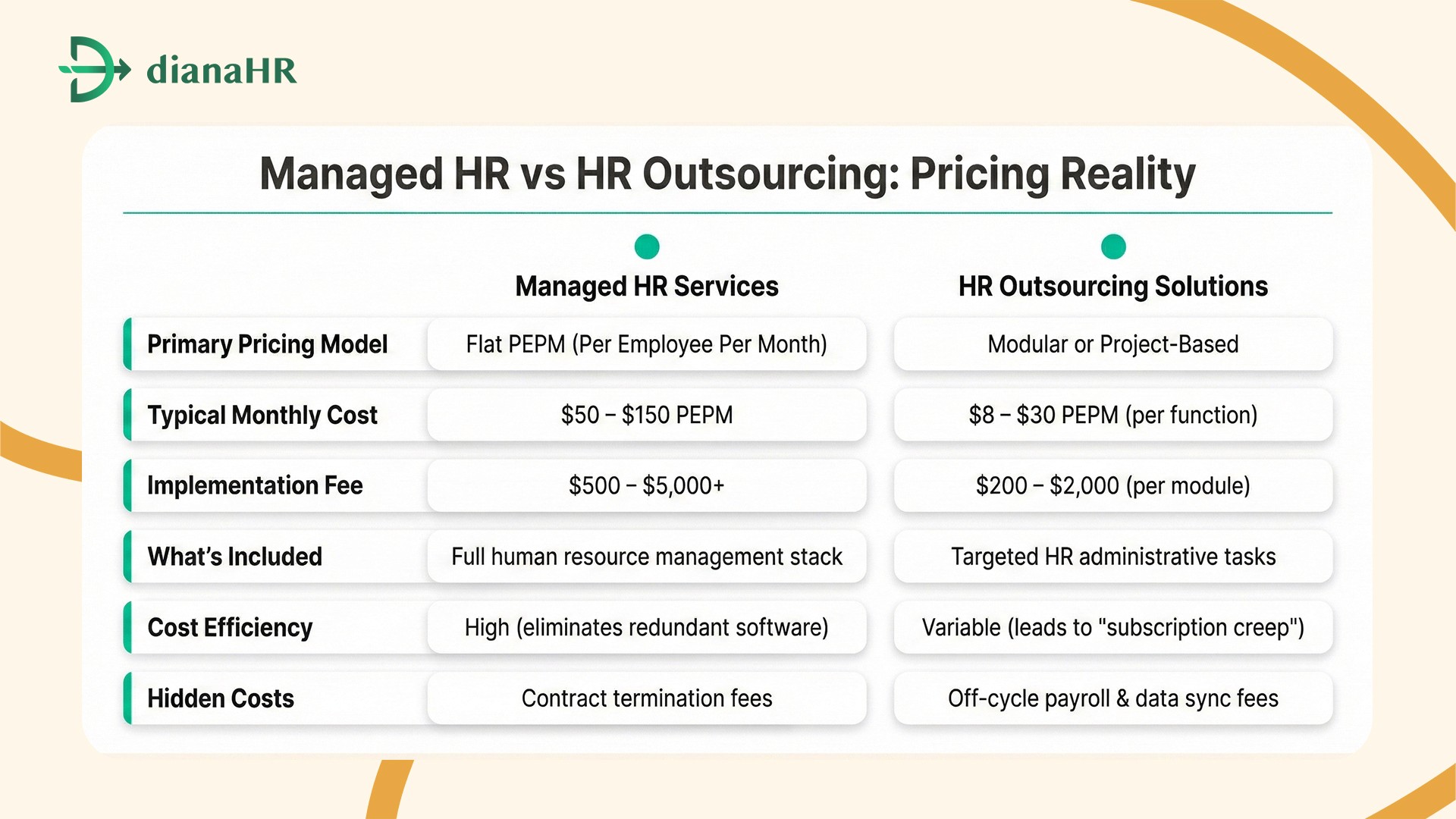
Most managed HR services use a per-employee-per-month (PEPM) model. You pay between $50 and $150 per person. If you choose PEO services via a co-employment model, expect $100 to $160 PEPM.
This fee covers payroll outsourcing and benefits administration. You get one invoice and one point of contact, which keeps your budget simple.
2. How HR Outsourcing Solutions Are Priced in 2026
Rates for outsourced HR services vary by task. Basic payroll outsourcing starts at $8 to $18 PEPM. Adding benefits administration costs an extra $20 to $50. Many businesses pick these HR outsourcing solutions to fix specific gaps without a full contract.
3. The Hidden Costs Neither Pricing Model Advertises
Setup fees often range from $500 to $5,000 to move your data. Some outsourced HR services charge for "off-cycle" payroll or bonuses. Always check if your managed HR services contract covers HR administrative tasks like compliance indemnity.
What You Actually Pay For: Cost Breakdown (Quick Glance)
Choosing a model starts with the price. Now, see which companies lead the market.
Top 5 HR Service Providers in 2026 (Updated List)
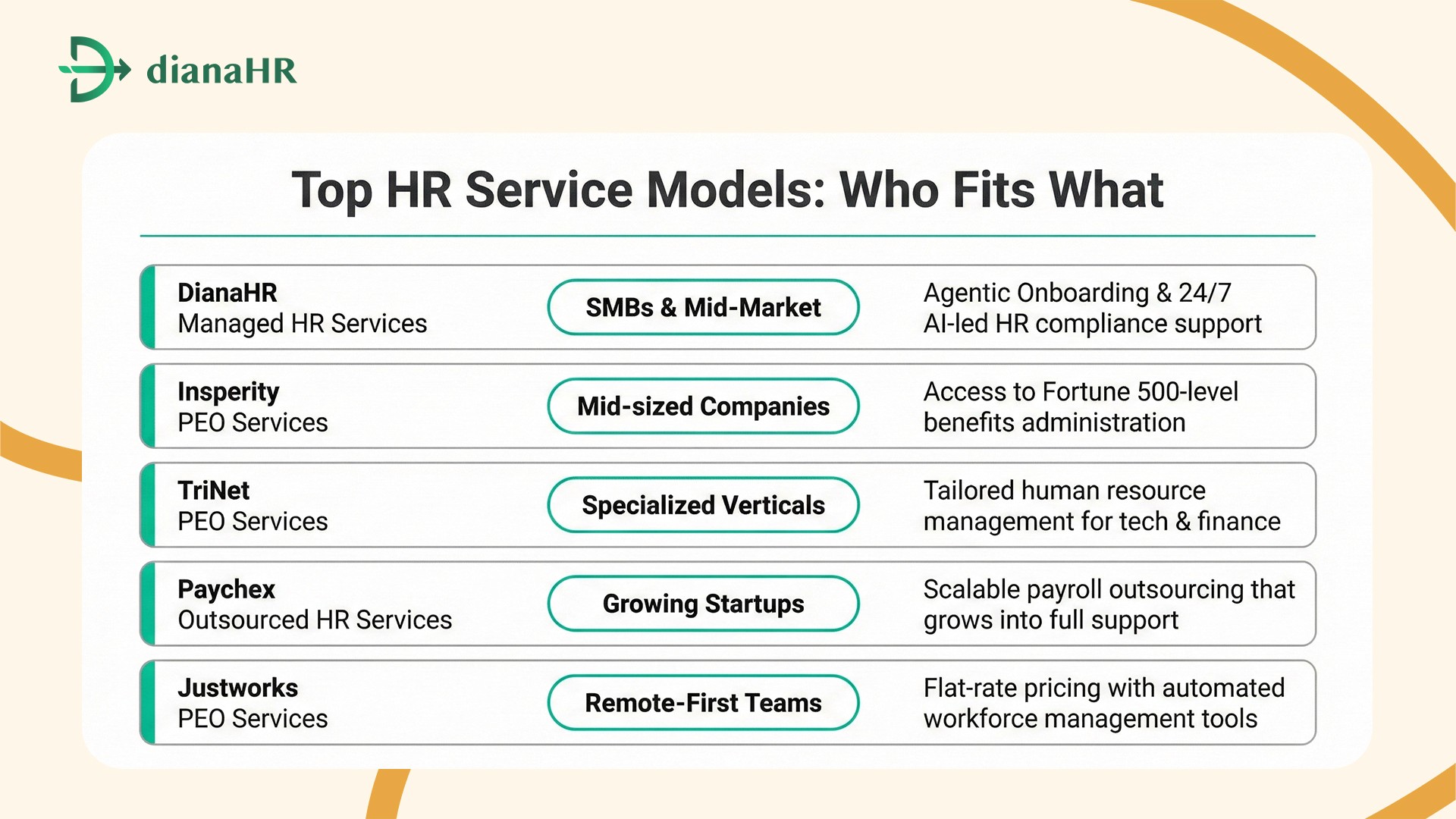
Selecting a partner helps you reclaim time and fix workforce management issues. These top firms excel in providing managed HR services and specialized HR outsourcing solutions to keep your company compliant and efficient.
Top 5 HR Service Providers in 2026 (Quick Glance)
1. DianaHR
Overview: DianaHR leads the market by providing managed HR services that integrate directly with your existing tools. This HR service provider uses human-led AI to handle complex HR administrative tasks and human resource management without extra software.
Key Features:
Automated payroll outsourcing with real-time anomaly detection.
Proactive HR compliance support tailored to multi-state labor laws.
Streamlined employee onboarding support via Slack and email integrations.
USP: Their unique model saves owners 15 hours per week on admin by managing human resource management within your current tech stack.
Services Offered: Payroll, Compliance, Benefits Administration, Onboarding, Policy Management, Employee Records.
Clients Review: ⭐⭐⭐⭐⭐ (5/5 stars)
2. Insperity
Overview: Insperity delivers a premium co-employment model through its PEO services. This HR service provider helps small businesses access enterprise-level benefits and robust human resource management tools to protect and scale their growing workforces in 2026.
Key Features:
Access to Fortune 500-level benefits administration and insurance rates via the HR360 platform.
Dedicated specialists for workforce management, safety compliance, and employee relations.
Integrated Workday technology through their new HRScale solution for mid-market accounts.
USP: Their clients historically receive higher-than-average support during crises, such as obtaining 3x the national average in financial aid payouts due to superior HR compliance support.
Services Offered: Payroll, Benefits Administration, Workers' Comp, Compliance, Performance Management, Training, HRScale.
Clients Review: ⭐⭐⭐⭐ (4.4/5 stars)
3. TriNet
Overview: TriNet provides specialized managed HR services through a vertical-specific co-employment model. This HR service provider tailors its technology and expert support to meet the unique regulatory demands of finance, tech, and nonprofit sectors.
Key Features:
Industry-specific HR teams that offer deep expertise in your particular business field.
An integrated Applicant Tracking System (ATS) that streamlines employee onboarding support.
"Three-click payroll" technology that syncs data across benefits administration and tax filings automatically.
USP: They are one of the few IRS-certified PEO services offering vertical-tailored consultants who manage high-stakes human resource management for complex industries.
Services Offered: Payroll, Benefits, Risk Management, Compliance, Performance Management, Applicant Tracking, Onboarding.
Clients Review: ⭐⭐⭐⭐ (4.1/5 stars)
4. Paychex
Overview: Paychex is a versatile HR service provider that excels at providing managed HR services. They offer a clear path from simple payroll outsourcing to complex HR outsourcing solutions for growing companies needing professional support.
Key Features:
Proactive HR compliance support with real-time legal alerts for multi-state employers.
Mobile-first employee onboarding support through the highly-rated Paychex Flex application.
Expert benefits administration to help you scale your managed HR services effectively across different locations.
USP: They serve over 800,000 businesses, utilizing AI-assisted tools to automate routine HR administrative tasks and significantly improve data accuracy.
Services Offered: Payroll Processing, Tax Administration, Benefits Administration, PEO Services, Workers’ Comp, Recruiting, Employee Performance.
Clients Review: ⭐⭐⭐⭐ (4.1/5 stars)
5. Justworks
Overview: Startups often choose this HR service provider because it removes the friction of human resource management. By bundling tech with a co-employment model, it creates a seamless environment for growth-minded entrepreneurs.
Key Features:
Automated state tax filings and payroll outsourcing across all 50 tax localities.
Mobile-centric employee onboarding support with self-service tools for health plan enrollment.
Integrated 24/7 HR compliance support through a sleek, modern dashboard that employees actually enjoy.
USP: Justworks processed over $31 billion in payroll in 2025 and supports 4,000+ tax localities, ensuring absolute accuracy for remote-first teams.
Services Offered: Payroll, Benefits Administration, PEO Services, Compliance, 401(k) Plans, International EOR, Workers' Comp, HR Consulting.
Clients Review: ⭐⭐⭐⭐ (4.6/5 stars)
Conclusion
Choosing between managed HR services and outsourced HR services defines your company’s trajectory. One offers a complete workforce management overhaul, while the other fixes specific gaps. Ignoring this distinction invites chaos.
Fragmented HR outsourcing solutions lead to "tech bloat," where payroll and benefits never sync. Picking the wrong model causes compliance disasters and legal fines that bankrupt small firms overnight.
Don't let your business become a statistic. DianaHR provides the ultimate human resource management fix by running your operations inside your current tools. It's the only way to ensure HR administrative tasks never stall your growth.
Lets connect with DianaHR and book your free cost and compliance assessment today.
Frequently Asked Questions
1. What is the main difference between managed HR services and outsourced HR services?
Managed HR services provide a complete, ongoing human resource management function. An HR service provider handles everything from payroll outsourcing to benefits administration. In contrast, outsourced HR services target specific HR administrative tasks, like recruitment, while you keep other functions in-house.
2. How much do managed HR services cost for a small business in 2026?
Most managed HR services cost $50 to $160 per employee monthly. PEO services using a co-employment model sit at the higher end but include better insurance. These HR outsourcing solutions typically reduce workforce management costs by 20% compared to in-house teams.
3. What HR functions are most commonly outsourced in 2026?
Payroll outsourcing remains the top choice, followed by benefits administration and employee onboarding support. Many firms now consolidate these into managed HR services to ensure better HR compliance support and avoid the "app bloat" caused by using too many separate vendors.
4. What is a PEO, and is it the same as managed HR services?
A PEO is a specific co-employment model where the HR service provider shares tax liability. While all PEOs offer managed HR services, not all HR outsourcing solutions require co-employment. Some providers offer full human resource management while you maintain total employer control.
5. How do I know if my business needs managed HR services or just payroll outsourcing?
If you only struggle with taxes, payroll outsourcing works. However, if HR administrative tasks, workforce management, and multi-state HR compliance support consume over ten hours weekly, you need managed HR services. This shift allows you to focus on growth instead of paperwork.
Share the Blog on: