
Growth often shows up first as stress on hiring, payroll, and performance questions. Many founders push through until it becomes clear they need a fractional HR director to take control of real HR work.
Full-time leadership can cost more than two hundred thousand dollars a year, so contract HR director services give you a practical option. A fractional HR director gives structure to people's decisions, compliance audit needs, and hiring priorities.
Companies that use a fractional HR director report major savings and faster implementation of HR tech stack optimization. You get strategic workforce planning without building an entire department. A platform like DianaHR supports this leadership model with automated compliance, policy templates, and employee data tracking so you don’t lose time on routine tasks.
The goal of this guide is to help you understand responsibilities, hiring models, and realistic costs.
Key Responsibilities of a Fractional HR Director
A fractional HR director handles strategic HR work each month, not paperwork. The list below shows common contract HR director services used by growing companies and what each one delivers.
1. Build a 12-month HR strategy aligned with revenue milestones.
A fractional HR director sets a yearly plan that links hiring, compensation strategy, performance systems, and compliance audit work with real revenue goals. This gives leaders direction instead of reacting to problems.
With contract HR director services, you get structure and clear timelines supported by strategic workforce planning.
Key steps:
Set quarterly hiring targets.
Create compensation bands.
Schedule performance reviews.
Plan HR tech stack optimization tasks.
Example: If you need three sales hires by Q2, the plan lists dates, onboarding steps, and manager coaching.
Outcome: One written roadmap that reduces delays and keeps everyone aligned.
2. Conduct compliance and risk assessments.
A fractional HR director checks every part of HR for gaps that can cause penalties or employee issues. They look at contracts, timekeeping, payroll classifications, privacy rules, harassment policies, and state requirements for remote workers.
This isn’t guesswork. The fractional HR director sets clear audit dates and uses contract HR director services to fix errors fast.
Checklist items:
Review employee files
Check policy wording
Verify classification status
Update training records
Example: A startup with mixed contractor and full-time staff learns several roles need reclassification before a complaint hits.
Outcome: Fewer surprises and cleaner HR records that hold up under review.
3. Create compensation bands and pay structures.
A fractional HR director studies market salaries and organizes pay levels so people with similar skills earn fair amounts. This solves random raises and makes hiring offers clear.
The fractional HR director uses salary data, job leveling, and skill matrices to build ranges tied to performance and growth. You get contract HR director services for documentation and internal communication, so no manager guesses.
Work involved:
Collect salary benchmarks
Define role levels
Add bonus criteria
Set review dates
Example: Sales teams get four levels with target earnings and promotion rules.
Outcome: Fair pay decisions that reduce turnover and support trust.
4. Implement performance feedback systems.
A fractional HR director sets rules for how feedback works across the company. They choose a schedule, a scoring model, and a process that supports growth instead of annual surprises.
The fractional HR director reviews current performance notes, meets with managers, and creates one method for coaching, goal tracking, and promotion decisions. With contract HR director services, the system stays simple and fair.
What they build:
Short check-ins
Clear goals tied to roles
Written review forms
Manager guidelines
Example: A team switches from yearly reviews to 30-minute monthly talks. Problems get solved early, not after a year of quiet frustration.
Outcome: People know where they stand and what to fix next.
5. Define hiring goals and employer branding.
A fractional HR director sets hiring targets based on actual needs, not guesswork. They study open roles, turnover data, skill gaps, and projected revenue. Then they create a hiring calendar with priority roles and realistic timelines.
The fractional HR director also shapes employer branding by writing role profiles, career page content, and interview guidelines. With contract HR director services, you get clearer messaging for job ads and talent acquisition roadmap planning.
What this covers:
Headcount forecasts
Interview scorecards
Job post language
Candidate experience rules
Example: If the company needs five engineers next quarter, the plan lists sourcing steps, interview stages, and what story to share about company culture.
Outcome: More qualified candidates and shorter time-to-hire.
6. Manage sensitive employee issues and investigations.
A fractional HR director handles issues that need privacy and documented steps. They manage conflict, harassment claims, retaliation concerns, and pay disputes. The fractional HR director checks policy language and past records and gathers separate statements.
They base decisions on facts and legal rules. With contract HR director services, each investigation stays organized from initial report to final action.
Practical actions:
Confirm what was reported and when
Document every conversation
Check policy fit before deciding
Provide a written summary for leaders
Outcome: Fewer messy disputes and controlled employee relations management, with decisions that stand up to review.
7. Recommend organizational changes as teams scale.
A fractional HR director studies how teams work and makes adjustments that remove confusion. They check reporting lines, decision flow, meeting structure, and manager workload. This stops growth from creating bottlenecks.
What they fix:
Misplaced reporting relationships
Too many direct reports for one leader
Job titles that don’t match duties
Unclear ownership of shared tasks
Example: A product manager has ten people reporting to them. A fractional HR director splits the group into two squads, assigns a team lead for each, and updates job descriptions to show who approves decisions.
Outcome: Faster decisions, fewer escalations, and a structure that supports growth instead of slowing it down.
8. Coach managers and executives
A fractional HR director trains leaders to handle real management issues with clarity. They review common team problems, communication gaps, and performance habits. The fractional HR director sets one-on-one coaching sessions and group workshops based on actual cases.
With contract HR director services, leaders get guidance on executive coaching, feedback methods, and change management steps they can apply the same day.
What they teach:
How to give direct feedback
How to run short check-in meetings
How to document decisions
How to handle conflict early
Example: A manager avoids tough conversations. A fractional HR director gives a script for the next meeting and joins a follow-up call to review results.
Outcome: More confident leaders who solve issues before they spread.
9. Select and roll out HR technology tools.
The goal is simple: stop using spreadsheets and scattered apps. A fractional HR director lists all current HR tasks, then picks tools that replace manual work. They look at HRIS systems for employee data, ATS platforms for hiring, and performance software for review cycles.
With contract HR director services, you get HR tech stack optimization without vendor hype or long demos.
Steps they run:
Map every HR task
Test two or three tools
Check integration with payroll
Build a simple rollout schedule
Example: A company using five different apps switches to one system with onboarding forms, time-off tracking, and review templates.
Outcome: Less admin work and faster access to clean HR records.
Quick Overview: 9 Core Responsibilities of a Fractional HR Director
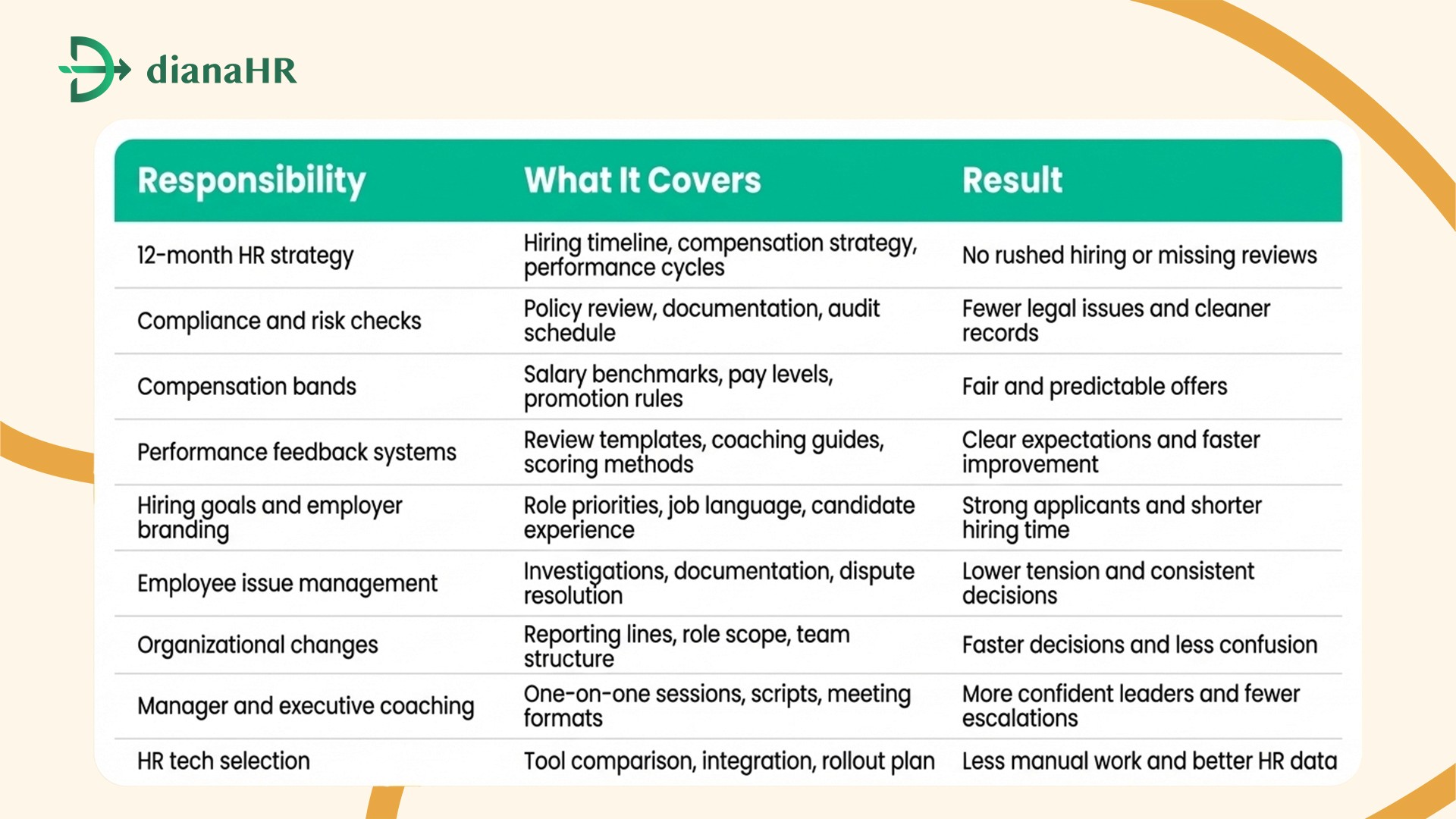
How DianaHR Delivers Fractional HR Director Support
DianaHR is an AI-powered HR-as-a-Service platform built to simplify fractional HR director support for small and mid-sized businesses in technology, healthcare, nonprofits, retail, and professional services.
By combining automation with expert HR guidance, DianaHR helps reduce HR costs by up to 60 percent and save 15 to 20 hours each week. It removes manual tasks, supports policy updates, maintains compliance, and keeps documents organized across 40-plus states.
Our Special Features:
AI-driven compliance management: Automates payroll taxes, benefits, and registrations across multi-state operations handled by a fractional HR director.
Human expertise with real support: Each client works with a dedicated HR specialist who manages onboarding, policies, documentation, and people operations tied to contract HR director services.
Seamless integrations: Works with Gusto, ADP, Rippling, and other systems. No switching tools or starting from scratch.
Smart task automation: Cuts repetitive HR work and improves tracking on daily items managed by a fractional HR director.
Scalable people operations: Designed for startups and SMBs adding staff across different locations, with consistent workflows and policy enforcement.
This support model keeps HR tasks moving without slowing leadership, which sets up clear cost and ROI comparisons. See how DianaHR handles HR work so you can stay focused on growth. → DianaHR
Cost and ROI Snapshot
A fractional HR director helps companies control spending and still get expert leadership. The numbers below show how full-time costs compare with contract HR director services in a simple format.
1. Full-Time HR Director Costs
Hiring a full-time leader often means paying for salary, benefits, payroll taxes, and software. Total spend rises fast and adds long-term commitments.
2. Fractional HR Director Costs
A fractional HR director offers strategic support without full-time expense. With contract HR director services, companies get documented guidance and compliance support at a lower rate.
Quick Cost at a Glance:
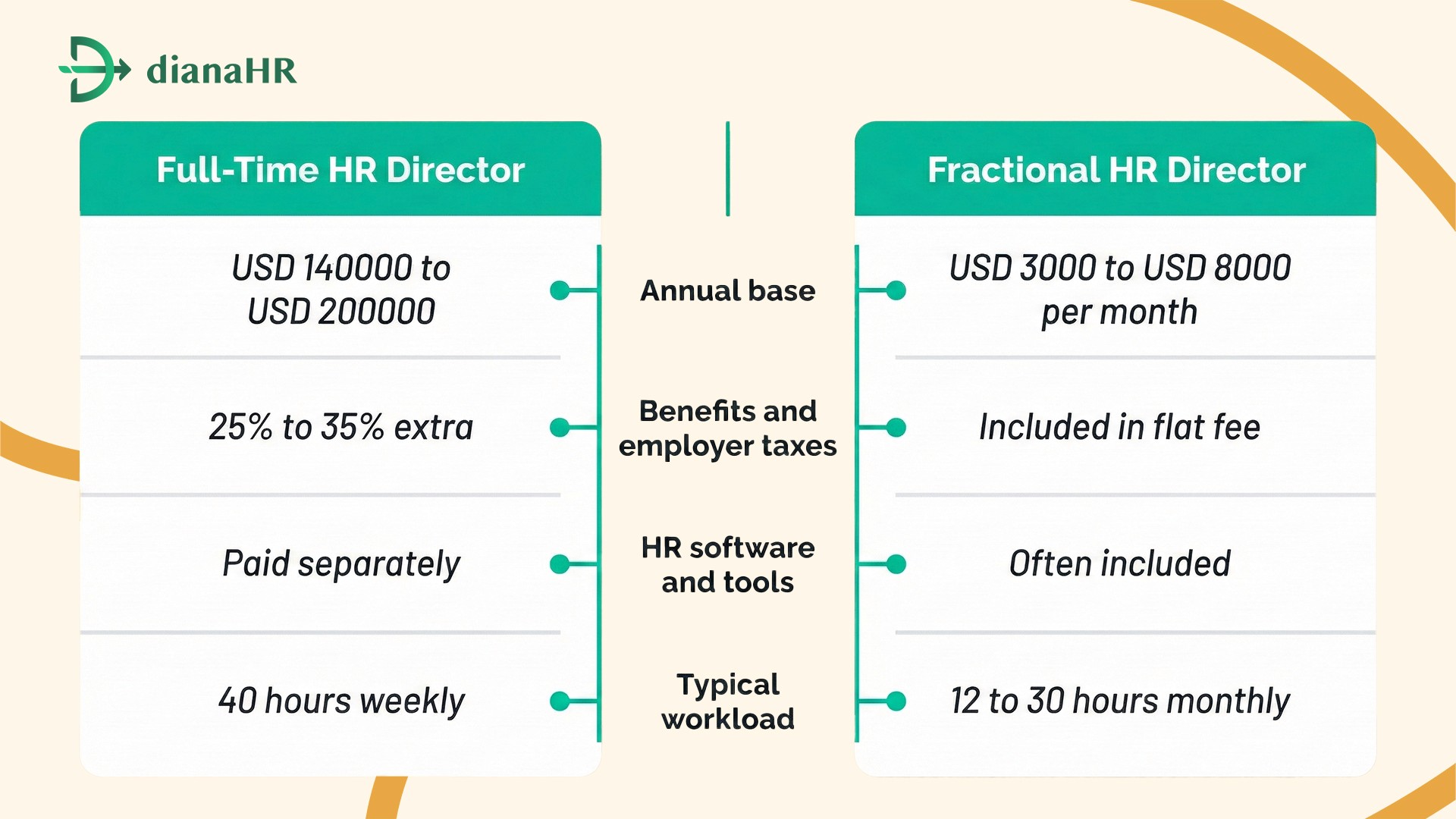
Example Cost Calculation:
A USD 180000 salary plus 30 percent in benefits comes to USD 234000 yearly. A fractional HR director at USD 6000 monthly totals USD 72000 yearly. That difference leaves room for recruiting, training, or HR tech stack optimization tools.
Conclusion
A fractional HR director fixes hiring delays, pay confusion, compliance risk, and weak performance systems. Responsibilities and hiring models vary, and the wrong setup causes turnover, payroll errors, policy gaps, and expensive investigations.
Some companies try freelancers or internal admins and then face missing documents, late registrations, and lost candidates. Those mistakes cost money and reputation.
DianaHR gives you structured support backed by automation, documented workflows, and expert guidance. You get monthly plans, tracked deadlines, compliance alerts, and clear ownership on every task so HR doesn’t fall through the cracks.
Start a conversation with DianaHR and see how simple HR leadership can be.
FAQs
1. How much does a fractional HR director cost?
A fractional HR director usually costs USD 3000 to USD 8000 per month. Full-time HR directors often exceed USD 200000 yearly. Contract HR director services give predictable spending, documented goals, and compliance audit support. This keeps budgets clean and still delivers strategic workforce planning and compensation strategy oversight.
2. What’s the difference between a consultant and a fractional HR director?
A consultant gives advice, but a fractional HR director manages real outcomes. They set hiring targets, review policies, handle employee relations management, and guide organizational design changes. Contract HR director services include weekly support, written plans, and accountability. You don’t get that with one-off consulting calls.
3. What team size works best for fractional HR leadership?
Most companies with between 10 and 150 employees benefit from a fractional HR director. At this stage, hiring ramps up, policy issues grow, and compliance audit risk increases. Contract HR director services provide structure before turnover or documentation errors cause long delays and extra cost.
4. How long does onboarding take?
Onboarding a fractional HR director usually takes two to three weeks. They review contracts, handbook language, current HR tech, and performance notes. Then they create a 90-day plan for strategic workforce planning and policy updates. Contract HR director services keep deadlines and deliverables on a written schedule.
5. Is this strategy or admin work?
It’s strategic. A fractional HR director focuses on compensation strategy, hiring goals, and culture development. Software handles onboarding forms and reminders. With contract HR director services, leaders see clean workflows and documented tasks while the director manages long-term planning and risk reduction.
Share the Blog on: