Small businesses face tough rules in 2026. Regulators are cracking down on labor law more than ever. The government recently collected millions in back pay due to common wage and hour violations.
Most small business labor violations happen because of simple oversights. Still, failing at employment law compliance leads to massive lawsuits. This guide highlights eight major labor law errors that drain your bank account. Protect your hard work from employment practices liability now.
1. Stop Misclassifying Employees as Independent Contractors
Hiring a freelancer seems easier than adding someone to the payroll. You skip the taxes and health insurance costs. However, the government sees this differently in 2026.
If you treat a worker like an employee but pay them like a contractor, you are asking for a federal audit. This mistake ruins employment law compliance and triggers costly labor law investigations. You must follow labor law to avoid big fines.
A) The High Price of Misclassification
Financial penalties hit hard and fast. Last year, the Department of Labor recovered over $259 million in back wages. In states like California, a single employee misclassification error leads to civil penalties reaching $25,000 per worker.
Constant small business labor violations related to contractor classification often lead to business closure. Ignoring labor law leads to ruin.
B) Applying the Economic Reality Test
To maintain employment law compliance, you must check the actual relationship, not just the contract. The 2026 labor law standard focuses on these points:
Control: Do you dictate exactly when and how they work?
Equipment: Do you provide their laptop, software, or workspace?
Exclusivity: Does the worker only serve your business?
Permanency: Is the job ongoing rather than project-based?
If you answered "yes" to these, you likely have an employee. Proper contractor classification requires the worker to operate as a separate business entity to avoid small business labor violations. Managing your employment law compliance starts with getting these labels right.
Getting your staff categories right is only half the battle; you also have to ensure the paychecks themselves meet strict federal rules.
2. Pay Overtime and Minimum Wage Correctly
Paying your team correctly sounds simple, but payroll math often leads to trouble. Failing to track hours or miscalculating rates creates massive labor law liability for your business. You must stay on top of your employment law compliance to avoid being the next target of a federal audit.
A) Common Wage and Hour Violations
Most wage and hour violations occur when owners assume a "Manager" title automatically removes the need for extra pay. It doesn't. To qualify for FLSA compliance, an employee must meet specific salary levels and perform actual leadership duties. Even if they are salaried, you might still owe them for extra time worked if they don't pass the duties test.
B) Calculating the True Overtime Rate
Many owners think overtime pay requirements only apply to the base hourly wage. That is wrong. You must include performance bonuses and commissions when you calculate the rate.
If you leave these out, you are committing wage and hour violations every single pay period. Keeping accurate labor law records prevents these expensive mistakes. Following labor law keeps your business safe.
Getting the math right protects your cash flow, but you also need the paperwork to prove it.
3. Fix Your Incomplete Employee Records
If a worker files a claim, the burden of proof falls on you. Without clear proof of hours and pay, you have no defense against a labor law audit. You must maintain strict employment law compliance by tracking every minute worked. Relying on messy spreadsheets or memory is a quick way to fail.
A) Why Documentation is Your Best Defense
Missing paperwork leads to massive payroll errors penalties. If you cannot prove you paid the right rate, the government assumes you didn't. This lack of proof often turns simple mistakes into "willful" labor law violations, which can double your fines. Proper records protect you from small business labor violations that stem from guesswork.
B) Keeping a Compliant Digital File
Storing data in emails or on personal phones is a huge risk. A compliant file should include:
Performance reviews and disciplinary notices.
Accurate time logs and tax forms.
Weak records often lead to employment practices liability costs that crush small budgets. Organised files show you respect labor law and protect your business from unnecessary wage and hour violations claims. Always ensure your contractor classification files are separate and detailed to avoid confusion.
Solid records are your shield, but you must also respect the personal time your employees need for their families.
4. Manage FMLA and Leave Rights Properly
Protecting your team’s health without hurting your productivity is a tough balance. You must follow federal labor law to ensure employees get the time they need without fear of losing their jobs. Managing leave correctly is a big part of employment law compliance for any growing team.
A) Protecting Job Security During Leave
The Family and Medical Leave Act (FMLA) offers 12 weeks of unpaid leave for medical reasons. One of the biggest FMLA violations is counting this protected time against someone’s attendance record. This mistake destroys your legal standing and leads to expensive lawsuits.
In 2026, many states are also adding paid family leave layers, which complicates your tracking. Failing to coordinate these benefits often triggers wage and hour violations if pay is docked incorrectly. You must respect labor law at every step to stay safe.
B) Notice and Reinstatement Rules
Staying within the lines of labor law means you must act quickly when a worker asks for time off.
Give the notice of eligibility within five business days of a request.
Reinstate employees to their exact same job or an equivalent role.
Continue health benefits as if they were still working.
Avoiding these small business labor violations keeps your labor law record clean and your staff happy.
Respecting leave rights builds trust, but you also have to watch for local rules that change depending on where your team lives.
5. Follow State and Local Law Variations
Federal rules are just the beginning of your labor law journey. If you hire remote staff, your employment law compliance depends on the specific laws of the state where your worker lives. Ignoring these differences is a primary cause of small business labor violations today. You must monitor labor law updates in every region where you operate to stay safe.
A) The Difficulty of Remote Work Compliance
Each state sets its own rules for pay and benefits. In 2026, paying a remote worker the federal minimum in a high-wage state like Washington creates immediate wage and hour violations.
Furthermore, states like California have specific overtime pay requirements that kick in after eight hours of work in a single day. Failing to adjust your payroll leads to massive payroll errors penalties that could have been easily avoided.
B) Monitoring Local Sick Leave and Breaks
Many cities now mandate benefits that federal labor law does not require. To maintain employment law compliance, you should:
Check Paid Leave: Several states now require specific sick time accrual.
Review Break Rules: Some regions mandate paid rest periods every four hours.
Update Handbooks: Local rules on workplace discrimination claims often expand protected classes beyond federal limits.
Avoiding these small business labor violations protects your business from employment practices liability lawsuits. Always apply the strictest labor law standard to ensure your employment law compliance remains bulletproof.
Managing these local rules keeps the regulators away, but you also need to ensure your internal culture remains fair and professional.
6. Train Managers to Prevent Harassment
Your managers represent your business every day. If a supervisor ignores a complaint, your company faces direct labor law liability. Many workplace discrimination claims start with a manager's poor choice or inconsistent discipline.
A) Manager Mistakes Lead to Lawsuits
You must maintain strict employment law compliance by teaching your leadership team how to handle sensitive issues professionally. Recent data shows that systemic cases often lead to multimillion-dollar settlements. Preventing small business labor violations requires more than just a written policy; it requires active oversight.
B) Setting Clear Reporting Channels
Setting clear reporting channels allows employees to report issues without fear. This proactive approach reduces your employment practices liability and keeps your culture healthy. By following labor law training standards, you protect your reputation from avoidable labor law disasters.
Strong management prevents local fires, but you also need to check your entire system regularly to catch hidden errors.
7. Run Regular Compliance Audits
Don’t wait for a lawsuit to check your books. A quarterly internal audit can catch misclassified workers or payroll errors before they turn into six-figure settlements. In 2026, staying ahead of labor law is your best strategy. By being proactive, you maintain employment law compliance and avoid the "willful violation" label that triggers much higher fines.
A) Proactive vs. Reactive Compliance
Being proactive proves that you care about labor law and your team. If an auditor finds a mistake that you were already working to fix, they are more likely to reduce your payroll errors penalties. This is often called a "good faith" defense. Without proof of regular audits, regulators assume you are ignoring your employment law compliance duties.
B) What to Audit Every Quarter
Focus on four areas: worker classification, overtime calculations, documentation completeness, and state-specific policy updates. To avoid small business labor violations, you should:
Verify contractor classification: Ensure your freelancers still meet the legal test.
Review wage and hour violations: Check that every bonus was included in overtime math.
Audit record-keeping: Ensure all labor law posters are current and visible.
Regular checks lower your employment practices liability and show you are a serious professional. Documenting these audits creates a shield for your business during official labor law inquiries.
8. Handle Terminations and Severance Safely
Ending a professional relationship is hard, but doing it wrong creates a massive labor law disaster. You must focus on employment law compliance to shield your assets during every departure.
A) Avoiding Retaliation Claims
Firing someone right after they report a problem looks like retaliation. This is the top cause of small business labor violations in 2026. Always keep a clear paper trail of performance issues that exists before any protected activity occurs. Without this proof, you face high employment practices liability costs and federal fines.
B) Final Paycheck and Severance Rules
States have strict deadlines for the final check. In California, you must pay all wages immediately if you fire someone. Missing this deadline triggers wage and hour violations for every day you wait. Ensure your severance agreements follow 2026 rules regarding "silence" clauses to avoid labor law traps.
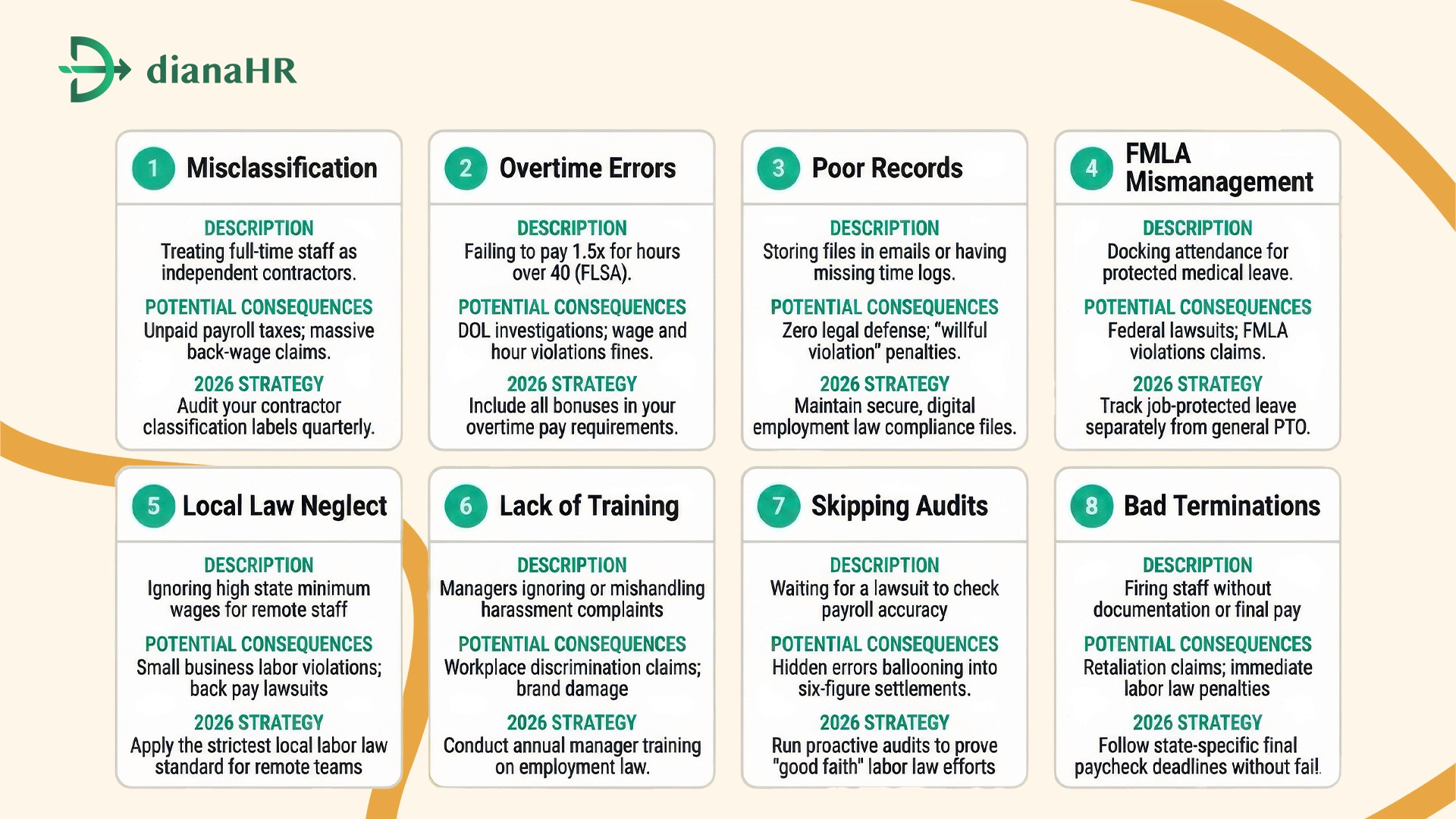
8 Labor Law Mistakes Small Businesses Make At a Glance:
Managing these final steps keeps your company safe while you focus on building a stronger team.
How DianaHR Protects Your Business
Managing labor law shouldn't keep you up at night. DianaHR is an AI-powered platform that simplifies employment law compliance for small businesses across 40+ states. By combining smart automation with human expertise, DianaHR cuts costs by up to 60%.
Key Compliance Features
AI-Driven Management: Automatically handles payroll taxes and registrations to prevent small business labor violations.
Dedicated HR Specialists: Every client gets a human partner to manage policies and employee misclassification risks.
Seamless Integrations: Syncs perfectly with Gusto and ADP without requiring you to switch tools.
Smart Task Automation: Saves 15+ hours per week by eliminating manual wage and hour violations risks.
This hybrid approach transforms labor law tasks from a burden into a streamlined process. Explore how DianaHR simplifies employment law compliance and helps your business scale faster → DianaHR
Conclusion
Failing to respect labor law is a gamble you cannot afford in 2026. Simple wage and hour violations or a single employee misclassification error can trigger aggressive audits that drain your bank account. These legal traps often lead to permanent business closure and devastating personal liability.
Don't let your hard work vanish due to a paperwork oversight. Employment law compliance is complex, but you don't have to face it alone. DianaHR automates your protections, shielding you from expensive small business labor violations so you can lead with confidence and grow without fear.
Connect to DianaHR today to automate your employment law compliance and eliminate the risk of wage and hour violations across your entire team.
FAQs
1. What's the difference between an employee and independent contractor, and why does it matter?
Proper contractor classification depends on behavioral and financial control. Mislabeling workers leads to employee misclassification lawsuits and massive labor law penalties. To maintain employment law compliance, treat anyone whose schedule you control as an employee to avoid small business labor violations.
2. How do I calculate overtime correctly under federal law?
Under FLSA compliance, pay 1.5 times the regular rate for hours over 40. Include bonuses in overtime pay requirements to prevent wage theft prevention issues. Ignoring these wage and hour violations triggers payroll errors penalties and increases your employment practices liability.
3. What specific records must I maintain for each employee?
Effective labor law defense requires tracking hours, wages, and deductions accurately. Maintain digital records of I-9s and contracts to ensure employment law compliance. Poor documentation leads to small business labor violations and high payroll errors penalties during a federal or state audit.
4. Am I required to provide paid leave under federal law?
Federal labor law doesn't mandate paid vacation, but you must avoid FMLA violations for unpaid, job-protected leave. Many states require paid sick time. Stay current with employment law compliance to avoid wage and hour violations when managing remote workers' leave rights.
5. What should I do if an employee files a discrimination or harassment complaint?
Act fast on workplace discrimination claims by investigating complaints impartially. Secure your business from employment practices liability with clear reporting channels and manager training. Prioritizing labor law and employment law compliance prevents legal escalation and protects your reputation from costly harassment lawsuits.
6. How often should I conduct labor law compliance audits?
Run quarterly checks to ensure total employment law compliance. Regular audits catch employee misclassification or overtime pay requirements errors before they become wage and hour violations. This proactive labor law strategy reduces payroll errors penalties and prevents ongoing small business labor violations.
Share the Blog on: