Most managers treat the employee lifecycle as a simple line. This approach fails since one in three new hires leaves within 90 days. 81% of business leaders link people directly to business goals.
A broken employee lifecycle drains your company. Agentic AI and skills-based hiring define success. Helena Almeida, VP at ADP, says AI audits your data in real time.
DianaHR automates your workforce planning to stop talent from leaving. Use this guide to improve the employee experience and keep your best people.
Modern Workforce Planning in the Employee Lifecycle
Static career paths died years ago. Today, smart workforce planning means building a "living loop" where people move fluidly between roles.
1. Moving Beyond Linear Career Paths
Modern workers don't just climb a ladder. They move sideways, take breaks for growth, and jump into internal projects. This loop keeps the employee lifecycle healthy.
If you want to keep your best people, you must offer cultural alignment through internal mobility. High-performers stay when they see a future that fits their life.
2. The Rise of Agentic AI in People Strategy
Generic automation is old news. You now need agentic AI to handle complex logic. These tools spot bottlenecks in your hiring funnel before they become problems.
They track engagement analytics to warn you about burnout. This technology acts like a digital partner that keeps your operations running without constant manual input.
3. From Degree-Led to Skills-First Hiring
Stop looking at degrees. Use skills-based hiring to find people who can actually do the work. Assessing real-world capability broadens your talent pool and improves the employee experience.
Quick Glance: Modern Workforce Planning in the Employee Lifecycle
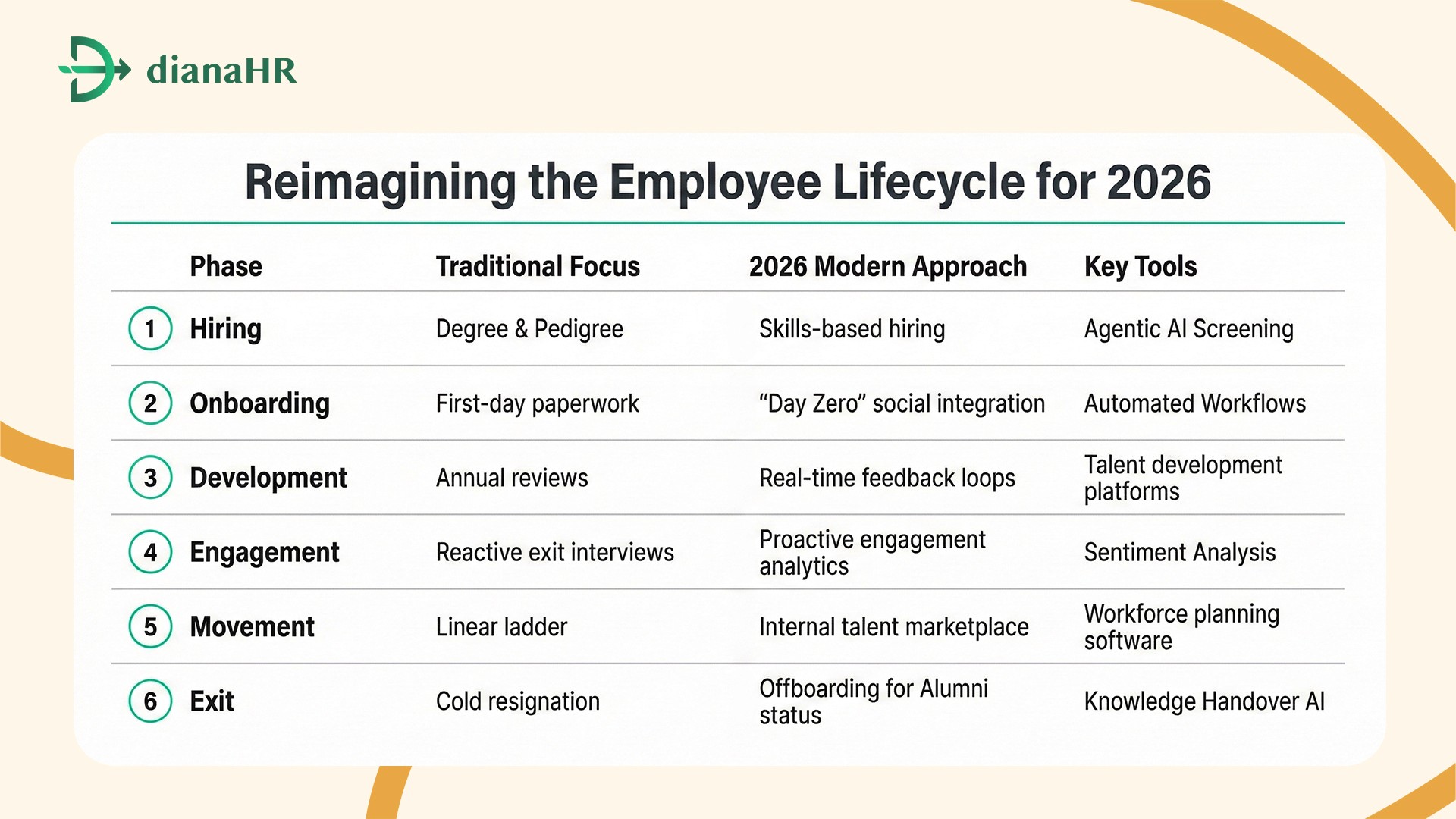
When you hire for skill, you ensure a better fit from the start.By fixing your foundation, you set the stage for better talent development as your team grows.
The Engine of Growth: Talent Development and the Integrated Employee Lifecycle
Effective talent development turns a group of workers into a high-speed engine. You must connect every stage to ensure your employee lifecycle stays strong and productive.
1. Attraction & Recruitment: The Magnetic Brand
Your brand attracts talent based on how your current team feels. 75% of job seekers check your culture before they ever apply. Candidates want to see cultural alignment and stability.
Agentic AI now helps you screen for the right values while maintaining a human touch. Authentic storytelling wins over flashy ads every time in modern recruitment.
2. Onboarding & Integration: The "Day Zero" Advantage
Don’t wait for the first day to start onboarding. Use "Day Zero" strategies to handle all admin tasks through automation. Successful firms use this time to build excitement and social bonds.
Since 82% of retention success happens here, you should focus on making new hires feel at home before they even log in.
3. Continuous Talent Development & Performance
Forget yearly reviews. Use real-time feedback and personalized learning paths to keep people growing. Tools like agentic AI suggest specific training based on daily work patterns. This keeps the employee experience fresh and meaningful.
4. Retention: Solving the "Quiet Quitting" Mystery
Retention is about spotting trouble early. Use engagement analytics to find "disengagement signals" like reduced meeting participation. This data lets you step in with a stay interview weeks before someone decides to quit. Managers who act on these insights build much stronger teams.
Investing in these growth stages ensures your workforce planning pays off as your team reaches peak performance.
Why Offboarding Defines the Employee Lifecycle
Leaving a job shouldn't feel like a breakup. A smooth offboarding process protects your brand and keeps the door open for future growth.
1. The Silent Risk of Poor Separation
A cold or messy exit is a risk to your reputation. In the age of viral reviews, the offboarding stage is your final chance to show you value your people.
Poor exits lead to bad feedback that hurts your future attraction efforts. Treat every departing worker with respect to keep your employer brand safe.
2. Building a Powerful Alumni Network
A former employee can still help your company. Treat offboarding as the start of an alumni relationship. These people become "boomerang" hires or refer new talent to your team.
Successful companies use these networks to maintain a long-term employee experience that extends past the last paycheck.
3. Predictive Analytics for Attrition Management
Use data to stop the "talent drain." By analyzing why people leave through engagement analytics, you can fix problems in your workforce planning.
If multiple people leave for the same reason, you have a clear roadmap for what to change. This turns every exit into a lesson for better retention.
4. Knowledge Handover: The Final Gift
Use agentic AI to automate your documentation. This ensures that when someone leaves, their expertise doesn't walk out the door with them. Capturing project details and contacts prevents an "expertise vacuum" and keeps your business running without a hitch.
How DianaHR Manages Every Stage from Hire to Retire
Managing the employee lifecycle shouldn't be a source of stress. DianaHR acts as your "Culture and Compliance Co-pilot," simplifying workforce planning for small and mid-sized businesses.
We reduce HR costs by up to 60% and save managers 20 hours per week by automating repetitive tasks.
DianaHR offers specialized capabilities to streamline your employee experience:
AI-Driven Compliance: Automates payroll taxes and benefits across 40+ states.
Human-in-the-Loop Expertise: Pairs you with a dedicated specialist for personalized talent development.
Seamless Integrations: Works with your existing tools like Gusto, ADP, or Rippling.
Smart Task Automation: Cuts manual employee lifecycle admin by 60%.
Scalable People Operations: Ensures consistency in talent development as your startup grows.
Explore how DianaHR simplifies the employee lifecycle and helps your business scale faster → DianaHR.
Conclusion
The employee lifecycle in 2026 is your blueprint for success. Failing to manage this journey creates massive friction. High turnover, compliance fines, and toxic culture are real risks that drain your profits. One bad exit or a messy onboarding can damage your brand forever. Ignoring these gaps leaves your business vulnerable to talent loss.
DianaHR fixes these issues by automating your workforce planning and talent development. We handle the complex admin so you can focus on leading your team.
Let's connect with DianaHR and simplify your employee lifecycle to build a team that stays.
FAQs
1. How long should the employee lifecycle last?
A healthy employee lifecycle never truly ends. By focusing on retention and talent development, you turn former staff into loyal alumni. Smart workforce planning ensures these relationships provide long-term value, keeping your employee experience and brand reputation strong indefinitely.
2. What is the most critical stage of the lifecycle?
While every stage matters, onboarding is where 82% of retention is won. Setting a high bar for the employee experience early through cultural alignment and agentic AI ensures new hires stay engaged. DianaHR helps you master this vital first impression every time.
3. Can AI replace human managers?
No. In 2026, agentic AI handles repetitive admin and engagement analytics. This tech allows managers to focus on talent development and empathy. Human leadership remains the core of a great employee lifecycle, while AI provides the data to lead better.
4. What is skills-based hiring?
Skills-based hiring prioritizes actual capability over degrees. This approach improves workforce planning by widening your talent pool and ensuring better cultural alignment. It creates a fairer employee experience and helps you find the right fit for every role in your organization.
5. How does offboarding affect hiring?
Positive offboarding protects your brand and boosts future attraction. A graceful exit leads to better reviews and referrals, reducing the cost of your next workforce planning cycle. Treating people well at the end makes the start of the next journey easier.
Share the Blog on: