
A 2025 study by Employment Hero and OnePoll found that small and mid-sized businesses spend an average of $60,000 (GBP 47,000) per year managing employment administration alone. (Employment Hero & OnePoll, 2025)
That figure covers only the direct cost of HR management. It does not include the startup operational costs of a founder or ops lead spending 30+ hours per week on payroll, compliance filings, onboarding paperwork, and state registrations instead of building product or closing deals.
When you calculate the full startup operational costs, including the value of the time being spent, a 10-person startup is burning through roughly $240,000 per year on work that does not require human judgment. These startup operational costs are hidden because they do not show up as a line item on your P&L. They show up as features not shipped, customers not acquired, and fundraises not prepared.
This guide breaks down where those hours actually go, what they cost at founder-level opportunity rates, and how AI employees are changing the startup operational costs equation for high-growth teams.
How Does a 10-Person Startup Lose $240,000 to Manual Ops?
The startup operational costs calculation is straightforward. In a typical 10-person startup, at least two people, usually the founder and an ops lead, spend significant chunks of their week on operational tasks that could be automated.
EY's 2025 research found that a single manual data entry made by an HR professional costs an average of $4.86. Multiply that across hundreds of entries per month for payroll, benefits, compliance updates, and onboarding forms, and startup operational costs accumulate fast. (EY, 2025, via Paycom, https://www.paycom.com/resources/blog/cost-of-manual-hr-processes/)
Here is the full startup operational costs breakdown at a conservative $150/hour opportunity cost, which is below market rate for a funded startup founder:
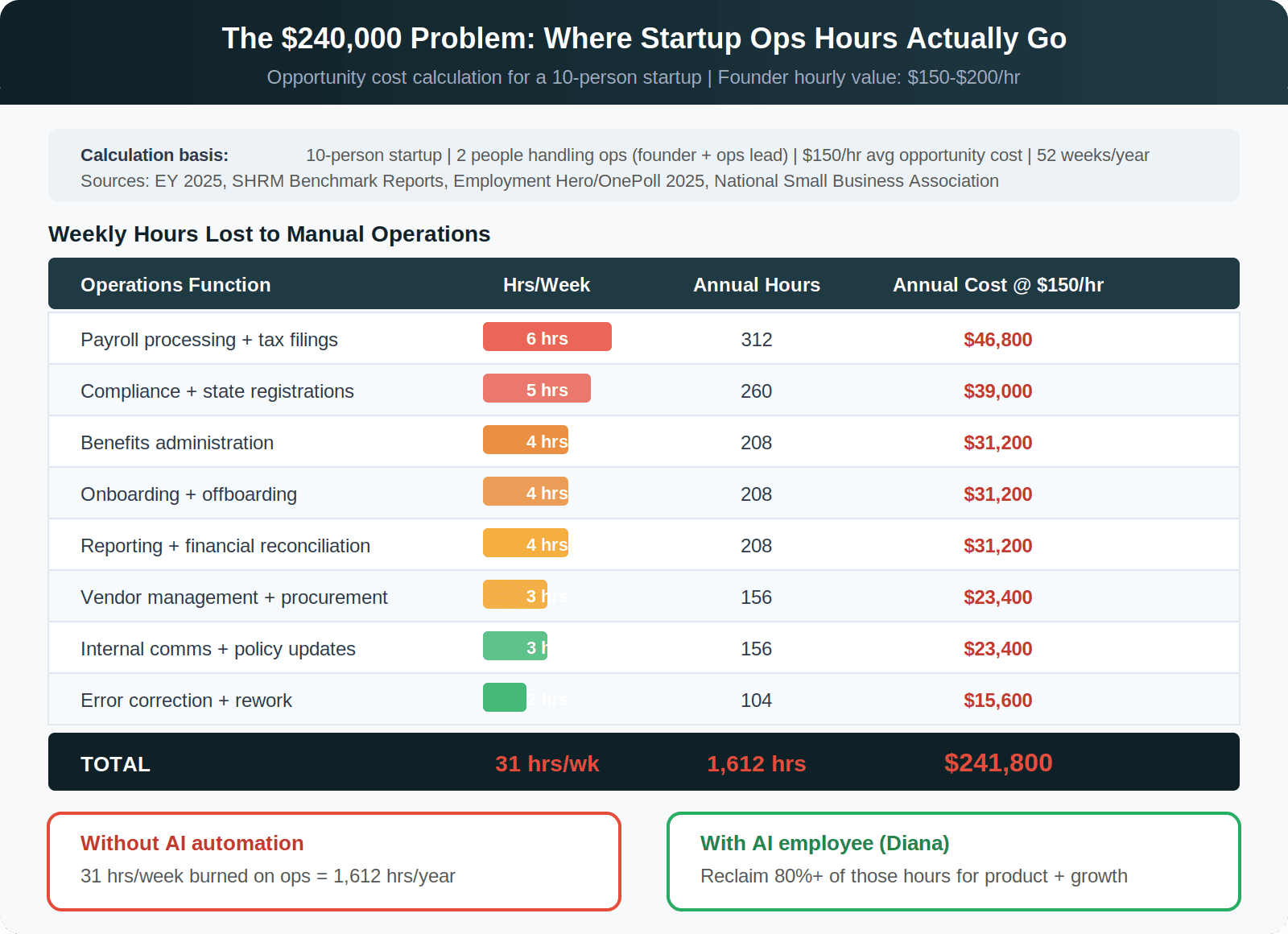
The total startup operational costs from manual ops: 31 hours per week, 1,612 hours per year, $241,800 in opportunity cost. Every one of those hours could be redirected to product development, customer acquisition, or fundraising.
Where Do the Biggest Startup Operational Costs Hide?
Payroll and Tax Filings: 6 Hours/Week
Running payroll for 10 employees across multiple states involves calculating withholdings, filing federal and state taxes, managing direct deposits, handling garnishments, and reconciling discrepancies. Every new state hire adds complexity. The National Small Business Association estimates the average cost of compliance management at $12,000 per year. For startups hiring remotely across state lines, this number is often higher. (National Small Business Association, https://www.nsba.biz/)
These startup operational costs compound with every new hire in a new state. Each state requires separate tax registrations, unemployment insurance accounts, and ongoing filing obligations. A startup with employees in 5 states faces 20+ distinct compliance requirements.
Compliance and State Registrations: 5 Hours/Week
State compliance is one of the least visible startup operational costs. Each state where you have an employee requires separate tax registrations, unemployment insurance setup, workers' compensation coverage, and ongoing filings. Miss one filing deadline, and you face penalties that range from $50 per day to $500 per occurrence depending on the state and violation type.
For remote-first startups, this problem scales linearly with hiring. Adding one employee in a new state can create 4-6 new compliance obligations that persist indefinitely.
Benefits Administration: 4 Hours/Week
Selecting plans, managing enrollments, handling life event changes, reconciling invoices from carriers, and answering employee questions about coverage. One benefits enrollment error costs an average of $400 to resolve, including staff time, vendor communications, and retroactive corrections. (LiftHCM, 2025, https://lifthcm.com/)
EY's research found that individual HR tasks now exceed $20 each for categories like benefit plan change notifications, making benefits administration one of the most expensive per-task startup operational costs.
Onboarding and Offboarding: 4 Hours/Week
I-9 verification, background checks, equipment provisioning, account setup, document collection, policy acknowledgments, benefits enrollment. A single new hire generates 15-20 discrete administrative tasks. For a startup growing by 2-3 people per quarter, onboarding alone becomes a part-time job.
These startup operational costs are front-loaded. You spend the most time on onboarding during your highest-growth periods, which is exactly when founder time is most valuable.
Reporting, Error Correction, and Internal Comms: 9 Hours/Week Combined
Financial reconciliation, board reporting, internal policy updates, and fixing mistakes from manual data entry consume the remaining 9 hours per week. This is the long tail of startup operational costs: individually small tasks that add up to more than a full workday every week.
Error correction alone is a significant hidden component of startup operational costs. When payroll data is entered manually, mistakes are inevitable. EY's 2025 research found that benefit plan change notifications cost $20.32 per task. Scale that across dozens of tasks per month and the cost adds up without any visible line item on your budget.
How Do Startup Operational Costs Compound Over Time?
Startup operational costs do not stay flat. They scale with every new hire. A 10-person startup spending 31 hours per week on ops will spend closer to 45-50 hours per week at 20 people. The administrative complexity does not grow linearly. It accelerates.
Each new employee in a new state adds 4-6 new compliance obligations. Each new hire generates 15-20 onboarding tasks. Each additional benefits enrollment adds reconciliation work. The startup operational costs that feel manageable at 5 employees become unsustainable at 15.
This is why the window to automate startup operational costs is early, before the complexity outpaces your team's capacity. Companies that wait until they have 30 employees to address operational automation face a backlog of manual processes that are deeply embedded in their workflows and far harder to untangle.
The compounding nature of startup operational costs also affects hiring. When your ops person spends 31 hours per week on admin, you need to hire a second ops person sooner than you otherwise would. That is an additional $80,000-$120,000 per year in salary, benefits, and overhead that could be avoided with proper automation.
Why Do Startup Operational Costs Hit Small Companies Harder?
SHRM's Human Capital Benchmark Report found that small businesses have an HR-to-employee ratio of 3.4%, compared to 1.03% at large organizations. Small companies dedicate proportionally three times more human resources to HR functions than enterprises. (SHRM Human Capital Benchmark Report, https://www.shrm.org/)
Large companies benefit from economies of scale and dedicated HR technology platforms that absorb administrative work. Startups do not have these advantages. At a 10-person startup, the founder and one ops person absorb all of the operational work. There is no HR department. There is no dedicated compliance officer. There is no payroll specialist.
The result: 64% of founders at the Series A stage report spending too much of their time on administrative work. These are tasks that do not require founder-level judgment, vision, or leadership. (WinSavvy Founder Research, 2025, https://www.winsavvy.com/)
This disparity in startup operational costs creates a structural disadvantage. While large companies have teams handling ops, your founding team is toggling between product strategy and payroll tax filings. The startup operational costs are financial and strategic at the same time. Every hour on admin is an hour not spent on the work that creates enterprise value.
How Do AI Employees Change Startup Operational Costs?
The AI employee model is different from traditional SaaS tools. SaaS tools automate a single function like payroll, benefits, or compliance individually. An AI employee handles the workflow end-to-end across multiple functions through a single interface.
Here is the difference in practice:
SaaS tool: You still configure, monitor, troubleshoot, and reconcile between systems
AI employee: You assign the work. The AI employee completes it, flags exceptions, and reports results
For a 10-person startup, replacing 31 hours/week of manual ops with an AI employee reclaims roughly 80% of that time. That is 1,290 hours per year redirected from administrative tasks to product development, customer acquisition, and fundraising. At $150/hour opportunity cost, that is $193,440 in recovered value per year.
The reduction in startup operational costs is not about cutting headcount. It is about redirecting the headcount you already have from low-leverage administrative work to high-leverage strategic work.
What Should a 10-Person Startup Automate First?
The highest-impact areas to automate are the tasks with the highest combination of time consumption, error risk, and compliance consequences:
Payroll and tax filings (highest time spend, highest penalty risk, 6 hrs/week)
State compliance registrations (highest complexity growth as you hire remotely, 5 hrs/week)
Employee onboarding (highest volume of discrete tasks per event, 4 hrs/week)
Benefits reconciliation (highest error cost per incident at $400 each, 4 hrs/week)
Reporting and internal communications can follow. These carry lower immediate penalty risk but still consume significant founder time. Automating these four categories first eliminates approximately 19 hours per week of startup operational costs, which represents $148,200 per year in opportunity cost recovery.
Diana: The AI Employee That Eliminates Startup Operational Costs
Diana handles HR, ops, finance, compliance, and reporting from inside Slack. It is not another SaaS dashboard that adds to your tool sprawl. It is an AI employee that every team member can message directly.
For a 10-person startup, Diana eliminates the need for a founder to spend 6 hours per week on payroll, 5 hours on compliance filings, and 4 hours on onboarding paperwork. The work gets done securely, completely, and automatically.
No new tools to learn. No portals to log into. Built on OpenClaw with enterprise-grade security. Every employee gets their own AI instance in seconds. Backed by Y Combinator, General Catalyst, and SNR.
Frequently Asked Questions About Startup Operational Costs
How much do manual ops actually cost a 10-person startup?
Based on opportunity cost calculations at $150/hour, a 10-person startup loses approximately $241,800 per year to manual startup operational costs. This includes payroll, compliance, benefits administration, onboarding, reporting, and error correction spread across 31 hours per week.
What percentage of a founder's time goes to admin work?
Research from WinSavvy (2025) found that 64% of founders at the Series A stage say they spend too much time on administrative tasks. These include scheduling, invoicing, compliance filings, and document management, all of which contribute to hidden startup operational costs.
What is an AI employee and how is it different from HR software?
An AI employee handles end-to-end operational workflows across multiple functions through a single conversational interface. Traditional HR software automates individual functions but still requires human configuration, monitoring, and reconciliation between systems. An AI employee reduces startup operational costs by eliminating the manual coordination layer between tools.
What should startups automate first to reduce startup operational costs?
Start with payroll and tax filings (highest time spend and penalty risk), state compliance registrations (highest complexity growth), employee onboarding (highest task volume), and benefits reconciliation (highest per-error cost). These four categories represent 19 of the 31 weekly hours of startup operational costs.
How much time can an AI employee save a startup per year?
For a 10-person startup spending 31 hours/week on manual ops, an AI employee can reclaim approximately 80% of that time. That equals 1,290 hours per year redirected from administrative tasks to product development, customer acquisition, and growth activities.
The Real Startup Operational Cost Is What You Are Not Building
The $240,000 is not cash leaving your bank account. It is the value of the product features not shipped, the customers not acquired, the fundraise not prepared. Every hour spent on payroll reconciliation is an hour not spent on the work that compounds. Startup operational costs are invisible until you measure them, and devastating once you do.
Start reclaiming those hours with Diana. Message your AI employee in Slack and get the ops work done without the ops burden. dianaHR.com
Share the Blog on: