
Qualified candidates walk away from your company more often now. Recent data shows that the offer acceptance rate dropped to nearly 30%. This trend drains your budget. It wastes team hours too. You can stop this cycle by using HR metrics to find the real issues.
Your data shows job offer decline reasons early in the process. By tracking recruiting metrics today, you find leaks in your recruitment funnel. Stop wondering why people say no. Use your HR metrics to fix the hiring process and hire better people.
9 HR Metrics That Reveal Why Candidates Decline Offers
Tracking HR metrics turns guesswork into a clear strategy. You must watch the numbers that predict a "no" before it happens. These recruiting metrics show you exactly where candidates lose interest in your recruitment funnel.
Metric #1. Candidate Net Promoter Score (cNPS)
This score tracks the quality of your interview experience. You ask candidates if they would recommend your process to others. If your cNPS is low, your employer branding suffers. Many people reject an offer simply because the interview felt disrespectful. Use these HR metrics to find and fix those negative interactions.
This metric quantifies the quality of your interview experience. After the process, ask candidates to rate their experience from 0 to 10.
Promoters: (Score 9-10)
Passives: (Score 7-8)
Detractors: (Score 0-6)

Example: Imagine you survey 100 candidates.
60 are Promoters (60%)
30 are Passives (30%)
10 are Detractors (10%)
Your cNPS is 50. This score acts as a key part of your HR kpis. A positive score shows strong employer branding, while a negative score explains why people are choosing your competitors instead.
Metric #2. Communication Velocity Metrics
Speed wins in the current job market. This metric tracks how long your team takes to reply to a candidate. If you leave someone in "radio silence," they assume you are not interested. Slow communication is a top reason for a job offer decline. By measuring these HR kpis, you ensure your team stays fast and responsive.
Metric #3. Offer Acceptance Rate (OAR) by Department
You must look at your offer acceptance rate by specific teams. A general average hides departmental problems. Comparing your departmental data against HR benchmarks helps you see where you are failing. If one team has a high rejection rate, use your HR metrics to investigate if the issue is pay or management style

For example, if you extend 10 offers and 3 candidates decline, your OAR is 70%. If your HR benchmarks show an average of 85% for your industry, a 70% rate signals a problem with your candidate experience or pay.
Metric #4. Compensation-to-Market Ratio
Pay is the top reason people say no to you. This metric compares your offer against real-time 2026 compensation benchmarks. If your ratio is below 1.0, you are paying less than the market average. Since 63% of candidates reject offers due to low pay, this is a vital part of your HR metrics. Tracking these HR kpis helps you adjust budgets before you lose your top choice.
Metric #5. Time-in-Offer-Stage
This metric measures the gap between a verbal "yes" and the formal written contract. Top talent moves fast and often has multiple offers. If you stall for more than three days, you risk "ghosting." This time to hire data points is one of the most important recruiting metrics to watch. Fast contracts prevent other companies from swooping in with a better deal.
Metric #6. Culture Alignment Sentiment
You can quantify how well a candidate fits your team during the evaluation. This metric uses feedback to see if the candidate’s values match your company’s reality. Many people decline offers because of culture concerns they felt during the interview experience. Use these HR metrics to ensure your employer branding matches the actual office environment so candidates feel confident saying yes.
Metric #7. Hiring Manager Quality Score
Candidates often quit because of managers, not companies. This score uses post-interview feedback to rate the leader. If a specific manager has high rejection rates, your HR metrics will flag it.
These HR kpis help you see if a manager needs training on how to talk to talent. Bad managers ruin your recruitment funnel and drive up costs. Using these HR metrics allows you to coach leaders before they lose more people.
Metric #8. Benefits Competitiveness Index
Health insurance and wellness perks matter more than ever. This index evaluates if your perks meet current HR benchmarks. Many candidates walk away if your benefits package feels outdated or weak.
Use these recruiting metrics to see how your total rewards compare to others. Strong benefits are a key part of your talent acquisition KPIs. You should update these HR metrics every quarter to stay competitive.
Metric #9. Career Path Clarity Score
People want to know where they are going. This score measures how well your team explained future growth during the process. If a candidate feels stuck, they won't sign.
This is a core part of your HR metrics because it affects the candidate experience. Clear paths lead to a higher offer acceptance rate across all departments. Tracking these HR kpis ensures your recruiters sell the future, not just a job.
9 Essential HR Metrics to Improve Your Offer Acceptance Rate
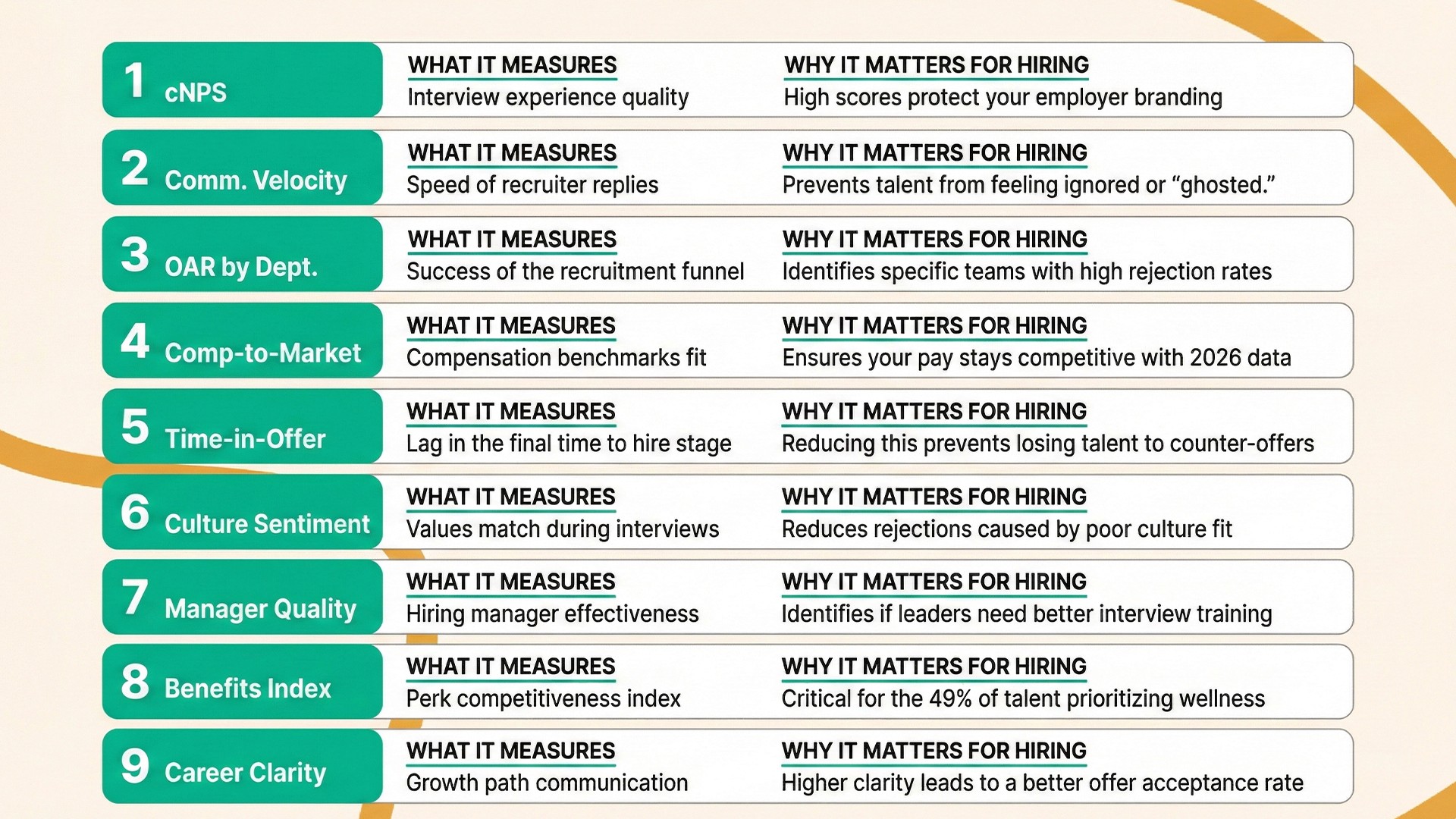
Knowing these numbers is the first step toward a better hiring strategy. Now, let’s look at how these HR metrics link directly to the reasons candidates choose to walk away.
Connecting Metrics to Candidate Rejection Triggers
Data does more than just show you what happened. It tells you why. When you connect HR metrics to specific triggers, you fix the root cause of your hiring problems.
High time to hire numbers usually point to a slow process. If your recruitment funnel moves too slowly, candidates often accept counter-offers from faster competitors.
Your hiring metrics can reveal if certain job boards attract the wrong people. If a specific source consistently leads to rejections over salary, your talent acquisition KPIs are flagging a sourcing issue.
Comparing your current offers to HR benchmarks shows if you are failing because of money. These recruiting metrics act as an early warning system for your budget.
Tracking HR kpis across the entire process helps you see if a "no" is a financial failure or a process failure.
By looking at these data points together, you stop guessing. You start making changes that turn rejections into hires.
Conclusion
Improving your offer acceptance rate starts with looking at the data. When you track these nine HR metrics, you find exactly why candidates walk away. Use your recruiting metrics to fix the interview experience and align your pay with HR benchmarks. Data-driven hiring stops the cycle of lost talent and wasted budget.
DianaHR helps you reduce HR costs by up to 60% and save 20 hours per week. It eliminates admin work and maintains compliance so you can focus on growth.
See how DianaHR makes tracking your HR metrics easy.
FAQs
1. What is a healthy offer acceptance rate in 2026?
Top teams target a 90% offer acceptance rate to stay competitive. If your HR kpis show rates below 75%, check your HR benchmarks. This usually means your candidate experience or pay lacks the strength needed to secure top-tier talent consistently.
2. Why is Time-in-Offer-Stage such a critical metric?
Speed is vital for your recruitment funnel. If you stall for 72 hours, the risk of a job offer decline jumps by 40%. Tracking this time to hire ensures you move fast, preventing competitors from stealing talent with better recruiting metrics.
3. How can metrics solve culture-based rejections?
If candidates report misalignment, your employer branding needs a fix. Use HR metrics to track sentiment during the interview experience. When you measure these recruitment KPIs, you can coach managers to better reflect company values, ensuring more people say yes.
4. Does pay transparency affect offer rejection rates?
Yes, clarity improves your offer acceptance rate by 12%. Providing salary bands early acts as a filter for your recruitment funnel. It prevents the job offer decline reasons tied to money surprises, making your talent acquisition KPIs much healthier overall.
5. How do I improve my Hiring Manager Quality Score?
Collect feedback on managers to identify why candidates walk away. If HR metrics show high rejection rates for one leader, they likely need training. Improving this candidate experience score helps your recruiting metrics and ensures you don't lose talent to bad management.
Share the Blog on: