
Gartner's January 2026 forecast projects worldwide AI spending at $2.52 trillion in 2026, a 44% increase over 2025. More than half of that goes to AI infrastructure alone. (Gartner, January 2026 Forecast)
That is not an experiment. It is a capital allocation shift at infrastructure scale. And the companies capturing the most value from it are not large enterprises with massive AI budgets. They are small teams using AI employees for startups to produce output that was previously impossible without 50-100 people.
Cursor (AI coding assistant) reached $2 billion in annualized revenue with roughly 30 people. Lovable hit $200 million ARR with a small team in under 12 months. Mercor reached a $10 billion valuation built on a model that matches human experts with AI training workflows. (TechCrunch, 2026; Bloomberg, 2025)
These are not outliers. They are the early signal of a structural shift in how startups operate. This guide covers how AI employees for startups are redefining team capacity, what actually changes at the operational level, and where Diana fits in this future.
What Does a 10-Person Team With AI Employees for Startups Actually Produce?
Core Innovation Capital estimates that in 2025, a single AI-equipped engineer produces the output of five or more traditional engineers. Benhamou Global Ventures has formalized this into the '10/100/3' framework: $100 million in ARR, with 10 people, in 3 years. (Core Innovation Capital, 2025; Benhamou Global Ventures)
This is not a projection. Cursor, Lovable, and Mercor are already operating at or near this benchmark. The common factor: each of these companies uses AI employees for startups across every function, from engineering to operations to customer support.
The multiplier works because AI employees for startups eliminate the administrative overhead that traditionally scales with headcount. In a conventional startup, every new hire adds complexity: more payroll calculations, more compliance obligations, more onboarding tasks, more HR questions. With AI employees for startups handling this overhead, the complexity does not scale.
What Actually Changes When You Add AI Employees for Startups?
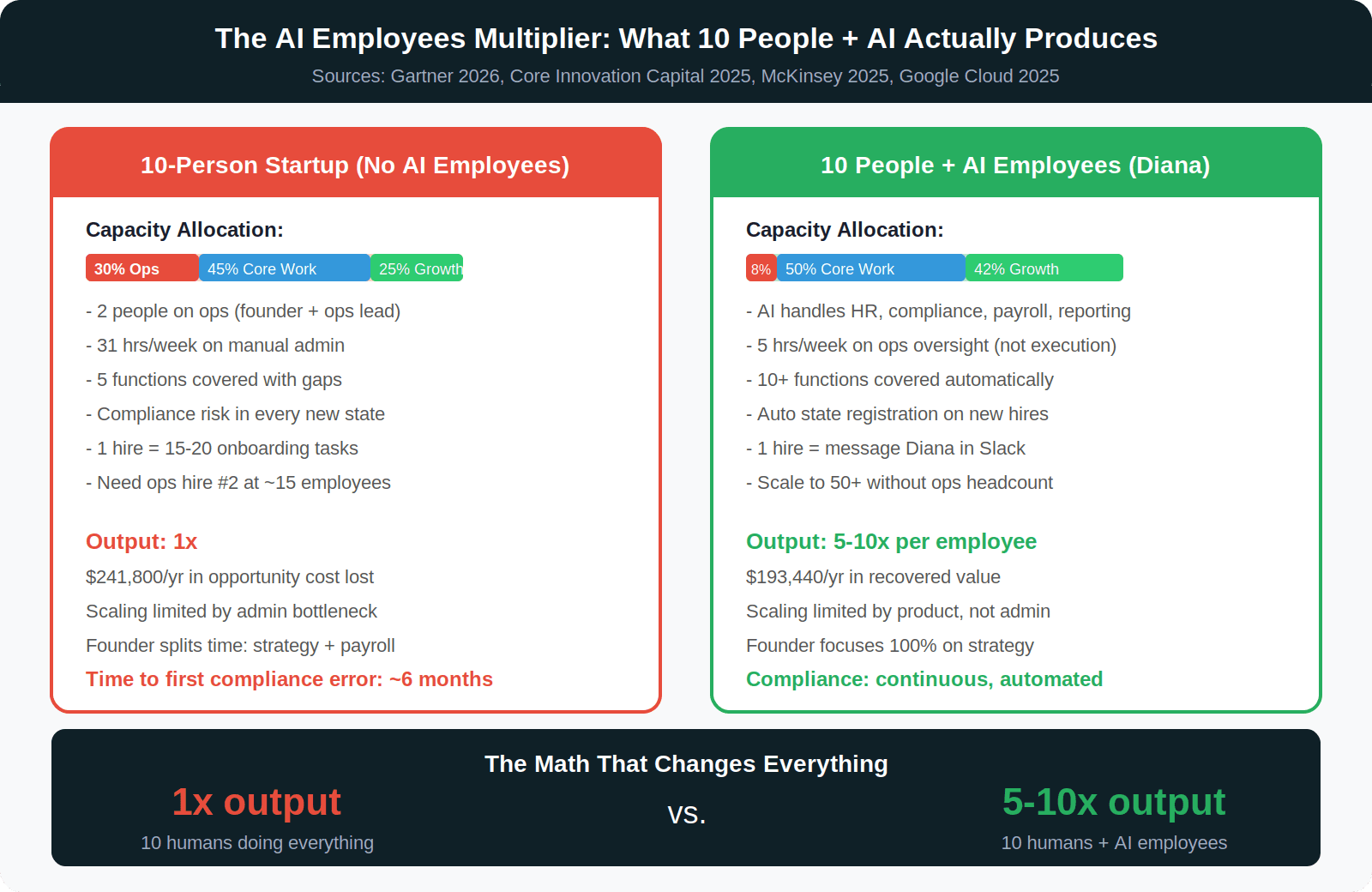
The shift from a 10-person team doing everything manually to a 10-person team with AI employees for startups changes five things at the operational level:
1. Ops Becomes a Background Process
Payroll, compliance filings, state registrations, benefits reconciliation, and onboarding stop being tasks that someone does. They become processes that run automatically. The founder's involvement drops from 31 hours per week of execution to 3-5 hours of oversight.
2. Hiring Creates Zero Administrative Debt
In a traditional startup, each new hire generates 15-20 discrete admin tasks. With AI employees for startups, a new hire triggers automated workflows: state registration, equipment provisioning, document collection, benefits enrollment, policy distribution. The administrative cost per hire approaches zero.
3. Compliance Becomes Continuous
Instead of a founder scrambling to catch up on regulatory changes quarterly, AI employees for startups monitor compliance obligations continuously. When a state changes its minimum wage, updates its leave policy, or introduces new reporting requirements, the AI flags it and generates the required updates.
4. Every Function Gets Capacity It Never Had
A 10-person startup with AI employees for startups has dedicated capacity for HR, finance, compliance, reporting, and internal operations without dedicating a single human to any of them full-time. Each function gets 24/7 coverage with zero additional headcount.
5. The Founder Works on Strategy, Not Admin
The most valuable shift: AI employees for startups free the founder from administrative work entirely. The 64% of Series A founders who report spending too much time on admin tasks can redirect 100% of that time to product, customers, and fundraising.
What Separates Companies That Adopt AI Employees for Startups Early?
Google Cloud's September 2025 study found that 52% of executives are deploying AI agents in production environments. McKinsey's State of AI 2025 confirms that 92% of companies plan to increase AI investments over the next three years. (Google Cloud, September 2025, https://cloud.google.com/; McKinsey State of AI 2025, https://www.mckinsey.com/)
The data shows a widening gap between early and late adopters of AI employees for startups. Unite.AI reports that in 2025, 62% of companies were experimenting with AI agents, but only 23% had scaled beyond a pilot in any single function. The companies that scaled first are now compounding their advantage. (Unite.AI, January 2026, https://www.unite.ai/)
Here is what the gap looks like in practice:
Early adopters: AI employees for startups handle ops from day one. Team capacity scales without headcount. Founders focus on growth.
Late adopters: Manual ops consume 30+ hours per week. Each hire adds complexity. Founders toggle between strategy and payroll.
The gap compounds quarterly. A startup that adopts AI employees for startups at 10 people reaches 50 people with the same ops overhead. A startup that waits needs to hire 2-3 ops people to handle the same growth, consuming $200,000-$360,000 per year in additional salary.
Why 2026 Is the Inflection Point for AI Employees for Startups
Gartner predicts that by 2026, more than 80% of enterprises will use generative AI applications in production, up from 5% in 2023. The AI agent market grew from $5.25 billion in 2024 to $7.84 billion in 2025, with projections reaching $52.62 billion by 2030. (Gartner 2026; AI Funding Tracker, 2026)
For startups, this means the tools are ready. The infrastructure is mature. The cost has dropped to the point where a 10-person startup can afford the same AI operational capacity that was previously available only to enterprises.
Human-AI collaboration is producing measurable results. Research compiled across Gartner, McKinsey, and Deloitte data shows a 60% productivity lift in teams that combine human workers with AI employees for startups, compared to human-only teams. (SendToTeam Research / Gartner / Deloitte, 2026)
The startups that build with AI employees for startups from the beginning will operate with fundamentally different economics. Lower burn rates. Faster execution. More founder time on the work that creates enterprise value.
What AI Employees for Startups Look Like in Practice
The concept of AI employees for startups is abstract until you see it at the task level. Here is what changes for a 10-person startup across five operational functions:
Payroll: AI employees for startups calculate withholdings, file federal and state taxes, process direct deposits, and reconcile discrepancies for every pay cycle. The founder reviews a summary instead of running the process.
Onboarding: New hire triggers automatic I-9 collection, state registration, equipment provisioning, document distribution, benefits enrollment, and Slack channel access. Time per hire drops from 4-6 hours to under 10 minutes of human review.
Compliance: AI employees for startups monitor regulatory changes across every state where the company has employees. When California updates its minimum wage or New York changes its paid family leave rules, the AI flags the change and generates updated policies within hours.
Reporting: Board-ready financial summaries, headcount reports, benefits utilization metrics, and compliance status dashboards generate automatically. No spreadsheet assembly required.
Employee support: Team members ask questions about PTO balance, benefits coverage, expense policy, or compliance procedures directly in Slack. The AI answers from the company's actual policies, not generic information.
Each of these tasks previously required a human to initiate, execute, verify, and record. With AI employees for startups, each task runs automatically with human oversight limited to exception handling and final approval.
Where Diana Fits in the AI Employees for Startups Future
Diana is the AI employee that handles the operational functions every startup needs but no founder wants to spend time on: HR, compliance, payroll, benefits, onboarding, reporting, and finance.
It lives in Slack. Every team member gets their own instance. Security is built into the architecture with OpenClaw, not bolted on after launch. The human specialists behind Diana handle the edge cases that AI cannot.
For a 10-person startup, Diana is the difference between two people spending 31 hours per week on ops and zero people spending time on ops. It is the first AI employee your team hires, and the one that pays for itself within the first month.
The Cost of Waiting to Adopt AI Employees for Startups
The financial case for AI employees for startups is straightforward. A startup that adopts at 10 employees avoids hiring a dedicated ops person at 15-20 employees. That single hire costs $80,000-$120,000 per year in salary, benefits, and overhead.
The operational case is equally clear. Every month of manual ops accumulates process debt: undocumented HR decisions, outdated handbooks, missed compliance filings, inconsistent onboarding. This debt becomes exponentially harder to clean up as the company grows. A startup that reaches 30 employees with manual processes embedded in its workflows faces a 3-6 month remediation project before it can adopt AI employees for startups effectively.
Gartner predicts that by 2028, 38% of organizations will have AI agents as formal team members within human teams. The companies that adopt AI employees for startups in 2026 will have a 2-year head start on building the operational muscle memory that defines how their companies run. (Gartner, 2026 Forecast, https://www.gartner.com/)
The startups that wait will spend that same two years hiring ops staff, training them, replacing them when they leave, and training replacements. AI employees for startups do not quit, do not need performance reviews, and do not take two weeks to onboard. They are available from day one and improve with every interaction.
Frequently Asked Questions About AI Employees for Startups
What are AI employees for startups?
AI employees for startups are AI systems that handle end-to-end business functions autonomously, including HR, compliance, payroll, reporting, and operations. They differ from traditional AI tools because they execute complete workflows rather than assisting with individual tasks.
How much more productive are teams with AI employees?
Research across Gartner, McKinsey, and Deloitte data shows a 60% productivity lift in human-AI teams compared to human-only teams. Core Innovation Capital estimates a single AI-equipped engineer produces the output of 5+ traditional engineers.
Which startups are achieving the most with small teams and AI?
Cursor reached $2 billion in annualized revenue with approximately 30 people. Lovable hit $200 million ARR in under 12 months with a small team. Mercor reached a $10 billion valuation. These companies use AI across every function to maximize per-employee output.
When should a startup adopt AI employees?
The optimal time is at 5-10 employees, before manual operational processes become embedded in workflows. Companies that adopt AI employees for startups early avoid the administrative debt that compounds with every new hire.
How does Diana work as an AI employee?
Diana lives inside Slack and handles HR, compliance, payroll, benefits, onboarding, and reporting. Every team member gets their own secure AI instance. The AI executes operational tasks end-to-end, flags exceptions for human review, and reports results. Built on OpenClaw with enterprise-grade security.
The Future Is 10 People Doing the Work of 100
This is not a prediction about what might happen in five years. Cursor, Lovable, and Mercor are already operating this way. The startups that adopt AI employees for startups now are building a structural advantage that compounds with every quarter of execution.
The companies that wait will hire more people to do the same work, spend more money on the same output, and move slower than teams half their size. The economics have already shifted. The question is whether your startup shifts with them.
Make Diana your first AI employee. Message your entire ops department in Slack and get the work done without the headcount. dianaHR.com
Share the Blog on: