The National Employment Law Project (NELP) estimates that 30% of employers misclassify at least some of their workers, exposing themselves to back taxes, penalties, and audit risk with every misclassified hire. (NELP, https://www.nelp.org/)
At DianaHR, we saw this number play out firsthand. Over two years of managing HR, compliance, payroll, and ops for seed-to-Series B startups, we collected a pattern library of the most expensive operational mistakes small companies make. Most of them are preventable. Almost none of them are obvious until the penalty notice arrives.
That operational experience is why we built Diana, an AI for startup operations that lives inside Slack and handles end-to-end HR, compliance, finance, and reporting. We did not start with the AI. We started with the work. This post covers what we learned, what it cost the companies we worked with, and why AI for startup operations had to be built with security as the foundation.
The Operational Experience Behind Diana
Before Diana existed, Upeka Bee spent years as Head of Engineering at Gusto, where her team built the HR platform features that expanded Gusto beyond payroll and benefits into full-service HR. Tim Kral, Diana's co-founder, was VP of Engineering at Relay Payments, where he helped grow the company from 6 people to 700+. (Y Combinator, DianaHR profile, https://www.ycombinator.com/companies/dianahr)
They met at Carnegie Mellon 17 years ago. Diana is the third time they have worked together. That shared history matters because the product decisions behind Diana's AI for startup operations architecture came from watching the same problems repeat across hundreds of startups.
DianaHR launched in YC's W24 batch with a human-in-the-loop model: AI-augmented human HR experts managing compliance, onboarding, state registrations, and payroll for startups starting at $99/month. The team includes Jennifer, an HR specialist with 20+ years of experience across high-growth startups and established corporations, and Dilan Dane, a serial entrepreneur whose first company (a real-time search engine) was acquired by Google.
This was intentional. Before building AI for startup operations at scale, we needed to understand exactly where AI adds value and where human judgment is irreplaceable.
The 5 Most Expensive Startup Operations Mistakes (Seed to Series B)
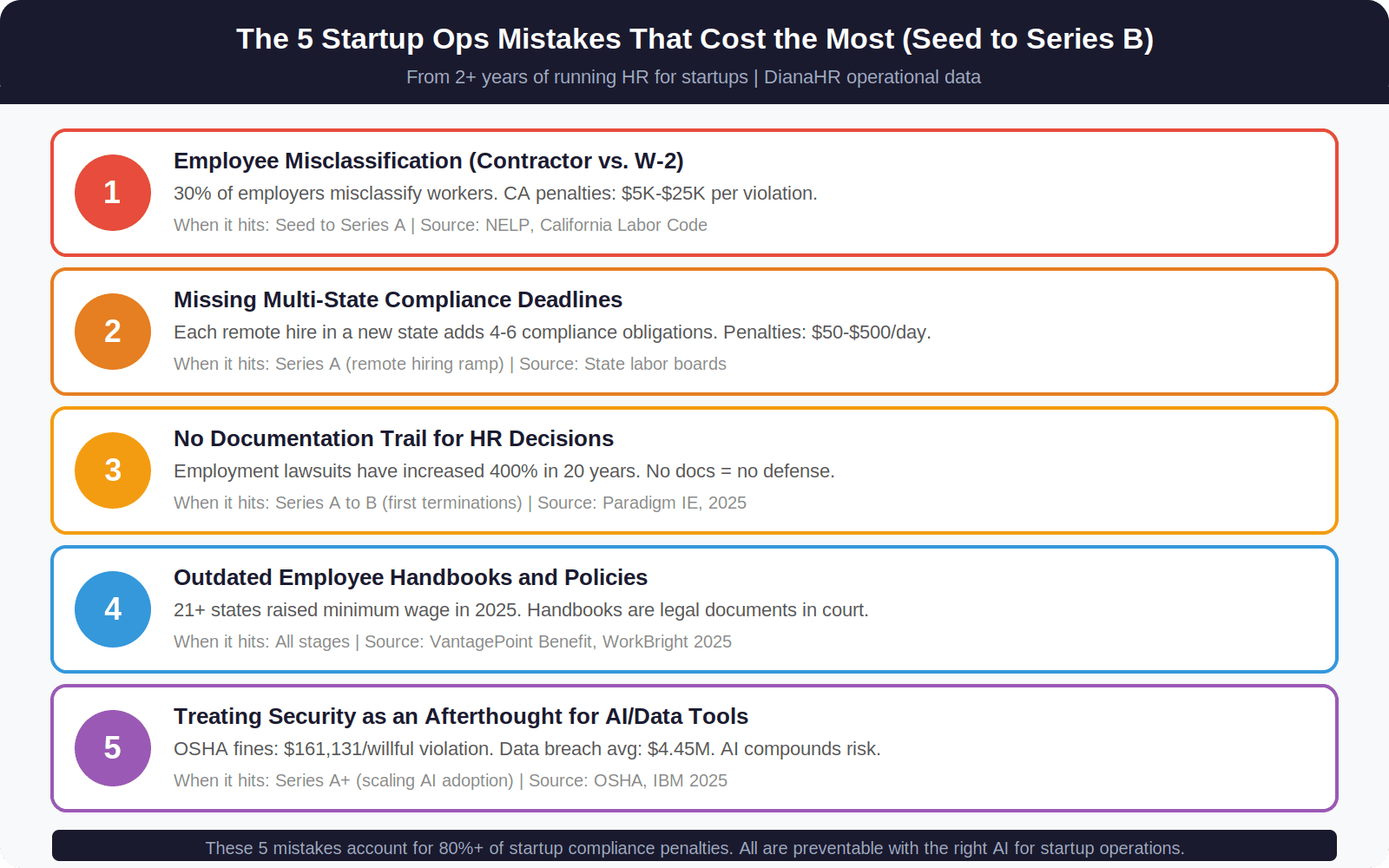
Two years of hands-on startup operations work surfaced a clear pattern. Five categories of mistakes account for the vast majority of compliance penalties, legal exposure, and wasted founder time. Each one connects directly to how we designed AI for startup operations inside Diana.
Mistake 1: Employee Misclassification
Misclassifying a worker as an independent contractor instead of a W-2 employee is the single most common and most expensive compliance failure in early-stage startups. In California, willful misclassification carries penalties of $5,000 to $25,000 per violation. Federal penalties include back taxes, interest, and potential fraud charges. (VantagePoint Benefit, 2025, https://vantagepointbenefit.com/)
Most founders misclassify workers because they do not understand the IRS criteria, not because they are trying to avoid taxes. The AI for startup operations solution is straightforward: automate the classification decision tree based on the actual IRS factors and flag edge cases for human review before the contract is signed.
Mistake 2: Missing Multi-State Compliance Deadlines
Every remote hire in a new state creates 4-6 new compliance obligations: state tax registration, unemployment insurance, workers' comp, and ongoing filings. At DianaHR, we saw startups miss these deadlines consistently once they had employees in 3+ states. Penalties range from $50 to $500 per day depending on the state and violation type.
This is a problem that scales linearly with hiring. AI for startup operations handles it by triggering automatic state registration workflows the moment a new hire is entered into the system. No founder needs to remember which states require which filings by which deadlines.
Mistake 3: No Documentation Trail for HR Decisions
Employment lawsuits have increased 400% over the past 20 years. When a startup faces a wrongful termination claim, the first thing a lawyer asks for is the paper trail: performance reviews, written warnings, policy acknowledgments. Most seed-stage startups have none of this. (Paradigm IE, 2025, https://www.paradigmie.com/)
AI for startup operations solves this by creating automatic documentation for every HR action: onboarding steps completed, policies acknowledged, performance conversations logged, termination checklists followed. The paper trail builds itself.
Mistake 4: Outdated Employee Handbooks
In 2025, 21 states implemented higher minimum wage rates. New pay transparency laws require salary ranges in job descriptions. EEOC guidance was revised to include new harassment and accommodation language. OSHA set fines for willful violations at $161,131 per violation. (WorkBright, 2025, https://workbright.com/)
Employee handbooks are legal documents in court. A handbook that does not reflect current labor law is a liability waiting to activate. AI for startup operations can flag outdated policies, generate updated language based on current regulations, and push handbook updates to employees for re-acknowledgment automatically.
Mistake 5: Treating Security as an Add-On Instead of the Foundation
This is the mistake that informed Diana's entire architecture. Every AI tool that handles HR data, employee records, payroll information, and compliance documents is processing the most sensitive data a company has. If security is bolted on after the product is built, there are always gaps.
IBM's 2025 Cost of a Data Breach Report found that the average US data breach costs $10.22 million. For startups using AI for startup operations, the security architecture has to be built in from day one: isolated instances per employee, zero cross-contamination of data, no model training on company inputs, and enterprise-grade encryption by default. (IBM Cost of a Data Breach Report, 2025)
Why Security Had to Be the Foundation of AI for Startup Operations
When we built Diana, the first engineering decision was security architecture, not features. Diana runs on OpenClaw with a fundamental design principle: every employee gets their own AI instance. No data crosses between instances. No company data is used for model training.
This was a direct lesson from our DianaHR operational experience. We saw what happens when startups paste employee SSNs into Google Sheets, run payroll data through unsecured tools, and store I-9 documents in shared Dropbox folders. The data exposure is constant and invisible.
AI for startup operations compounds this risk if the AI itself is not secure. A single AI tool that processes onboarding data, payroll calculations, compliance filings, and employee records has access to everything. If that tool leaks data, trains on inputs, or shares information across accounts, the exposure is catastrophic.
Diana's architecture treats every piece of data as if a regulator is watching. Because, increasingly, they are.
The Human Specialists Behind the AI for Startup Operations
Diana is not a replacement for human HR expertise. It is an AI for startup operations employee backed by human specialists who have collectively managed HR operations for thousands of employees across hundreds of startups.
The AI handles the execution: running payroll, filing state registrations, generating compliance documents, processing onboarding tasks. Human specialists handle the judgment calls: reviewing edge cases, advising on complex terminations, interpreting ambiguous regulatory requirements, and providing strategic guidance.
This hybrid model exists because two years of operational experience taught us exactly where AI for startup operations excels and where it does not. AI for startup operations is exceptionally good at executing repetitive, rule-based tasks with zero errors. It is less reliable at interpreting nuanced employment law in novel situations. The right architecture uses both.
Where AI for Startup Operations Creates the Most Value (and Where It Does Not)
Not every operational task should be automated. Two years of running HR for startups taught us exactly where AI for startup operations creates the most value and where it creates risk.
AI for startup operations works best on tasks with clear rules, high volume, and low ambiguity. Payroll calculations, tax filing deadlines, state registration workflows, benefits enrollment processing, and compliance document generation all fall into this category. The rules are defined. The inputs are structured. The output is binary: correct or incorrect.
AI for startup operations delivers less value on tasks that require reading context, interpreting intent, or making judgment calls with incomplete information. Examples include deciding whether a performance issue warrants termination, interpreting a new state regulation that contradicts a federal rule, or determining the right approach for a difficult conversation with an employee.
Diana's architecture reflects this distinction. Every task that involves judgment, ambiguity, or high-stakes human impact routes to a human specialist. Every task that involves execution, calculation, or deadline management runs through the AI for startup operations engine. The boundary between the two adjusts based on the confidence level of the AI's output.
This is why AI for startup operations built by people who have actually done the work produces different results than AI built by people who have only studied the problem. The edge cases are where the value lives. And you only learn the edge cases by processing hundreds of real client situations over years of operational work.
Frequently Asked Questions About AI for Startup Operations
What is AI for startup operations?
AI for startup operations refers to AI systems that handle end-to-end operational workflows across HR, compliance, finance, payroll, and reporting for startups. Unlike single-function SaaS tools, AI for startup operations manages the full workflow through a conversational interface like Slack.
What are the most common compliance mistakes startups make?
The five most expensive compliance mistakes are employee misclassification, missing multi-state compliance deadlines, lack of HR documentation, outdated employee handbooks, and treating data security as an afterthought. Together, these account for the majority of startup compliance penalties.
Why does AI for startup operations require security-first architecture?
AI tools that handle HR data process the most sensitive information a company has: SSNs, salary data, medical information, legal documents. If the AI is not built with isolated instances, zero data sharing, and enterprise-grade encryption from day one, the compliance risk outweighs the productivity benefit.
How is Diana different from other HR SaaS tools?
Diana is an AI employee that lives inside Slack, handles multi-function workflows end-to-end, and is backed by human HR specialists with 20+ years of experience. Traditional HR SaaS automates individual functions. Diana automates the full operational workflow with a security-first architecture built on OpenClaw.
What operational experience does the DianaHR team bring?
The founding team includes Upeka Bee, former Head of Engineering at Gusto's HR platform, and Tim Kral, former VP of Engineering at Relay Payments. The team has managed HR operations for hundreds of startups through DianaHR's human-in-the-loop service since YC W24, backed by Y Combinator, General Catalyst, and SNR.
We Built It Because We Lived It
Diana exists because we spent two years doing the work manually before we automated it. Every feature in the product maps to a real operational failure we witnessed, a real penalty a client received, or a real compliance gap that cost a founder weeks of time.
AI for startup operations is only as good as the operational knowledge behind it. We did not build Diana from a whiteboard. We built it from a stack of state compliance notices, a queue of onboarding checklists, and the direct experience of watching founders burn 30+ hours per week on work that does not grow their company.
See what 2 years of startup operations experience looks like as an AI employee. Try Diana in Slack today. dianaHR.com
Share the Blog on: