Strong employee relations builds trust and keeps your team together. Productivity rises when people feel safe. Claims for harassment and retaliation hit record highs of 14.7 issues per 1,000 workers.
Poor workplace conflict resolution kills morale. You lose good people when issues go ignored. Only 1 in 10 unreported problems get solved. You need a clear employee relations process. A solid strategy boosts employee engagement.
This guide shows you how to handle an intake triage resolution workflow. Better employee relations stops problems before they grow. Use data to fix your workplace today.
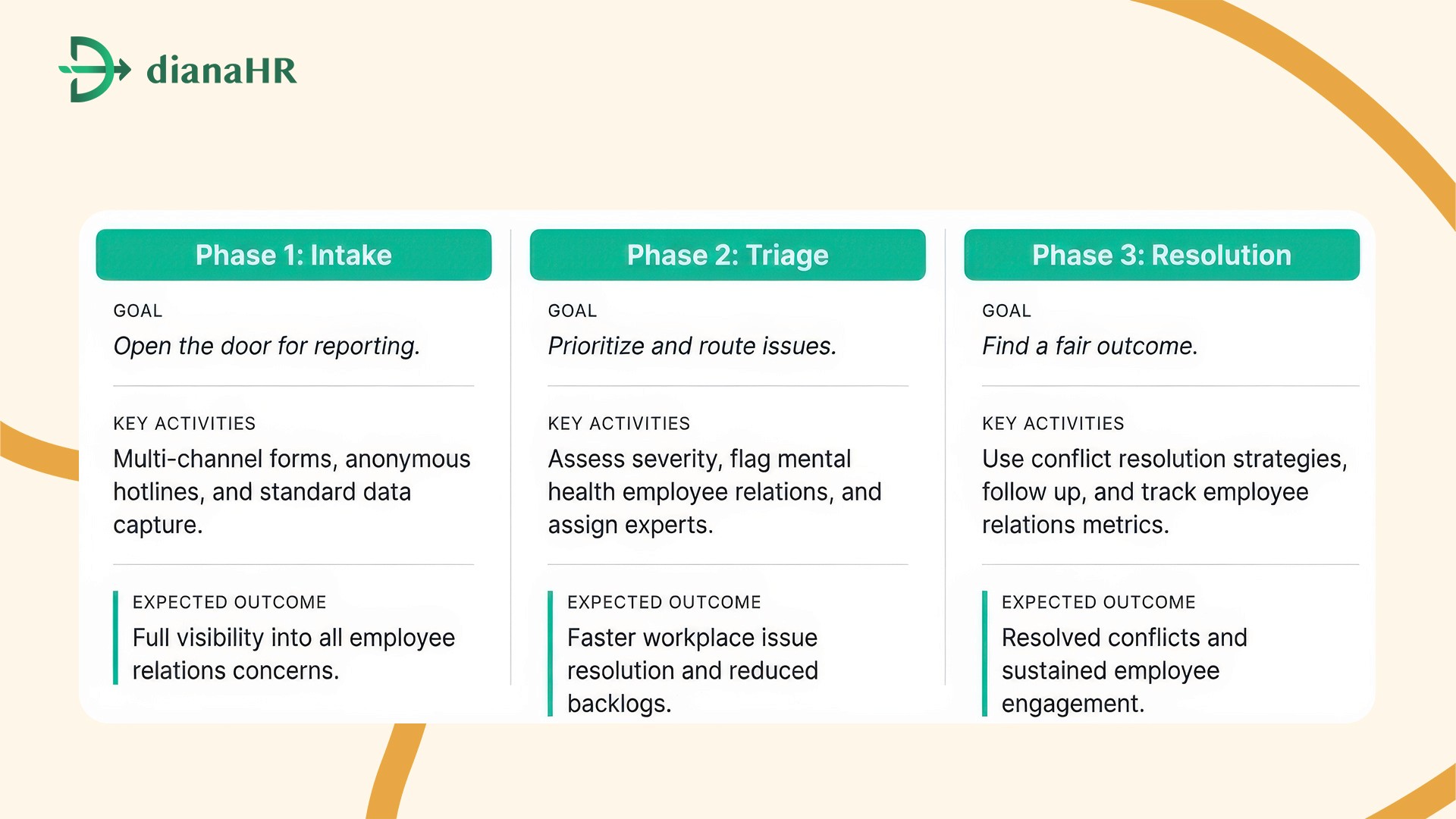
The Three-Phase Employee Relations Playbook
Think of your employee relations strategy as a machine with three main parts. You need a system that handles every concern with care. Moving away from messy emails helps employee engagement stay high.
This framework keeps things fair for everyone. A solid employee relations plan prevents burnout. It makes sure no complaint gets lost in an inbox.
1. Why Structure Matters in Employee Relations
Chaos makes people quit. If you lack a clear path, you risk missing legal threats. Good workplace conflict resolution needs rules to work. You want to see every issue clearly. Structured employee relations helps you track progress.
You can see how long cases stay open. It lets you fix problems before they explode. Consistent workplace conflict resolution builds a better culture.
Use these steps to build your structure:
Standardize how you collect data
Set clear timelines for answers
Keep records for legal safety
Help your team work faster
2. A Framework for Success
The three phases create a reliable loop. This HR case management approach identifies trends early. Maybe one manager needs training. Maybe the policy is unclear. Use workplace issue resolution to find these gaps.
Modern employee relations rely on facts. It stops guesswork and treats people like humans. Your employee relations team becomes more efficient with this setup. Effective employee relations starts with a single entry point.
Now that you see the full picture, let’s look at how to open the door for reporting.
Phase 1 – Intake: Creating Your Single Front Door
The first step in your employee relations workflow is the most important one. You must make it easy for people to speak up. If reporting feels hard, people stay silent. A clear employee relations process starts with a single gateway.
This phase sets the tone for the entire investigation. You want a process that shows you value every voice. Successful employee relations depend on this initial contact.
1. Building the Gateway to Trust
You need a reliable way to gather facts. Your employee complaint handling system should feel safe. When employees trust the system, employee engagement grows. Make sure everyone knows where to go.
A messy intake creates confusion. Use a standard form to capture the "who, what, and when." Good employee relations require accurate data from the start. This prevents you from chasing missing details later.
2. Core Intake Components
Give your team many ways to reach out. Some people prefer a quick chat, while others want a formal form.
Your employee relations intake should include:
Digital Portals: Let people submit issues 24/7.
Anonymous Options: Protect identities to increase reporting.
Direct Channels: Provide clear email addresses or phone lines.
Mobile Access: Allow workers to report issues from anywhere.
Clear workplace issue resolution starts with these tools. Employees are more likely to report bad behavior when they feel protected. Standardize your employee relations intake to save time.
3. The Technology Layer
Manual entry is slow. Modern employee relations uses tools to sort data. You can use software for HR case management to organize files. This tech flags urgent issues like safety risks immediately.
It removes the busy work so you can focus on the person. Efficient employee relations helps you stay organized. It makes your employee relations process much faster.
Once you have the information, you need to decide which issues matter most.
Phase 2 – Triage: Prioritization and Smart Routing
After the intake, you must decide what happens next. Not every employee relations issue carries the same weight. Triage is the engine that drives your employee relations process. It helps you separate minor gripes from legal risks.
A fast intake triage resolution cycle keeps the office running smoothly. You want to move quickly while staying accurate. Good triage improves employee engagement by showing you act on serious matters first.
1. The Triage Function: Separating Signal from Noise
Triage brings order to chaos. You need to look at the facts and assign a priority level. Without this step, your employee relations team gets overwhelmed. Smart employee complaint handling prevents a backlog of cases.
You can resolve small issues in days instead of weeks. This efficiency is a hallmark of strong employee relations. It ensures that high-risk complaints get the right eyes on them immediately.
2. Triage Decision Framework
You need a rubric to judge each case. Evaluating issues consistently makes your employee relations fairer.
Focus on these areas:
Severity: Does the report allege violence or theft?
Legal Risk: Is there a claim of discrimination?
Repeat Issues: Has this person or department been reported before?
Mental Health: Is mental health employee relations support needed here?
Impact: Does this problem affect the whole team or just one person?
Prioritize workplace conflict resolution for harassment or safety. These issues need a fast employee relations process. Using a framework keeps your decisions objective.
3. Assignment Strategy
Once you know the priority, route the case. Send payroll questions to finance and behavioral issues to employee relations. This HR case management step keeps experts on the right tasks. It stops balls from being dropped.
Use your workplace issue resolution tools to track who owns the case. Accountability is a core HR best practice. When everyone knows their role, problems get fixed faster.
With the case assigned to the right person, it is time to find a solution that works.
Phase 3 – Resolution: From Issue to Outcome
Closing a case is the final part of your employee relations process. You want to reach a fair outcome that stays in place. Effective employee relations makes sure everyone feels heard.
A good workplace issue resolution strategy prevents the same problem from coming back. This is where your team earns its reputation for fairness and keeps employee engagement from falling.
1. Moving Beyond Investigations—Toward Actual Resolution
Not every report needs a months-long investigation. Sometimes, a simple conversation fixes the friction. You should match your response to the severity of the issue.
A fast intake triage resolution cycle prevents minor gripes from turning into legal battles. Use your employee relations expertise to choose the right path. This flexibility is a core part of modern employee relations.
2. Core Resolution Strategies
Your workplace conflict resolution shouldn't just be about punishment. Use different conflict resolution strategies depending on the situation. These methods help you handle employee complaint handling with more empathy.
Collaborative Problem-Solving: Bring both sides together to find a middle ground.
Structured Dialogue: Use a neutral leader to guide a tough conversation.
Active Listening: Let people vent their frustrations before proposing a fix.
Grievance Management: Follow formal steps for serious policy violations.
These HR best practices keep your company safe and your culture healthy. Good workplace conflict resolution builds long-term loyalty.
3. Follow-Up and Verification
Resolution doesn't end when the meeting stops. You must check back later to see if the fix worked. Tracking employee relations metrics helps you measure the health of your team over time.
Use your HR case management tool to set reminders for 30 and 60-day check-ins. This ensures that the employee relations matter is truly settled. It proves to your staff that you care about their long-term success.
Finding a solution is great, but you must also consider the person's well-being throughout the process.
Quick Glance: The Three-Phase Employee Relations Playbook
The Role of Mental Health in Modern Employee Relations
Mental health issues now drive a massive portion of employee relations cases. You cannot ignore how stress affects your team. Mental health employee relations support is now a standard HR best practice.
When an employee acts out, look deeper. It might be burnout rather than a policy breach. A kind employee relations process identifies these trends early.
Reframing the Mental Health-ER Connection
Treating people like humans improves employee engagement. While stress doesn't excuse bad behavior, it explains it. Your workplace conflict resolution should include resources like an EAP. If you spot a mental health flag during intake, act fast.
Spot the Signs: Look for sudden performance drops or social withdrawal.
Provide Resources: Link employees to counseling or EAP tools immediately.
Offer Flexibility: Use accommodations to help them get back on track.
Train Managers: Teach leaders how to handle sensitive talks with care.
This dual approach saves careers and reduces legal risks. Strong employee relations relies on empathy. By supporting well-being, you fix the root cause of many workplace issues.
How DianaHR Can Help You Execute This Playbook
Managing employee relations manually wastes time and increases risk. DianaHR simplifies your employee relations process by blending AI with human expertise.
This platform handles the heavy lifting of HR case management so you can focus on growth. It helps small businesses scale while staying compliant.
Special Capabilities:
AI-Driven Compliance: Automates taxes and registrations for employee relations across 40+ U.S. states.
Expert Guidance: Pairs you with a specialist for tailored workplace issue resolution.
Smart Automation: Cuts manual employee relations tasks by 60%, saving 15+ hours weekly.
Tool Integration: Syncs with Gusto or ADP to keep your employee relations metrics accurate.
Transform your back-office into a data-driven machine. With DianaHR, your workplace conflict resolution becomes faster and more reliable.
Conclusion: From Reactive to Proactive
Strong employee relations keeps your business running. However, many teams struggle with messy intake and slow workplace conflict resolution. If you ignore these pain points, the consequences are severe.
Bad employee relations leads to expensive lawsuits, high turnover, and a toxic culture that scares away top talent. One mishandled report can ruin your reputation and sink employee engagement.
You cannot afford to leave your employee relations process to chance. DianaHR provides the structure you need to manage cases safely. By automating your intake triage resolution workflow, you stop fires before they spread.
Ready to streamline your employee relations? Book a demo with DianaHR today to build a faster, fairer workplace issue resolution process for your team.
FAQs
1. What is the main difference between triage and investigation?
Triage is the first step in the employee relations process to assess urgency and route cases. Investigation is the deep dive into facts. Fast intake triage resolution saves time by ensuring your employee relations team focuses on high-risk issues first.
2. How do you handle workplace issues involving mental health?
Prioritize mental health employee relations by spotting stress early. Use your employee relations intake to flag concerns and provide resources. Combining workplace conflict resolution with empathy improves employee engagement and ensures your employee relations process remains fair and human-centered.
3. Which metrics are most important for employee relations success?
Track employee relations metrics like time-to-resolution and substantiation rates. Monitoring these helps refine your workplace issue resolution strategy. High employee engagement and low recurring complaints prove your employee relations system works and your HR case management is truly effective.
4. Can AI improve employee relations without losing the human touch?
Yes. AI automates HR case management by organizing data and flagging risks. This lets your employee relations experts focus on the people involved. Smart tools streamline employee complaint handling, making your workplace conflict resolution faster while keeping the process empathetic.
5. What is the ideal timeline for resolving employee relations cases?
Simple employee relations issues should be resolved within 10 days. Complex workplace conflict resolution may take 30 to 60 days. Using a structured employee relations process ensures you meet these goals, protecting employee engagement and maintaining a healthy company culture.
Share the Blog on: